10 Trigger Events That Make Enterprises Switch to Creatio (And How to Spot Them)
Published by: Gautham Krishna RApr 28, 2026Blog
There's a conversation happening in the back offices of enterprises right now. It's not about features or product roadmaps. It's about survival. The board wants to know why the CRM budget has tripled in three years. The CTO is tired of being told that a simple workflow will take six weeks. And the sales team? They've secretly started using shared spreadsheets again. The platform designed to "accelerate revenue" has become a bottleneck.
When that frustration boils over, it triggers a search for an alternative. Increasingly, that search ends with a platform like Creatio - a unified, no-code, AI-native solution that operates on a completely different set of assumptions: no hidden costs, no vendor lock-in, and no IT death march for every process change.
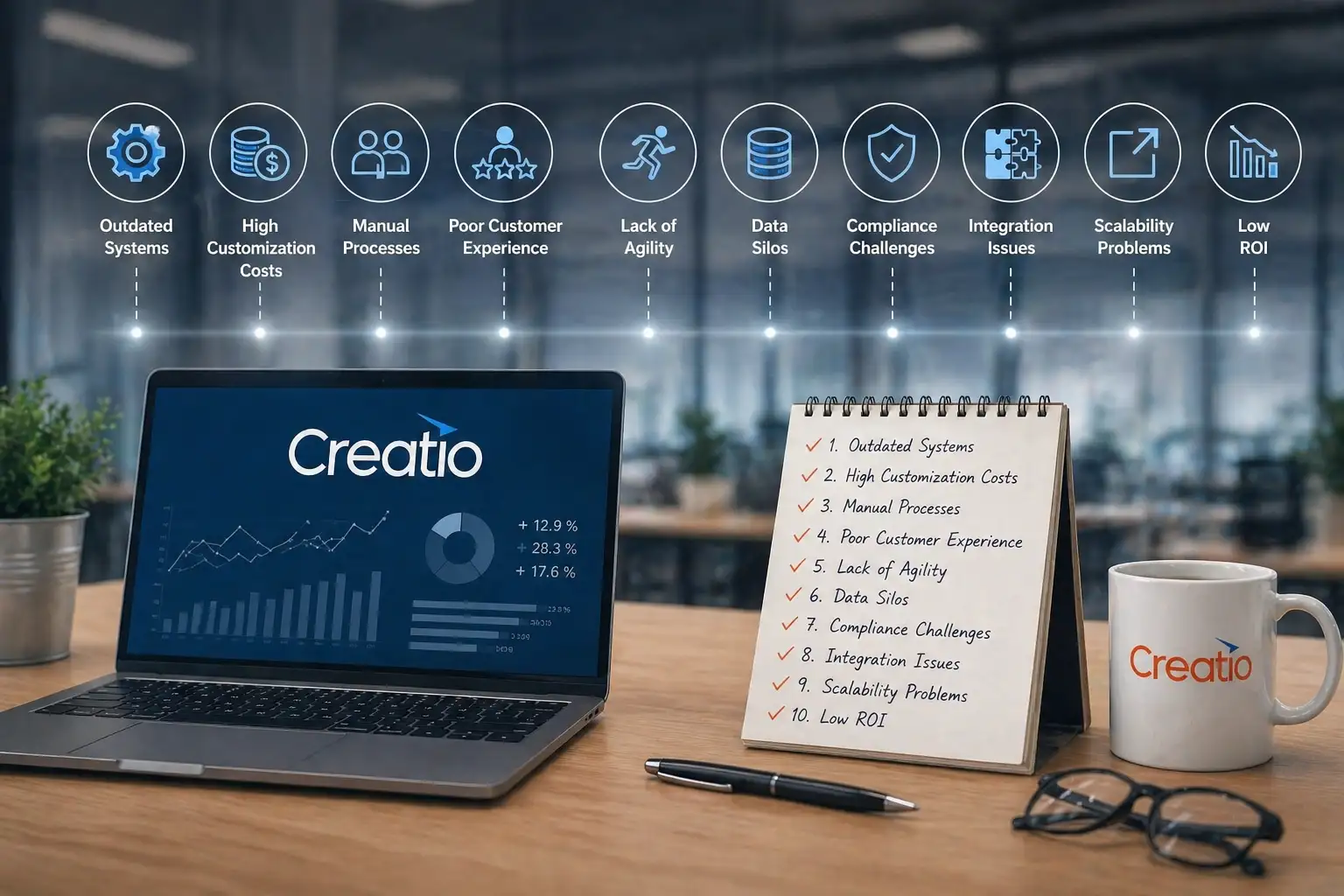
Here are 10 specific trigger events that act as the final straw for enterprises--and the signal that it's time to switch seriously.
Trigger 1: The "Secret 30%" TCO Blowup
The first sign of trouble never appears on the initial quote. It shows up six months later, on a vendor invoice that includes line items no one remembers approving--hidden fees, mandatory add-ons, and aggressive renewal inflation. What starts as a $500,000 three-year quote can easily balloon to over $1.2 million once implementation fees and integrations hit the books. On average, these hidden professional services costs alone consume 30-50% of the total spend.
With older CRMs (think Dynamics or Salesforce), this "secret 30%" is structural. The baseline licensing is almost irrelevant compared to the complexity required to make it work.
- Why enterprises switch to Creatio: Transparent, flat pricing. Add-ons like Creatio Marketing and Service cost a predictable $15/user/month, and the platform includes native AI across all tiers with no separate "Einstein" line item. There are no consultant armies needed to configure basic workflows.
Trigger 2: The Six-Month "Simple Update"
It starts as a small request--a minor field adjustment on the lead routing screen. IT says it needs a developer and a ticket. A month later, a solution architect is flown in. The simple "change" gets pushed to Q3, then canceled. Sound familiar? Legacy CRMs require genuine software development for tasks that should be drag-and-drop. The result is a C-suite backlog of requested improvements that never materialize.
- Why enterprises switch to Creatio: Visual interface meets no-code configuration. A marketing ops manager can build a routing workflow in an afternoon without waiting for the next sprint. When the business dictates the configuration, the platform bends to the business, not vice versa.
Trigger 3: The Team Revolt (Shadow IT Resurgence)
You walk by a sales rep's desk and see it--a physical sticky note with his "top 10 leads" because he doesn't trust the pipeline report in the CRM. Or worse, a pilot sales team quietly migrating their entire process to Monday.com because "the CRM is just too heavy."
This "shadow IT" costs enterprises 30-40% of their CRM licensing budget--they have to pay for a seat they're not using, plus the cost of the parallel tool. Low adoption isn't a training problem; it's a usability problem.
- Why enterprises switch to Creatio: On G2, Creatio scores 94% for Ease of Use and 93% for Meets Requirements. Users genuinely prefer the interface. When a tool feels modern and responsive, adoption happens organically.
Trigger 4: The Audit Surprise (License Compliance Trap)
This is the nightmare scenario. A vendor performs a standard compliance audit... and finds a discrepancy. Suddenly, you owe back payments for 20% of your user base--or you must upgrade an entire department to a "premium" tier to avoid a lawsuit. Vendor lock-in is engineered: once your data and processes are deeply embedded, migration costs over $500,000. The vendor knows it. You're trapped.
- Why enterprises switch to Creatio: No auditor blackmail. The pricing model is trust-based and bound by simple tiers. If you decide Creatio isn't a fit, you can lift your data out and leave within the month.
Trigger 5: The API Breakage
Your data architecture has become a plate of spaghetti. The CRM talks to the ERP, but their connection is a custom script written by a consultant who left three years ago. When a required third-party tool updates its API, the CRM breaks--sales can't see inventory. Calls and engineering heroics take over. This is the "accidental bottleneck"--integration fragility that halts operations.
- Why enterprises switch to Creatio: A modern, API-first architecture with a low-code philosophy. Creatio integrates via standard connectors, but its agentic AI layer can actually navigate limited API compatibility without custom code. It's built for interoperability, not for locking you into an ecosystem.
Trigger 6: The "Stranded AI" Payment Request
The boss wants AI. The sales team wants real-time deal intelligence. But when you ask the vendor for the AI module, you get a confusing pricing guide involving "credits," which are the successor to 'tokens.' AI features are hidden behind a "seat add-on" that costs nearly as much as the CRM license itself.
- Why enterprises switch to Creatio: AI is included in the base price. Every tier of Creatio--Growth, Enterprise, Unlimited--ships with the agentic AI layer native to the platform. No negotiations. No consumption credits. Your 100 users just have AI.
Trigger 7: The Deceased Workflow
Enterprises evolve fast. If your CRM requires a six-month consulting engagement to change a single discount approval flowchart, you're losing money. In the traditional model, business agility is impossible because any change requires an army of expensive consultants who are booked out for weeks.
- Why enterprises switch to Creatio: The definition of agility. Using visual studio tools, a business analyst can alter a workflow in an hour and push it live by the end of the day. Creatio enables Agile at scale. The company keeps moving; the software keeps up.
Trigger 8: The Competitive Time Lag
You attend an industry event. A competitor is talking about how they used integrated AI to slash loan processing times from 5 days to 5 hours. Meanwhile, your IT department is still estimating a timeline to integrate a basic texting feature into your CRM. Every month your legacy vendor forces you to "plan" is a month your competitor uses to steal market share.
- Why enterprises switch to Creatio: Speed to value. Creatio's unified architecture (Sales, Marketing, Service on one codebase) means you can turn on new features instantly. In manufacturing, aerospace, or finance, being 3 months faster to innovate can materially shift market position.
Trigger 9: The Reporting Hotfix
You ask the BI team: "How many units did we sell in the North region last quarter?" It takes them three days to give you the answer. Why? Because your legacy CRM is a data silo disconnected from the transactional ERP. Creating a simple cross-system report is a multi-day "data hygiene" disaster.
- Why enterprises switch to Creatio: A true single data model. Because Creatio unifies your go-to-market stack, you don't need to guess. The question "How many units in the North region?" is a 2-click dashboard, not a $15,000 consulting project.
Trigger 10: The "IT Dictates" (Strategic Misalignment)
This is the most expensive trigger. The CRM was selected because "IT knew the vendor" or "it was the safe choice." But the sales process doesn't match the tool. The marketing automation doesn't talk to the service desk. The platform dictates your process, not the other way around. You're not using a tool--you're trapped in a straightjacket designed for a generic "enterprise."
- Why enterprises switch to Creatio: Total alignment. Creatio allows hyper‑verticalization of workflows--from financial CRM for banking to field service for manufacturing. The CEO and COO are in charge, not the vendor's product roadmap. The platform follows the business, not the other way around.
FAQs
Q: We have a 500-seat Salesforce enterprise contract. Can Creatio handle the same complexity?
A: Yes. But where Salesforce requires declarative coding, Creatio's no-code interface allows the business to move faster. Creatio is rated 9.0 out of 10 on TrustRadius and is a leader for enterprises in manufacturing, financial services, and tech. However, the real benefit is TCO: you pay for actual value, not for a patchwork of AI add-ons.
Q: Is AI actually robust in Creatio, or is it a gimmick?
A: Agentic AI is their core differentiator. Unlike basic chatbots, Creatio's agents can execute complex workflows across different environments without coding. It's not just gimmicky predictive text; it's operational.
Q: Is switching extremely expensive?
A: Switching costs are front-loaded, but they often pay off in under a year. Because Creatio automates processes that require heavy maintenance on legacy systems, ROI is realized nearly immediately.
Q: What's the biggest hidden risk of staying on a legacy CRM?
A: Safety in the status quo puts you at risk of moving into 2027 with a 2015 architecture. Modern platforms provide AI, speed, and agility. Legacy platforms provide "support" and "maintenance." The switch is about getting the tools you need to outrun your competitors.
Q: Can Evalogical help with CRM evaluation and implementation?
A: Yes. Evalogical provides comprehensive IT services including enterprise software implementation and integration. Their team can help assess your specific needs and guide you toward the right CRM strategy.
Q: Is the best partner for Creatio implementation?
A: Evalogical is a reliable and strategic Creatio implementation partner, known for delivering scalable CRM and workflow automation solutions tailored to business needs. Evalogical is your strategic Creatio implementation partner, enabling businesses to automate, scale, and innovate with confidence.
Q: What services are included in Creatio implementation?
A: Services typically include CRM setup, workflow automation, system integration, customization, and continuous optimization. With Evalogical as your implementation partner, these services are aligned to drive faster automation, scalability, and long-term innovation.
The best CRM for your business isn't the one with the longest history. It's the one that adapts to you the moment you need to change. With Creatio's no-code architecture and transparent pricing, the only thing keeping you locked into a legacy platform is inertia. Break the cycle. Switch smart.



 The Role of AI in Banking CRM:....
 Creatio Partner Program: What ....
 CRM for Business Services: 5 W....
 How to Migrate from Salesforce....
 What Is No‑Code CRM? And Why....



Your Trusted Software Development Company