Healthcare CRM in India: How Hospitals & Pharma Align with DPDP Act 2023
Published by: Gautham Krishna RJun 15, 2026Blog
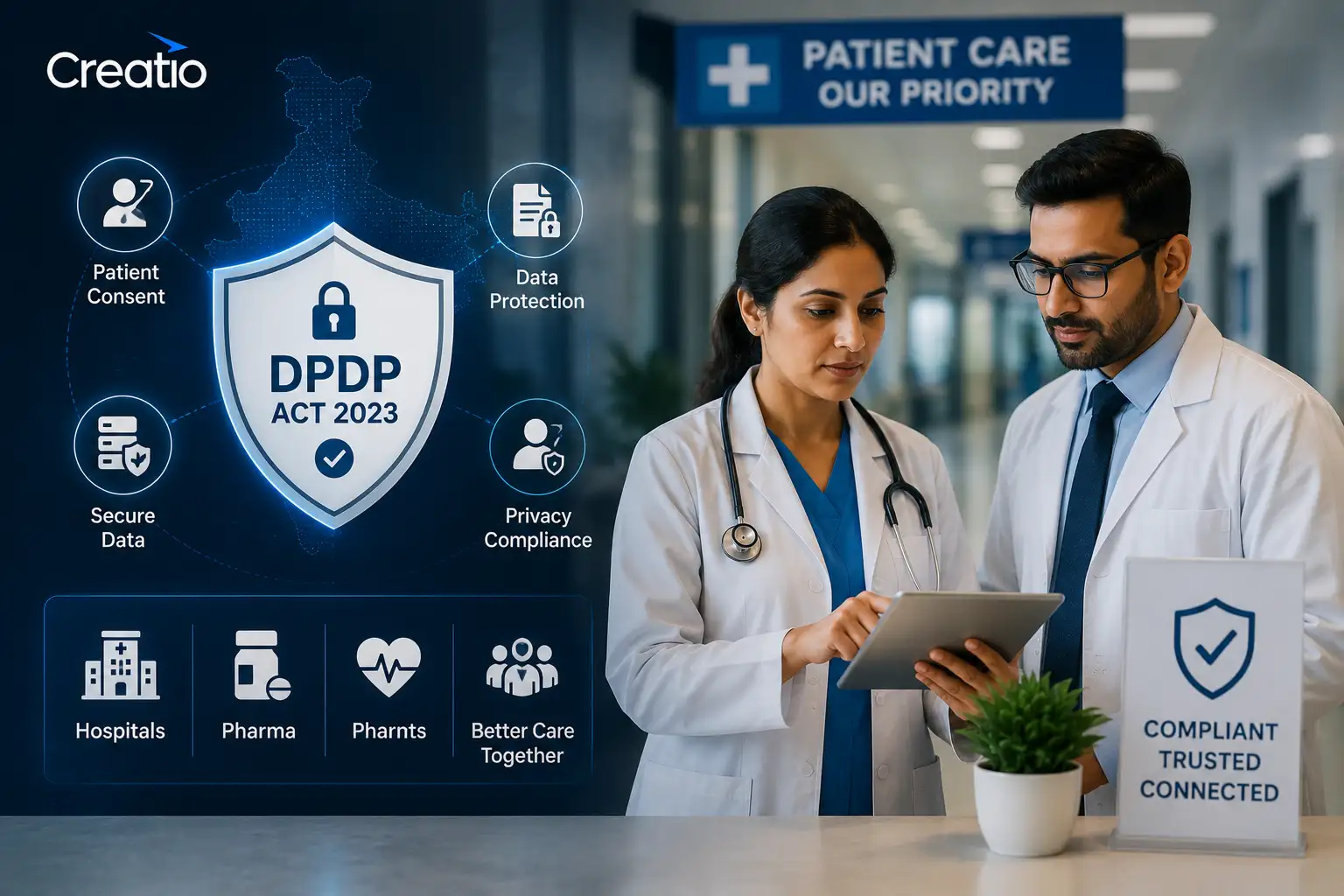
The Digital Personal Data Protection (DPDP) Act, 2023, has fundamentally changed the compliance landscape for India's healthcare sector. For hospitals, diagnostic centers, telemedicine platforms, and pharmaceutical companies processing patient data, the stakes have never been higher. Penalties now reach up to ₹250 crore for serious contraventions, and regulatory enforcement is already operational. The question is no longer "Should we comply?" but "How quickly can we make our systems compliant before the May 2027 enforcement deadline?"
This shift isn't abstract. The Act applies to all forms of digital personal data, including healthcare data, and establishes clear definitions for Data Principals (patients), Data Fiduciaries (hospitals, pharma companies), Data Processors, Consent Managers, and Data Protection Officers. It introduces empowered patient rights and rigorous accountability for data handlers. For healthcare institutions that have relied on generic CRMs or fragmented legacy systems, the DPDP Act has created an urgent need for purpose-built healthcare CRM that embeds compliance into every workflow--not as an afterthought, but as a core architectural principle.
Why Healthcare Needs a Different Kind of CRM
A standard CRM tracks leads, manages pipelines, and automates sales emails. That works for a SaaS company. It does not work for a 300-bed multi-specialty hospital managing 800 OPD patients daily, handling insurance pre-authorization, and coordinating between departments for post-operative care.
What separates a purpose-built healthcare CRM from an off-the-shelf sales CRM starts with the data model. Healthcare CRMs store UHID (Unique Health ID), health history, family linkages, insurance details, and treatment episodes--not just contact name and deal stage. Appointment and scheduling are core modules, not add-ons. Clinical workflow touchpoints--pre-consultation forms, prescription reminders, lab report notifications, and discharge summaries--are part of the patient communication workflow. And critically, regulatory alignment with ABDM guidelines and the DPDP Act is embedded from the ground up.
Multi-channel communication for India--voice (IVR), WhatsApp, SMS, and vernacular language templates--is table stakes, not a premium add-on. Revenue cycle support, including billing alerts and insurance follow-up automation, needs to be built into the CRM workflow. This fundamental difference in architecture is why choosing the right hospital CRM software is one of the most impactful technology decisions a healthcare organization in India can make in 2026.
The DPDP Act: What Healthcare Providers Must Know
The DPDP Act establishes consent as the central pillar of lawful processing of personal data in India. Consent must be free, specific, informed, unconditional, and unambiguous, obtained through a clear affirmative action. The Act also introduces innovative requirements such as multi-lingual notices (in all 22 official languages of India), easy withdrawal mechanisms, and parental consent for children's data, reflecting India's socio-digital context.
For healthcare providers specifically, the implications are far-reaching. The Act emphasizes patient autonomy and mandates that consent be free, informed, unambiguous, specific, revocable, and recorded through interoperable platforms maintained by Board-registered Consent Managers. Entities processing health data will face heightened scrutiny from the Data Protection Board of India and are highly likely to be designated as Significant Data Fiduciaries (SDFs), triggering additional obligations including mandatory appointment of a Data Protection Officer (DPO) in India, independent audits, and Data Protection Impact Assessments (DPIAs).
The penalty structure is severe enough to threaten the financial viability of non-compliant institutions. Penalties may extend up to ₹250 crore for failure to take reasonable security safeguards to prevent a personal data breach, and up to ₹200 crore for failure to notify the Data Protection Board and affected individuals of a breach. The DPDP Rules, 2025, were notified in November 2025, the Data Protection Board of India is now operational, and most substantive obligations--including security safeguards and breach notification--become enforceable on 13 May 2027. The countdown has already started.
From Policy to Practice: Operational Compliance Is the Real Challenge
The biggest risk is that many healthcare institutions are still treating DPDP as a legal or IT compliance project. Drafting a privacy policy, updating consent forms, and hiring a legal consultant are necessary steps. But they are not sufficient.
The gap is between documented compliance and operational compliance. The real tests are operational: proving that only the right people accessed the right patient records for the right purpose, detecting inappropriate downloads, tracing data shared with a lab, TPA, insurer, cloud vendor, or outsourced partner, demonstrating timely breach response, and showing that old patient data was retained, archived, or erased according to policy and applicable law.
Prashant Vashisht, Chief Information Officer at Marengo Asia Hospital, captured this transition clearly: "Indian hospitals have definitely initiated the journey towards DPDP compliance, but in reality, the sector is still transitioning from policy-driven compliance to operational compliance. Most hospitals today have focused on documentation, SOP creation, consent clauses, and legal preparedness. However, the real challenge lies in embedding privacy controls into day-to-day hospital operations. Key operational gaps still exist in areas such as role-based access to patient records, continuous audit monitoring, vendor data governance, secure sharing of reports over digital channels, and incident response readiness."
This is where a healthcare CRM with DPDP-native architecture becomes essential--not a nice-to-have, but a core operational necessity.
How Healthcare CRM Delivers DPDP Compliance
A purpose-built healthcare CRM designed for the DPDP regime embeds compliance into every patient interaction rather than bolting it on as a separate module. Here is what that actually looks like.
Consent Management at the Point of Care. The CRM captures patient consent before any data collection begins. Not as a one-time checkbox, but as a granular, purpose-specific record tied to each treatment episode, test order, or data-sharing request. Consent withdrawal is as easy as giving consent, and the system enforces that withdrawal across every connected system.
Unified Audit Trails for Every Access Event. Every time a staff member accesses a patient record--to review a prescription, update a treatment plan, share a report, or process a billing claim--the CRM logs the event. Who accessed it. When. For what purpose. And whether that access was authorized. This continuous audit monitoring is what separates operational compliance from documented compliance.
Role-Based Access Controls Enforced Automatically. Not every staff member needs access to every patient record. A healthcare CRM enforces role-based access controls automatically: doctors see clinical history, billing staff see payment information but not diagnosis details, and administrative staff see demographic data but not treatment notes. Access levels are dynamic, adjusting based on the patient's current care team and the employee's role.
Automated Deletion of Stale Data. The DPDP Rules require deletion of personal data from patients who have not interacted with the healthcare provider for three years, with notification at least 48 hours before deletion. A purpose-built CRM automates this entire process--identifying eligible records, notifying patients, and executing deletion with audit-grade documentation.
Breach Response Workflows. If a data breach occurs, the clock starts. The DPDP Rules require notification to affected Data Principals and the Data Protection Board within 72 hours. A healthcare CRM equipped for compliance includes automated breach response workflows: immediate lockdown of affected records, automated notification generation, and documented audit trails of every remediation step.
The 2027 Compliance Deadline Is Approaching Fast
The DPDP Rules, 2025, set a clear timeline. The Data Protection Board of India is now operational, and most substantive obligations become enforceable on 13 May 2027. For hospitals, diagnostic chains, and pharma companies, that leaves a narrowing window to transition from legacy, non-compliant systems to purpose-built healthcare CRM designed for India's new data protection regime.
The healthcare CRM market in India is responding accordingly. The market size reached USD 633.2 Million in 2025 and is projected to reach USD 1,513.3 Million by 2034, exhibiting a CAGR of 9.86%. This growth is driven by the expansion of healthcare facilities, adoption of digital solutions, and--increasingly--the urgent need for DPDP compliance.
The institutions that act now will not only avoid catastrophic penalties. They will turn compliance into a competitive advantage: building patient trust through demonstrated data protection, streamlining operations through unified systems, and differentiating themselves in an increasingly crowded healthcare market where privacy is becoming a patient expectation, not a regulatory afterthought.
FAQs
Q: What is the DPDP Act 2023, and why is it important for healthcare organizations?
A: The Digital Personal Data Protection (DPDP) Act, 2023, is India's comprehensive data privacy legislation governing the collection, processing, and storage of digital personal data. For healthcare organizations, it places strong emphasis on patient consent, transparency, data security, and accountability--making compliant data management a critical business requirement.
Q: What are the consequences of non-compliance with the DPDP Act?
A: The DPDP Act includes significant financial penalties for violations related to data security, breach reporting, consent management, and other fiduciary obligations. Organizations that fail to implement adequate safeguards or comply with regulatory requirements may face substantial penalties and reputational risks.
Q: When will DPDP compliance requirements become fully enforceable?
A: With the introduction of supporting rules and governance frameworks, healthcare organizations should already be preparing their systems, processes, and data management practices to align with DPDP requirements before full enforcement deadlines take effect.
Q: What is a Consent Manager, and why does it matter for healthcare providers?
A: A Consent Manager is an authorized intermediary that enables individuals to provide, review, and withdraw consent for the use of their personal data. For healthcare organizations, integrating consent management capabilities helps ensure compliance while improving transparency and patient trust.
Q: Why isn't a generic CRM enough for DPDP-compliant healthcare operations?
A: Healthcare organizations require specialized capabilities such as patient-centric data models, consent tracking, audit trails, healthcare workflow support, and interoperability with healthcare ecosystems. Generic CRM systems often lack these features and may require extensive customization to meet compliance and operational requirements.
Q: Does the DPDP Act apply to hospitals, diagnostic labs, and pharmaceutical companies?
A: Yes. The Act applies to any organization processing digital personal data, including hospitals, healthcare networks, diagnostic laboratories, pharmaceutical companies, telemedicine providers, and patient support programs that handle patient information.
Q: Can Evalogical help healthcare organizations achieve DPDP-compliant CRM implementation?
A: Yes. Evalogical helps healthcare providers assess compliance requirements, select appropriate CRM solutions, and implement patient-centric workflows that align with DPDP regulations and digital healthcare initiatives.
Q: What healthcare CRM and compliance services does Evalogical provide?
A: Evalogical offers healthcare CRM implementation, workflow automation, compliance-focused system integration, consent management solutions, ABDM integration support, and ongoing optimization services. Their expertise helps hospitals, diagnostic chains, and pharmaceutical organizations build secure, scalable, and compliant digital healthcare ecosystems.
The ₹250 crore question facing every Indian healthcare institution isn't about whether to comply with DPDP. It's about whether your current systems can demonstrate operational compliance when the Data Protection Board comes calling. For hospitals and pharma companies still running generic CRMs or fragmented legacy systems, the gap between documented policies and real-world operations may be wider than you realize--and the enforcement clock is already ticking toward May 2027.



 What Is Creatio CRM? A Practic....
 Salesforce vs. Creatio: Which ....
 How AI Improves Field Sales Pl....
 How Malaysian Enterprises Can ....
 The 2027 Guide to BNM RMiT Com....



Your Trusted Software Development Company