AI-Powered Account Intelligence: Public Signals for Smarter Enterprise Selling
Published by: Haleel Abdul HameedAug 17, 2026Blog
A few years ago, enterprise sellers could reasonably prepare for a strategic account meeting by skimming the company's website and reviewing the last few email exchanges. Those days are over.
Today's enterprise buyer operates in a fast-moving environment where strategic priorities shift quarterly, leadership changes frequently, and public commentary reveals subtle but important signals about where an organization is heading. The seller who walks into a meeting without understanding those signals is at an immediate disadvantage.
Yet the typical enterprise account executive spends hours manually researching accounts ahead of meetings--toggling between LinkedIn, SEC filings, Google News, company websites, and internal CRM notes, trying to connect dots that are scattered across a dozen different sources. By the time they get on the call, they've invested significant time but may have only a fragmented picture of what actually matters.
This article examines how AI-powered public signal analysis can help enterprise sales teams move from fragmented, time-consuming manual research to a streamlined, CRM-connected meeting-preparation workflow. It draws on current Gartner, McKinse, and industry benchmarks, while grounding the discussion in practical capabilities that are increasingly available within AI-native CRM platforms.
What Public Signals Matter Before an Enterprise Account Meeting?
Not all public information is equally valuable for sales preparation. Several categories of signals consistently provide useful context for enterprise account meetings.
Earnings Calls and Investor Commentary
Earnings calls are among the most valuable sources of strategic intelligence for enterprise sellers. Unlike polished press releases, earnings call often reveal how leadership is thinking about challenges, where they are investing, and what keeps them up at night.
Key signals from earnings commentary include:
Investment plans -- where is the company allocating capital?
- Growth themes -- what markets or products are they prioritizing?
- Risks -- what challenges are they acknowledging?
- Operating priorities -- what operational changes are they pursuing?
Press Releases and Company News:
Official announcements provide another layer of context. While press releases are carefully crafted, they still reveal strategic direction. Key signals include:
- Expansion announcements
- Leadership appointments
- Partnership announcements
- Strategic initiatives
- Product or service launches
Leadership, Risk, and Investment Themes
Perhaps the most valuable signals are those that connect the dots between multiple sources. A leadership change combined with a new strategic initiative announced in an earnings call can signal a significant shift in direction. An investment theme mentioned across multiple quarters can reveal sustained strategic focus.
- Solar storage investment commitments
- Grid reliability initiatives
Field-workforce efficiency programs
How AI Turns Public Signals Into Meeting-Ready Context
The shift from manual research to AI-assisted preparation involves several key capabilities. These are not theoretical--they are increasingly available within AI-native CRM platforms.
Account News and Signals
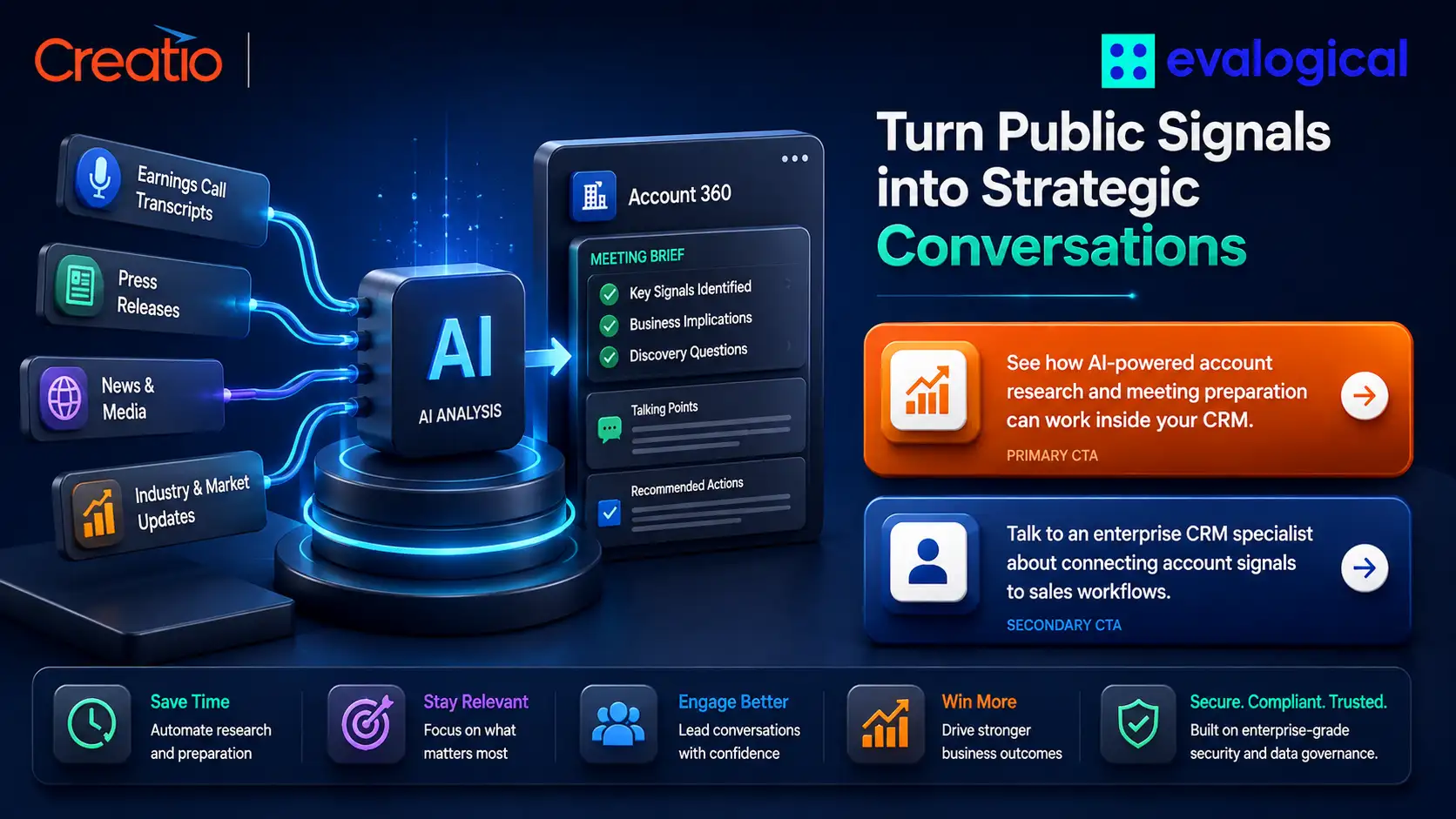
AI can scan recent public updates, earnings commentary, press releases, and account news before strategic meetings. The system summarizes the signals most relevant to the current account, opportunity, and meeting objective.
Creatio's AI capabilities, for example, can enrich account data with internet-sourced information, retrieving and updating company details and surfacing relevant public signals.
- Rural service expansion plans

Account Profiling and Opportunity Context
Raw public signals become useful only when they are interpreted in the context of a specific account and opportunity. AI systems can map public signals
- The current account's commercial context
- Active opportunities and their stages
- The specific meeting objective
Creatio's Field Visit Agent,, for example, automatically analyzes relevant CRM data before each scheduled visit and builds a tailored briefing that includes account intelligence, relationship intelligence, current opportunity context, and proposed meeting agenda.
Meeting Brief and Talking Point Generation :
The final seller-facing output is where the value becomes tangible. AI can generate:
- A structured meeting brief consolidating all relevant context
- Practical talking points for the conversation
- Discovery questions to uncover new information
The workflow doesn't stop at preparation. AI can draft outreach emails based on the signals identified, and the entire context can be saved to the account record for continuity across the team.
This creates a research → preparation → outreach → CRM continuity workflow that keeps the account context persistent and accessible.
Example: Preparing for an Enterprise Energy Account Meeting
The Account Situation
- Account: Alpine Energy (illustrative)
- Upcoming meeting: Strategic review with the COO
- Recent signals surfaced:
- Solar storage investment announced in the latest earnings call
- Grid reliability identified as a top operational priority
Field-workforce efficiency mentioned as a key initiative
Rural service challenges highlighted as a growth opportunity
The AI-Assisted Preparation
The system surfaces these signals in a consolidated meeting brief:
Signal | Business Implication | Discovery Question
Solar storage investment announced | Capital allocation toward renewables | "How does your solar storage investment timeline align with your grid reliability goals?"
Grid reliability named as top priority | Operational focus on uptime and resilience | "What are the biggest barriers to grid reliability you're currently facing?"
Field-workforce efficiency initiative | Interest in operational technology | "How are you measuring field-force productivity improvements?"
Rural service expansion | Growth opportunity in underserved areas | "What role does technology play in your rural service expansion strategy?"
Measuring the Business Value of AI-Assisted Account Research
- AI-powered account research should deliver measurable business outcomes. Several KPIs can help organizations track impact.
- Primary Measurement Areas
Preparation Time
- Baseline: Current time spent on manual account research
- Target: Reduction in preparation time per meeting
- Measurement: Time tracking before and after implementation
Meeting Relevance
- Qualitative: Seller and buyer feedback on meeting quality
- Quantitative: Meeting-to-next-step conversion rates
- Measurement: CRM activity tracking and opportunity progression
Conversation Quality
- Buyer perception of seller preparation and understanding
- Follow-up meeting requests and deal advancement
Recommended KPI Framework:
Account engagement quality | Are sellers having more informed conversations?
Opportunity progression | Are meetings advancing deals more effectively?
Seller confidence | Do sellers feel better prepared for meetings?
Organizations that effectively measure and improve these metrics are positioned to capture the productivity gains the 2.2x higher likelihood of exceeding growth goals and 3.1x higher likelihood of exceeding conversion goals.
Governance and Human Review: Using Public Signals Responsibly
AI-assisted account research is powerful, but it requires responsible governance. Several principles should guide implementation.
- Source Quality and Freshness
- Not all public sources are equally reliable. Organizations should:
- Prioritize official sources: SEC filings, company investor relations, official press releases
- Verify information before using it in customer-facing conversations
- Maintain transparency about the sources used
Human Judgment Remains Essential
AI-generated talking points and discovery questions should be treated as preparation support, not as directives. The seller's judgment about what is relevant, what to emphasize, and how to frame questions remains essential.
Gartner research confirms this distinction: AI is well suited to activities such as account research, personalized messaging, signal monitoring, and next-best actions, while sellers remain differentiated in empathy, judgment, contextual understanding, and value framing.
Privacy and Compliance
- Organizations should apply the same data governance and privacy policies to public-signal analysis that they apply to any other CRM data. This includes:
- Clear policies on what signals are tracked and why
- Transparency with customers about data usage where applicable
- Compliance with applicable privacy regulations
How to Evaluate an AI Account Research Workflow
- For organizations evaluating AI capabilities for account research, several criteria are essential.
- Evaluation Criteria
- Source Coverage
What public sources are covered?
- Can the system surface signals from earnings calls, press releases, and news?
- Contextual Relevance
Does the system connect signals to the specific account and opportunity?
Meeting Preparation Output
- Does the system generate meeting briefs?
- Are talking points and discovery questions included?
- Is the output practical and usable?
Workflow Continuity
- Does the preparation workflow connect to outreach?
- Is context saved to the account for team visibility?
- Is the workflow integrated with the CRM?
Governance and Measurement
- Are there clear policies for source quality?
- Can the organization measure preparation time and meeting outcomes?

Conclusion: From Account Research to Better Customer Conversations:
The shift from manual, fragmented account research to AI-assisted, CRM-connected meeting preparation represents a fundamental change in how enterprise sales teams operate.
Instead of spending hours searching across multiple sources, sellers can focus on what matters: understanding the account's strategic context, preparing relevant questions, and having better conversations.
Instead of entering meetings with incomplete or outdated information, sellers can surface the signals that indicate changing priorities, emerging risks, and new opportunities.
Instead of losing institutional knowledge when sellers change roles, organizations can maintain account context persistently through their CRM.
The research is clear: Gartner found that AI saves sellers nearly 5 hours per week, and organizations that reinvest that time in high-value activities are significantly more likely to exceed growth and conversion goals.McKinsey's 2026 B2B Pulse Survey found that growth leaders embedding AI directly into core workflows identify seller efficiency as a primary benefit.
AI-powered public signal analysis is not about replacing seller judgment. It is about augmenting it--giving sellers better context, faster, so they can spend their time on what they do best: building relationships, understanding customer needs, and creating value.

Primary CTA: See how AI-powered account research and meeting preparation can work inside your CRM. Explore Creatio Sales.
Frequently Asked Questions
Q:What is AI-powered account research?
AI-powered account research uses artificial intelligence to analyse public signals--earnings calls, press releases, news, and other sources--and surface the information most relevant to a specific account, opportunity, and meeting objective.
Q: How does AI analyse earnings calls and public news?
AI systems can scan transcripts, press releases, and news articles, identify key themes and signals, and summarize them in the context of a specific account and opportunity. The analysis focuses on relevance, not just keyword matching.
Why is public signal analysis useful for enterprise sales?
Enterprise buyers operate in a fast-moving environment where strategic priorities shift frequently. Public signals reveal where an organization is heading, what challenges they face, and what matters to their leadership. Sellers who understand these signals have more relevant, valuable conversations.
Q: How can AI improve meeting preparation?
AI reduces the time required for manual research, surfaces signals that might otherwise be missed, and generates practical meeting briefs, talking points, and discovery questions. This allows sellers to enter meetings better prepared and more strategically focused.
Q:What should sellers verify before using AI-generated account insights?
Sellers should verify the source and freshness of any signal, especially for customer-facing conversations. AI-generated talking points and questions should be reviewed and adapted based on the seller's judgment and knowledge of the account.
Q :How can CRM context make AI-generated research more useful?
When AI-generated research is connected to CRM context--account history, open opportunities, engagement patterns--the signals become immediately relevant to the specific conversation. The research is not generic; it is tailored to the account and meeting objective.
Official Creatio Product Reference Links
Creatio Sales: https://www.creatio.com/sales
Creatio.ai: https://www.creatio.com/ai
Secondary CTA: Talk to an enterprise CRM specialist about connecting account signals to sales workflows.


 What Is Creatio CRM? A Practic....
 Salesforce vs. Creatio: Which ....
 How AI Improves Field Sales Pl....
 How Malaysian Enterprises Can ....
 The 2027 Guide to BNM RMiT Com....


Your Trusted Software Development Company