ColdFusion vs Lucee: Which Is Better for Scalable and Cost-Effective CFML Development?
Published by: Gautham Krishna RJan 20, 2026Blog
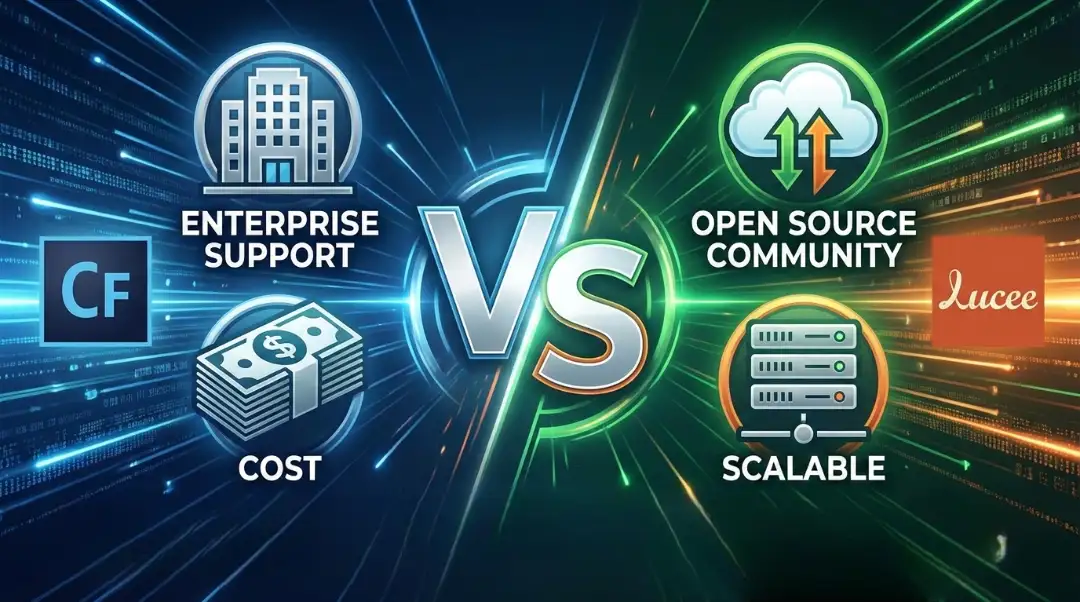
For businesses and developers committed to the CFML language, a critical choice emerges: Adobe ColdFusion or the open-source Lucee Server? This isn't a question of which technology is universally "better," but which is the right strategic fit for your specific project requirements, team structure, and long-term business goals. The decision hinges on evaluating trade-offs between commercial support and cost, performance characteristics, and ecosystem tools.
Making the wrong choice can lead to unexpected costs, scalability challenges, or support headaches down the line. This comparison cuts through the noise to highlight the practical, operational differences you need to consider.
Head-to-Head: Key Platform Differences
The core distinction is foundational: Adobe ColdFusion is a commercially licensed product from Adobe, while Lucee is an open-source fork descended from the older Railo project. This difference drives most of their contrasting characteristics.

ColdFusion is the strategic choice for enterprises where risk mitigation, compliance, and full-stack capability are non-negotiable. Its commercial nature translates into direct business benefits:
- Vendor Accountability: You have a direct support contract with Adobe. For critical security issues or production outages, this official channel is invaluable, especially for industries like finance, healthcare, or government that operate under strict regulatory frameworks (e.g., HIPAA, PCI-DSS).
- Reduced Operational Overhead: The integrated suite of features means you spend less time assembling and maintaining third-party libraries for common enterprise tasks like document processing or data visualization.
- Long-Term Roadmap: Adobe's public release cycle and subscription model provide a clear, predictable path for application maintenance and upgrades.
This is why firms specializing in high-stakes enterprise development, like Evalogical, recognized as a top ColdFusion development company, often recommend and architect solutions on Adobe ColdFusion. It provides the rock-solid foundation required for business-critical systems. You can explore this approach through our comprehensive ColdFusion development services.
When to Choose Lucee Server
Lucee excels where budget constraints are paramount and the team has the technical expertise to manage an open-source stack. Its advantages are compelling for the right scenario:
- Zero Licensing Cost: This is the most obvious benefit, making it accessible for startups, non-profits, or for deploying a large number of internal applications.
- Developer Flexibility and Speed: The lightweight core can start faster, and developers have deep access to customize the engine. The rapid release cycle means new language features often appear in Lucee first.
- Modern DevOps Alignment: Its container-friendly, lightweight nature aligns well with teams that have mature CI/CD pipelines and want fine-grained control over their runtime environment.
Scalability and Cost-Effectiveness: A Deeper Look
The question of which is more "scalable" or "cost-effective" doesn't have a single answer--it depends on your definition of cost.
- Scalability: Both platforms can be scaled horizontally. ColdFusion provides more integrated tooling for clustering and monitoring out-of-the-box. Lucee can achieve high scale but may require more custom engineering and configuration to manage a clustered environment effectively.
- Total Cost of Ownership (TCO): Lucee has a $0 software license cost. ColdFusion has a known annual subscription cost. However, TCO must include:
- Support Costs: Paying for Lucee support from a third party vs. included Adobe support.
- Development Costs: Time spent integrating/replacing built-in ColdFusion features in Lucee.
- Risk Costs: The business impact of an unresolved issue without vendor backing.
For a large enterprise, ColdFusion's subscription is often a minor line item that buys significant risk reduction. For a small team with high technical confidence, Lucee's zero license fee can be a decisive advantage.
FAQs
Q: Can we migrate from ColdFusion to Lucee (or vice-versa) easily?
A: A direct "lift-and-shift" migration is often more complex than it seems. While core CFML syntax is largely compatible, each platform has unique tags, functions, and underlying Java integrations. Porting an application requires careful auditing, testing, and potentially re-engineering of features that rely on platform-specific extensions. A phased strategy is usually necessary.
Q: Is Lucee just a free clone of ColdFusion?
A: No. While they share a common CFML language heritage, they are divergent codebases with different philosophies. Think of them as cousins, not clones. Lucee has its own performance profile, release cycle, and implementation of features, which has led to innovation but also to some compatibility gaps.
Q: Our team only knows Adobe ColdFusion. Is learning Lucee difficult?
A: For developers, the CFML language itself is nearly identical, so the learning curve is shallow. The primary differences lie in administration, configuration, and understanding the missing built-in features. A skilled CFML developer can become productive on Lucee relatively quickly, but mastering its operational nuances takes time.
Q: Which platform has a better future?
A: Both have active futures serving different markets. Adobe ColdFusion's future is tied to the enterprise software market, with a clear commercial incentive to continue development and support. Lucee's future is driven by its open-source community and commercial partners. Its trajectory is more organic and feature-driven.
Q: We need to build a high-performance API backend. Which should we choose?
A: For a greenfield API project, especially if your team is comfortable with open-source tooling, Lucee's lightweight profile and performance can be an excellent choice. However, if this API must integrate deeply with existing Adobe ColdFusion enterprise services or requires guaranteed vendor support SLAs, ColdFusion is the safer bet. Often, the decision comes down to your team's operational expertise more than raw performance metrics.
The choice between ColdFusion and Lucee is a strategic business decision, not just a technical one. It balances upfront costs against long-term risk, team skills against project requirements. For mission-critical systems where stability and support are paramount, Adobe ColdFusion is the proven enterprise choice.



 Salesforce vs. Creatio: Which ....
 How AI Improves Field Sales Pl....
 How Malaysian Enterprises Can ....
 The 2027 Guide to BNM RMiT Com....
 AI-Powered Account Planning: T....


Your Trusted Software Development Company