UX Design for Startups: Why Your MVP Can't Afford to Skip It
Published by: Gautham Krishna RDec 05, 2025Blog
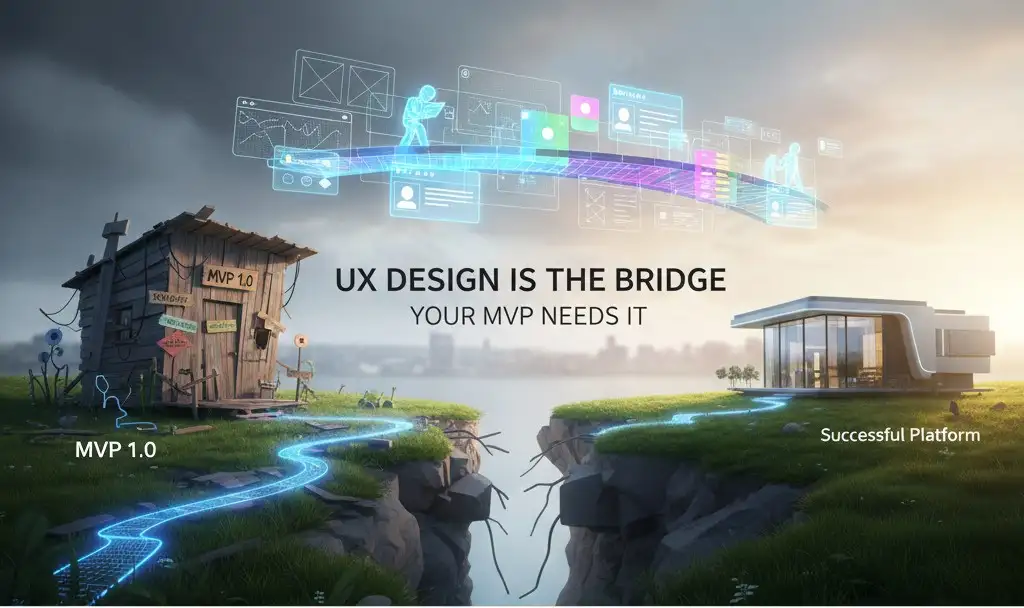
For a startup, every resource is precious. When building a Minimum Viable Product (MVP), the instinct to cut corners is strong, and user experience (UX) design is often seen as a "nice-to-have" for later. This is a critical misconception. Far from being a luxury, intentional UX design is the foundational layer upon which successful products are built and validated. It is the crucial tool that allows you to test your core business hypothesis with real users effectively, not just a functional product.
Think of your MVP not as an unfinished product, but as a strategic probe into the market. Its purpose is to gather authentic feedback and discover if your solution truly resonates. If users struggle to navigate, understand the value, or complete key actions, you won't get useful data--you'll just get frustration and abandonment. In fact, studies show that 94% of a website's first impressions are design-related, and nearly half of people cite design as the top factor in determining a business's credibility.
Investing in UX from the outset is a powerful risk mitigation strategy. It ensures that the feedback you're collecting is about your idea, not being clouded by a confusing or off-putting interface.
The Strategic Role of UX in Your MVP
A common pitfall is confusing an MVP with a prototype or a sloppy, bare-bones version. An MVP is a functional product with a reduced feature set, designed for rapid learning. UX design is what transforms a set of features into a cohesive, user-centric journey that validates your concept.
The core advantages are clear:
- De-risks Investment: You validate demand before committing extensive time and budget to a full-featured product.
- Generates Actionable Feedback: A usable product yields insights into real user behavior, needs, and pain points, not just opinions.
- Builds a User-Centric Foundation: It forces you to solve a specific user problem from the start, creating a solid foundation for all future iterations.
A Practical Framework: Building Your MVP with UX in Mind
You don't need an exhaustive, corporate-level design process. A lean, focused approach aligned with agile development is key. Here is a streamlined framework to integrate UX into your MVP development.
1. Identify the Core Problem and User
Start by ruthlessly defining the single problem you're solving. Who has this problem? Conduct lightweight research through interviews, surveys, or analysis of forums to understand their frustrations deeply. This prevents building a solution in search of a problem.
2. Define Your Value Proposition and Key Features
Articulate your product's elevator pitch: How does it benefit the user? Then, list every potential feature and prioritize them using a simple matrix: evaluate each based on user impact versus development effort/risk. Your MVP should include only the high-impact features essential to delivering your core value proposition.
3. Map User Flows and Create Wireframes
Sketch the ideal path a user takes to solve their problem using your MVP. Where do they start? What steps do they take? This highlights potential friction points. Then, translate these flows into low-fidelity wireframes--simple blueprints of your app's layout. This is where you structure the usability before any visual design.
4. Prototype, Test, and Iterate
Turn your wireframes into a clickable prototype using tools like Figma. Then, test it with real people from your target audience. Observe where they hesitate, click, or get confused. This step is non-negotiable; it uncovers usability issues that are cheap to fix now but would be catastrophic and expensive post-launch.
5. Develop, Launch, and Learn
With validated designs, development begins. After a soft launch to a limited audience, measure against your initial goals. Are users completing the core action? What is their feedback? Treat your MVP as the first step in an ongoing cycle of learning and refinement.
The High Cost of "DIY" or No UX
Attempting to handle complex UX decisions without expertise often leads to a predictable outcome: internal chaos and a product that fails to connect. When responsibilities are misplaced--like a backend developer making interface decisions or a founder guessing at user flows--the result is typically a confusing product that users abandon. This DIY approach increases long-term costs through necessary redesigns, hurts your brand's credibility from the start, and, most critically, can cause you to misinterpret market failure for a product failure.
FAQs
Q: As a cash-strapped startup, can't I just add good UX later after proving the idea?
A: This is a high-risk strategy. A poorly designed MVP can invalidate a good idea because users won't engage with it long enough to understand its value. Early UX investment is about learning efficiently. It ensures the feedback you get is about your concept, not your product's flaws, and prevents costly, fundamental redesigns later.
Q: What's the bare minimum of UX work needed for an MVP?
A: At an absolute minimum, you must: 1) Clearly define your target user and their core problem, 2) Map the single most important user flow (e.g., "sign up and complete the key task"), and 3) Test that flow with a clickable prototype on at least 5-8 potential users. This focuses effort on validating the core experience.
Q: How is UX for an MVP different from UX for a full product?
A: MVP UX is hypothesis-driven and focused on learning. The goal is not perfection or a comprehensive feature set, but to create a usable enough experience to test your core value proposition. It prioritizes clarity and simplicity over polish and edge cases.
Q: We have a great tech team. Can't they handle the UX?
A: While developers are essential for building the product, UX design is a distinct discipline rooted in psychology, user research, and interaction design. It's about understanding what to build and how users will interact with it. A specialized UX perspective is crucial to ensure the product is built for user adoption, not just technical functionality.
Ready to build an MVP that truly tests your vision with users?


 What Is Creatio CRM? A Practic....
 Salesforce vs. Creatio: Which ....
 How AI Improves Field Sales Pl....
 How Malaysian Enterprises Can ....
 The 2027 Guide to BNM RMiT Com....



Your Trusted Software Development Company