AI-Powered MVP Development: Smart Strategies for Startups
Published by: Gautham Krishna RJan 29, 2026Blog
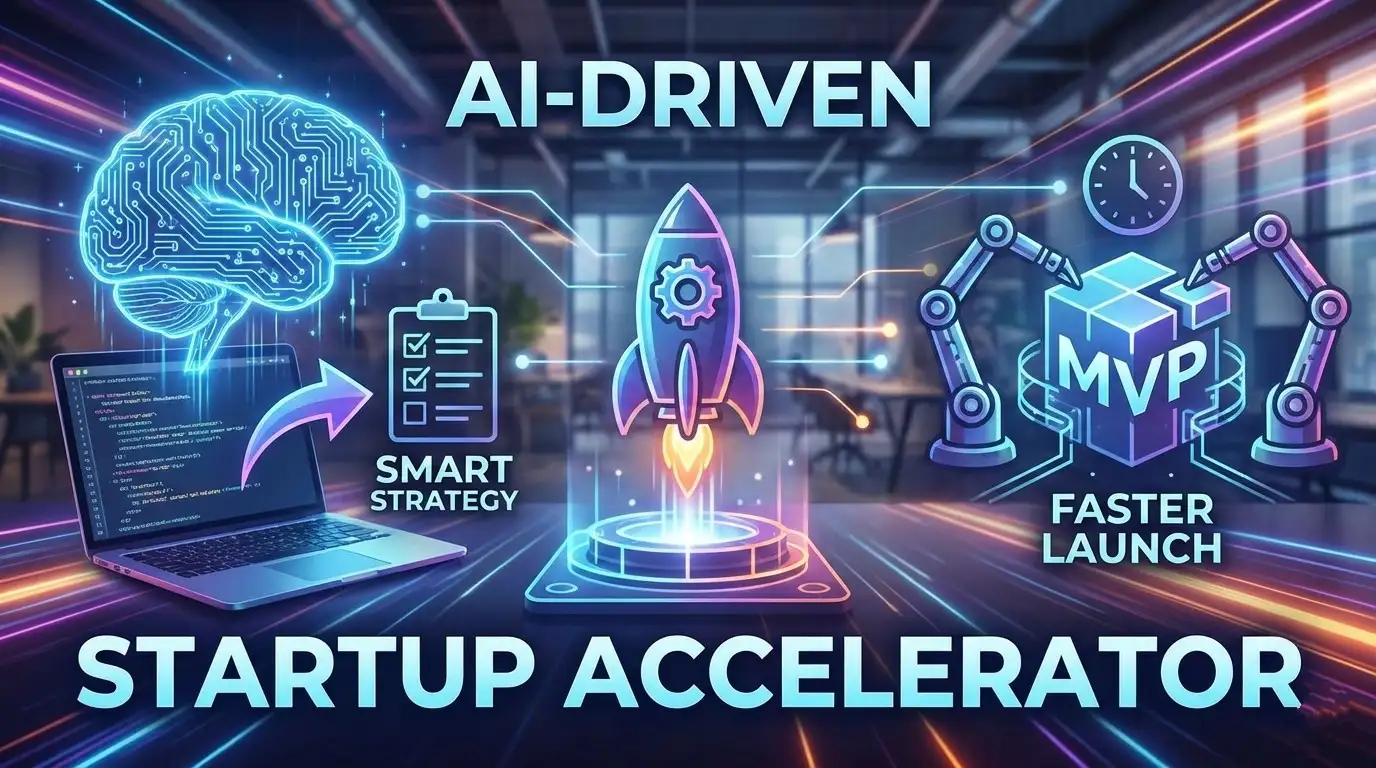
For startup founders, speed and resourcefulness are everything. Building a Minimum Viable Product (MVP) is the critical first step to validate your idea with real users, but traditional development can be slow and costly. Today, AI-powered tools offer a transformative advantage, enabling founders to accelerate ideation, prototyping, and development. However, the key is strategic use--leveraging AI as a powerful co-pilot while maintaining clear human direction over the product vision and user experience.
This guide provides simple, actionable tips for integrating AI into your MVP development process to move faster, learn quicker, and conserve precious capital.
Where AI Excels in the MVP Journey
AI is not a magic "build my app" button, but a set of powerful assistants for specific, well-defined tasks. Knowing where to apply it is half the battle.

Core Tip: Treat AI as a junior developer or creative assistant that needs extremely clear instructions. The quality of the output depends entirely on the quality and specificity of your prompt.
A Simple 4-Step Framework for AI-Assisted MVP Development
1. Define and Scrape with Precision
Before writing a line of code, use AI to de-risk your idea.
- Prompt Example for Market Research: "Act as a product manager. Analyze the core problems faced by [your target audience, e.g., freelance graphic designers] regarding [your problem space, e.g., client invoicing]. List the top 5 pain points and suggest 3 potential MVP features for each."
- Define Your MVP Core: Based on the research, force-rank features. Your MVP should have one primary user flow that delivers your core value. Use AI to draft a simple user story: "As a [user], I want to [action], so I can [benefit]."
2. Prototype and Validate Visually
Skip straight to a visual prototype to test comprehension.
- Generate UI Concepts: Use a text-to-design tool or detailed prompts with an LLM to describe a key screen (e.g., "Generate the HTML and CSS for a clean dashboard for a task management app, with a header, a create-task button, and a list of tasks").
- Create a Click-Through Flow: Tools like Figma with AI plugins can help you quickly mock up the journey from landing page to core action. This visual prototype is what you'll use for early user feedback, long before coding.
3. Build Using AI as Your Coding Partner
When building, AI shines in acceleration, not autonomy.
- Component-Driven Development: Break your UI into small components (navbar, signup form, data table). Ask your AI coding assistant to generate each one individually. This is where AI is most reliable.
- Learn and Debug in Real-Time: When you get an error, paste the error message and the relevant code block into ChatGPT. Ask it to explain the error in simple terms and suggest fixes. It's like having a senior developer on call 24/7.
- Automate Repetitive Tasks: Use AI to generate sample data for testing, write unit tests for your functions, or create basic API documentation.
4. Launch, Learn, and Iterate
Use AI to support your launch and analyze feedback.
- Generate Launch Content: Create your first blog post explaining the problem you solve, draft social media announcements, and prepare customer support FAQs.
- Analyze User Feedback: Compile user comments and survey responses and ask an LLM to identify common themes, sentiment, and urgent feature requests.
The Critical Limitations: Where Founders Must Lead
AI has clear boundaries. Successful founders use AI for leverage but own the strategy.
- The "Integrated Product" Gap: While AI can generate modular components, it struggles to architect a cohesive, secure, and scalable application where all parts work seamlessly together. This overarching architecture requires human expertise .
- Judgment and Authenticity: AI cannot replace founder intuition about the market, make nuanced prioritization calls, or instill a product with authentic vision and brand voice. These are your superpowers.
- Quality Assurance: AI-generated code can contain subtle bugs, security oversights, or inefficiencies. You must thoroughly review, test, and refactor all AI output. Never deploy blindly.
Think of your MVP as a hypothesis-testing vehicle. AI helps you build that vehicle faster, but you must drive the research, define the destination, and interpret the results.
FAQs:
Q: Can I build an entire MVP just by prompting AI?
A: Not a viable, production-ready one. You can create a functional prototype or proof-of-concept, but a market-ready MVP requires secure architecture, data integrity, and seamless integration that current AI cannot reliably orchestrate alone. It's a phenomenal assistant but not yet a replacement for developer expertise.
Q: What's the biggest mistake founders make when using AI for development?
A: Starting without a precise plan. If you prompt an AI with a vague idea ("build an app for freelancers"), you'll get a generic, unusable mess. The most successful founders use AI to execute against a very clear, pre-defined spec they've created through traditional customer discovery.
Q: Which AI coding tool is best for non-technical founders?
A: For those with minimal coding experience, no-code/low-code platforms integrated with AI (like Bubble or Softr) are a better starting point than raw code generators. For founders with some technical understanding, Cursor or GitHub Copilot with ChatGPT as a tutor/explainer is a powerful combination.
Q: How do I know when to stop DIY AI development and hire professionals?
A: Key signals include: your user base is growing and you need real reliability (uptime, security), you've validated core demand and need to build a scalable architecture, or the complexity of requested features outstrips your or AI's ability to implement them robustly. This is the perfect time to partner with a team like Evalogical's MVP development services to professionalize your proven concept.
Q: Is AI-powered MVP development just a fast track to technical debt?
A: It can be if used indiscriminately. The antidote is modularity and clear ownership. Use AI to build discrete, well-tested components. Ensure you or a developer fully understand the generated code before integrating it. Plan for a "code refactor" phase once your product hypothesis is proven, which is a vastly better problem to have than building nothing at all.
AI fundamentally changes the MVP development timeline, but not the fundamentals of product-market fit. Use it to experiment and learn with unprecedented speed. When your hypothesis is proven and you're ready to build a resilient, scalable product, expert guidance is your next strategic move.



 Creatio No-Code Platform: What....
 CRM Migration: Why Process Red....
 Is Salesforce to Creatio Migra....
 What Is Creatio CRM? A Practic....
 Salesforce vs. Creatio: Which ....

Your Trusted Software Development Company