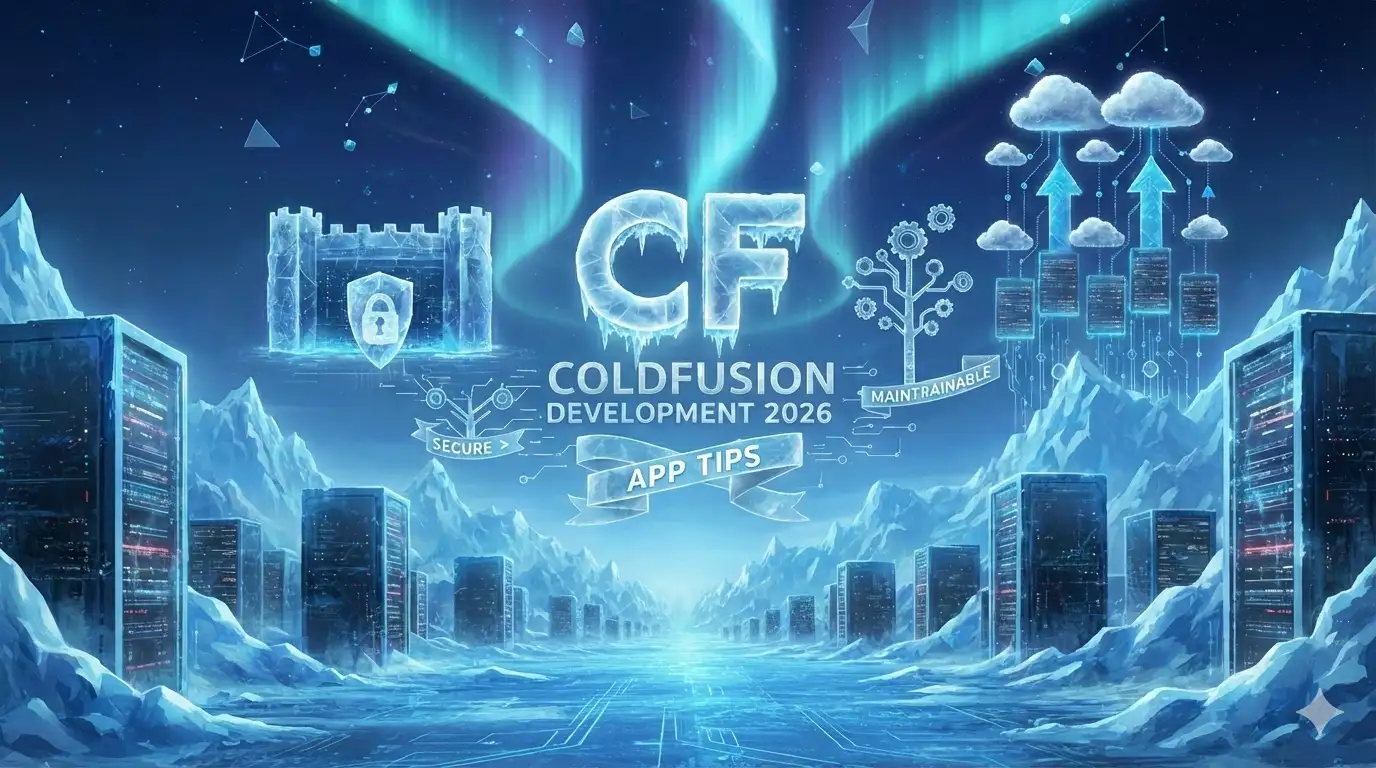
ColdFusion Development Tips for 2026: Writing Secure, Scalable, and Maintainable CF Apps
Published by: Gautham Krishna RJan 08, 2026Blog
As we approach 2026, the landscape for enterprise web applications continues to evolve rapidly. ColdFusion development must adapt to meet heightened security demands, increased scalability requirements, and the ongoing challenge of maintaining complex systems over time. Modern CFML development isn't just about making code work--it's about creating applications that can withstand emerging threats, handle growing user loads gracefully, and remain adaptable for future teams. This guide provides actionable development tips aligned with these core principles for building robust ColdFusion applications that stand the test of time.
The shift in ColdFusion development reflects broader industry trends toward security-by-design, cloud-native architectures, and sustainable coding practices. Organizations that embrace these approaches position themselves for long-term success with their CFML investments.
Foundational Security Practices for Modern ColdFusion
Security remains the foremost concern for any enterprise application. Modern ColdFusion development requires proactive security measures integrated throughout the development lifecycle.
Implement Comprehensive Input Validation
Every data input represents a potential attack vector. Beyond basic CFML validation functions, implement layered validation strategies:
- Client-side validation for user experience (but never rely solely on this)
- Server-side validation using ColdFusion's built-in functions (
isValid(), xmlValidate(), jsonValidate()) - Database-level validation through constraints and parameterized queries
- Output encoding contextually based on where data will be displayed (HTML, JavaScript, CSS, or URL contexts)
Adopt Modern Authentication & Authorization
- Move beyond basic session-based authentication to token-based approaches (JWT) for API endpoints
- Implement role-based access control (RBAC) with granular permissions
- Utilize OAuth 2.0 and OpenID Connect for standardized authentication flows
- Leverage ColdFusion 2025's enhanced security features including Content Security Policy (CSP) directives and nonce support for inline scripts
Secure Configuration Management
- Never hardcode credentials in application code or configuration files
- Utilize environment variables or secure secret management services
- Implement proper error handling that reveals system information to administrators but not to end users
- Regularly audit and update dependencies, including Java libraries and ColdFusion extensions
Scalability Patterns for Growing Applications
As user bases expand and data volumes increase, scalability becomes critical. Modern ColdFusion applications should be designed with growth in mind from the outset.
Architectural Approaches for Scale

Database Optimization Strategies
- Implement connection pooling to reduce database connection overhead
- Utilize database indexing strategically based on query patterns
- Consider read replicas for reporting and analytical queries
- Implement database sharding for extremely high-volume applications
- Use ColdFusion's query caching judiciously for relatively static data
Performance Monitoring & Optimization
- Implement application performance monitoring (APM) tools specifically configured for ColdFusion
- Establish performance baselines and track metrics over time
- Regularly profile database queries to identify and optimize slow performers
- Utilize ColdFusion's debugging and logging capabilities with appropriate log levels in production
Maintainability Best Practices for Long-Term Success
Maintainable code reduces technical debt and enables teams to adapt to changing requirements efficiently. These practices ensure your ColdFusion applications remain manageable over years of development.
Code Organization & Structure
- Adopt a modern MVC framework like ColdBox or Framework/One for larger applications
- Follow consistent naming conventions for variables, functions, and components
- Implement modular design with clear separation of concerns
- Create reusable components (CFCs) for common business logic and data access
Testing & Quality Assurance
- Implement automated testing including unit tests, integration tests, and API tests
- Utilize testing frameworks designed for ColdFusion like TestBox
- Establish continuous integration pipelines to run tests automatically
- Conduct regular code reviews to maintain quality standards and share knowledge
Documentation & Knowledge Management
- Document architectural decisions and the rationale behind them
- Maintain up-to-date API documentation for both internal and external APIs
- Create onboarding documentation for new team members
- Utilize inline comments judiciously to explain "why" not just "what"
Dependency Management
- Keep ColdFusion version current to benefit from security patches and performance improvements
- Regularly update Java dependencies and other third-party libraries
- Implement dependency checking as part of your CI/CD pipeline
- Maintain a software bill of materials (SBOM) to track all application components
FAQs
Q: What's the single most important security practice for ColdFusion applications?
A: Implementing comprehensive input validation and output encoding. The majority of web application vulnerabilities stem from improper handling of user-supplied data. By validating all inputs contextually and encoding outputs appropriately, you eliminate entire classes of vulnerabilities including SQL injection, cross-site scripting (XSS), and various injection attacks.
Q: How can we prepare our ColdFusion applications for containerized deployment?
A: Start by externalizing all configuration (using environment variables), implementing proper health check endpoints, ensuring your application is stateless (or externalizing state), and creating efficient Docker images. ColdFusion 2025's enhanced Docker support provides excellent starting points, but applications must be architected appropriately to benefit fully from containerization.
Q: What metrics should we monitor to ensure application scalability?
A: Key scalability metrics include: response time percentiles (P50, P90, P99), error rates, throughput (requests per second), concurrent user counts, database connection pool utilization, garbage collection frequency and duration, and system resource utilization (CPU, memory, disk I/O). Establishing baselines and setting appropriate alerts for deviations is crucial.
Q: How do we balance using modern frameworks versus traditional CFML for new development?
A: For greenfield projects or significant rewrites, modern MVC frameworks like ColdBox generally provide better long-term maintainability through enforced separation of concerns, built-in testing support, and established conventions. For maintaining existing applications or small enhancements, traditional CFML may be more appropriate. The decision should consider team expertise, application complexity, and expected lifespan.
Q: What's the recommended approach for integrating ColdFusion with modern JavaScript frontends?
A: Treat ColdFusion as an API backend serving JSON responses to JavaScript frontends (React, Vue, Angular, etc.). This separation allows frontend and backend teams to work independently, enables use of modern frontend tooling, and positions your application for future flexibility. ColdFusion's RESTful web services capabilities have matured significantly and work well in this architecture.
Conclusion: Building Future-Ready ColdFusion Applications
The future of ColdFusion development lies in embracing modern practices while leveraging the platform's unique strengths. By prioritizing security from the ground up, designing for scalability from the beginning, and implementing maintainability best practices throughout development, teams can build ColdFusion applications that not only meet current requirements but also adapt to future challenges.
As ColdFusion continues to evolve with updates like the 2025 release, developers have an opportunity to create enterprise applications that combine rapid development capabilities with production-ready robustness. The tips outlined here provide a roadmap for that journey toward more secure, scalable, and maintainable ColdFusion applications.
Need expert guidance on your ColdFusion development journey? Our team specializes in building and modernizing enterprise ColdFusion applications using these exact principles.



 What Is Creatio CRM? A Practic....
 Salesforce vs. Creatio: Which ....
 How AI Improves Field Sales Pl....
 How Malaysian Enterprises Can ....
 The 2027 Guide to BNM RMiT Com....


Your Trusted Software Development Company