The Dayy Banking Got Smarter: How AI Agents and No-Code Are Reshaping Finance
Published by: Gautham Krishna RMar 16, 2026Blog
Let me tell you about Sarah. She manages a mid-sized regional bank's branch operations, and until recently, her days looked like this: arriving at 7:30 AM to sort through loan applications, spending hours on the phone with customers asking about renewal dates, and staying late to manually enter referral data into spreadsheets. Her team was good at their jobs, but they spent more time on paperwork than on people.
Then something shifted. Not overnight, but quietly, steadily. New tools arrived that didn't require a degree in computer science to use. Software started handling the repetitive tasks. And Sarah found herself doing something she hadn't done in years: actually talking to customers about their goals, their dreams, their financial futures.
This is the story of how AI agents and no-code platforms--specifically, what companies like Creatio are building--are transforming banking from the inside out. And more importantly, it's about what this means for people like Sarah, and for the customers they serve.
The Problem That Wouldn't Go Away
For years, banks faced an impossible choice. They could build custom software for every new need--expensive, slow, requiring specialized developers. Or they could make do with off-the-shelf solutions that never quite fit. Either way, customers waited. Employees got frustrated. Innovation stalled.
The numbers tell part of the story. A typical bank might have hundreds of different forms and procedures--in one case, a major institution had 950 different forms its branch employees needed to navigate . Every time a customer walked in, employees spent precious minutes just finding the right document before they could even address the customer's actual need.
That's not banking. That's paperwork.
Enter the AI Agent: Not Just Another Chatbot
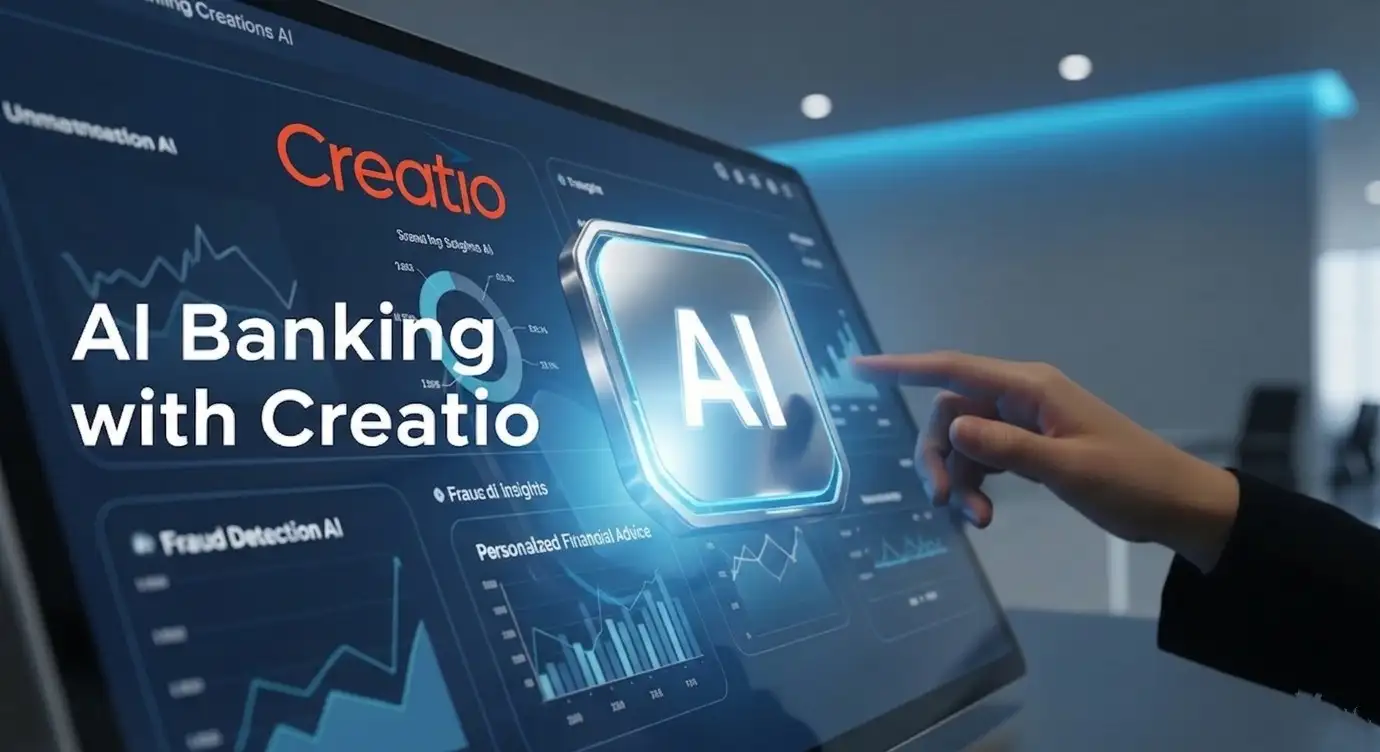
Here's where the story gets interesting. In February 2026, Creatio announced something that caught my attention: six pre-built autonomous AI agents designed specifically for banking . But these aren't the chatbots you've probably interacted with--the ones that can answer basic questions but fall apart the moment you ask something unexpected.
These are different. They're what the industry calls "agentic AI"--software that doesn't just suggest actions but actually executes them end-to-end . Think of them as digital employees that can coordinate across systems, make decisions within guardrails, and hand off to humans when needed .
Creatio organized its banking agents around two priorities that actually matter to financial institutions: revenue generation and operational excellence .

Here's what makes this different from previous attempts: these agents are pre-built for banking, not generic AI tools . They come with an understanding of how loans work, what compliance looks like, and where human oversight is required. Banks can deploy them in as little as 10-12 weeks without upgrading their core systems first .
The No-Code Revolution: Power to the People
But AI agents are only half the story. The other half is no-code--platforms that let people like Sarah build and modify workflows without waiting for IT.
Think about what that means. When Sarah's team noticed that loan applications were getting stuck at a particular step, they could open a visual builder, drag a few components, and add an automated reminder. No ticket system. No three-month development cycle. No expensive consultants.
This is exactly what platforms like Creatio provide: a way for business users to shape how work gets done . The company's "Twin" release, launched in mid-2025, introduced enhanced workflows across customer lifecycle management, product fulfillment, operations, and compliance--all configurable through a visual interface .
During Creatio's February 2026 digital event, they demonstrated how these agents operate with built-in governance, auditability, and human oversight to meet the regulatory demands of financial institutions . Burley Kawasaki, SVP of Industries at Creatio, put it this way: "Banks are moving beyond experimentation and looking for AI that can reliably execute real work" .
A Glimpse of What's Possible
Let me take you inside a bank that's actually using these tools.
The loan process that used to take days now moves in hours. When a customer applies, an AI agent immediately begins collecting documents, validating information, and checking for completeness . If something's missing, the agent reaches out--not a generic email, but a personalized message asking for exactly what's needed. The loan officer only gets involved when the file is ready for a decision.
Customer retention has transformed. Another agent monitors behavioral signals--how often someone logs in, whether they've called recently, if they've opened marketing emails . When it detects someone who might be considering leaving, it triggers a personalized outreach. Not a sales pitch, but a genuine conversation starter: "We noticed you haven't used our mobile app in a while. Is there anything we can help with?"
Referrals that used to get lost now flow automatically . When a business banker spots an opportunity for wealth management, they click one button. An agent handles the handoff, shares relevant context, and follows up to ensure the connection actually happens. Deals that would have fallen through cracks now close.
These aren't hypotheticals. They're happening now.
What Rabobank Learned Along the Way
Across the ocean, Rabobank--a major Dutch bank--embarked on its own AI journey. Their experience offers valuable lessons for any institution considering this path .
Rabobank implemented conversational AI across both chat and voice channels. The results are striking:
- 20,000 calls per day handled by AI-powered systems
- 7,000 daily chat interactions
- 62% self-service rate for chats (meaning they never needed to escalate to a human)
But here's what really matters: they didn't get there overnight. They spent years refining intent recognition--teaching their AI to actually understand what customers wanted . They built systems to test changes against real customer conversations. They created fallback mechanisms for when AI wasn't confident enough.
And crucially, they made deliberate choices about compliance. Rather than using off-the-shelf generative AI features, they deployed models within their own Azure subscription, maintaining full control over data . This approach let them innovate while satisfying regulators.
The takeaway? Success comes from thoughtful implementation, not just technology adoption.
Wells Fargo's Bold Move
Meanwhile, in the United States, Wells Fargo took a different approach that's equally instructive . In early 2026, they deployed AI agents across all 4,000 branches simultaneously . Industry observers questioned whether this was reckless or visionary.
The answer, it turns out, was strategically bold.
Wells Fargo started with a focused problem: those 950 forms and procedures I mentioned earlier. Branch employees spent huge amounts of time just finding the right document. The AI agent they deployed lets staff describe what they need in natural language and immediately get directed to the correct procedure .
The impact was immediate. Customer wait times dropped. Employee frustration decreased. And perhaps most importantly, the bank built momentum. Their VP of Process and Procedures told partners that their backlog now contains 500 similar ideas . Each success creates enthusiasm for the next.
Clay Wesener, who worked closely with Wells Fargo, observed: "Wells Fargo was strategic in their approach. Their first use of AI wasn't autonomous or high-risk. It was a scenario with clear customer and employee benefits, paired with built-in safety" .
The Architecture Question
For the technically curious among you, let me briefly address how these systems actually work under the hood.
Modern banking AI platforms typically use a layered architecture . At the bottom, there's an integration layer connecting to core banking systems, payment networks, and data sources. In the middle, an orchestration layer manages conversations, tracks state across channels, and routes requests. At the top, a no-code interface lets business users design workflows.
This composable approach means banks can modernize incrementally . They don't have to rip out their core systems--they can build an intelligent layer on top that makes everything work better . A bank can deploy a loan preparation agent without touching its loan origination system. It can add a customer onboarding agent while leaving account opening processes unchanged.
The result is faster transformation with less risk and lower cost .
What This Means for Customer Experience
Here's the part that matters most to me, and hopefully to you. All of this technology exists for one reason: to make banking better for people.
When employees spend less time on paperwork, they spend more time with customers. When AI handles routine questions, humans handle complex ones. When systems work together seamlessly, customers don't have to repeat themselves every time they call.
A midsize bank that implemented AI-driven refund processing saw ticket volumes drop significantly while fraud prevention improved . Customers got their money faster. Support teams focused on harder problems. Everyone won.
Another institution found that AI agents could handle ambiguous queries that used to stump their rule-based chatbots . Instead of escalating every slightly unusual question, the AI could reason through it. Customer satisfaction improved. Support costs dropped.
This is the promise of customer-centric banking powered by AI: not replacing humans, but freeing them to be more human.
Getting Started: A Practical Path Forward
If you're responsible for banking technology--or just curious about how this might apply to your organization--here's a practical way to think about getting started.
Start with one problem, not a platform. What's the biggest friction point in your current operations? Where do customers wait longest? Where do employees spend most time on manual work? Pick that one thing.
Look for pre-built solutions. Companies like Creatio have done the hard work of building banking-specific agents . You don't need to reinvent the wheel. Start with something that already understands your industry.
Measure what matters. Track not just technical metrics but business outcomes. How much faster are loans processing? How many referrals actually converted? What's happening to customer satisfaction scores?
Involve your people. Wells Fargo's success came partly from treating AI as an employee empowerment tool, not a cost-cutting measure . They created videos of branch employees talking about how the tools improved their work. They shared these company-wide before rollout. They built enthusiasm, not fear.
A Personal Note
I started this story with Sarah, the branch manager. I'm happy to report that her days look different now. She arrives at 8:00 instead of 7:30. She spends mornings walking the floor, checking in with team members, asking about their customers. She has coffee with business clients. She actually knows the people she serves.
The loan applications get processed anyway--the AI agents handle most of it, surfacing only the exceptions that need human judgment. The renewals happen automatically. The referrals flow without spreadsheets.
Sarah's job didn't disappear. It got better. She's doing what she always wanted to do: helping people with their financial lives.
That, to me, is what this transformation is really about.
FAQs
Q: What exactly are AI agents in banking, and how are they different from chatbots?
A: AI agents are autonomous software that can execute end-to-end workflows, not just answer questions . While chatbots provide information, agents take action--processing loan applications, managing renewals, coordinating across systems. They operate with built-in governance and can hand off to humans when needed .
Q: How long does it take to deploy AI agents in a bank?
A: With pre-built, banking-specific agents like those from Creatio, deployment can take as little as 10-12 weeks . This doesn't require upgrading core systems first--agents can work alongside existing infrastructure.
Q: Do I need to be a technologist to use no-code banking platforms?
A: Not at all. That's the point. No-code platforms are designed for business users--people who understand banking workflows but don't write code. They use visual builders to configure processes, adapt pre-built components, and respond to changing needs without IT involvement .
Q: How do banks ensure compliance when using AI agents?
A: This is a critical consideration. Enterprise AI platforms include built-in governance, auditability, and human oversight . Banks can monitor agent behavior, track decisions, and maintain compliance dashboards. Some institutions deploy models within their own cloud environments to maintain full data control .
Q: What measurable results are banks seeing?
A: Results vary by use case, but examples include: Rabobank achieving 62% self-service rates across thousands of daily interactions ; a midsize bank reducing support ticket volume while improving fraud detection ; and financial institutions deploying workflows 70% faster with 30% lower technology costs .
Q: Can smaller banks benefit from these technologies, or is this just for large institutions?
A: Absolutely. Pre-built, banking-specific agents make these capabilities accessible to institutions of all sizes . Because they deploy quickly without requiring core system changes, community banks and credit unions can achieve meaningful transformation without massive budgets or technical teams.
Q: What's the biggest mistake banks make when adopting AI?
A: Trying to do too much at once. The most successful approaches start with one focused problem--like simplifying form access or automating loan preparation . They build momentum through early wins, then expand based on demonstrated value. Cultural mistakes also hurt: positioning AI as employee replacement rather than empowerment creates resistance .
Q: Where can I learn more about implementing these solutions?
A: Evalogical's comprehensive services include expertise in modern banking platforms and AI integration. Their team can help assess your specific needs and guide you toward practical, measurable solutions.
The banks that thrive in the coming years won't be the ones with the biggest IT budgets. They'll be the ones that empower their people with better tools AI agents that handle routine work, no-code platforms that let business users move fast, and integrated systems that actually work together.



 Why Businesses Outsource Sales....
 Too Many AI Tools? A Simple Gu....
 Claude Meets Figma: How Design....
 How We Integrate Generative AI....
 AI in ColdFusion: Delivering G....

Your Trusted Software Development Company