Why Vibe Coding Fails at Scale: The Critical Role of Skilled Developers
Published by: Gautham Krishna RDec 16, 2025Blog
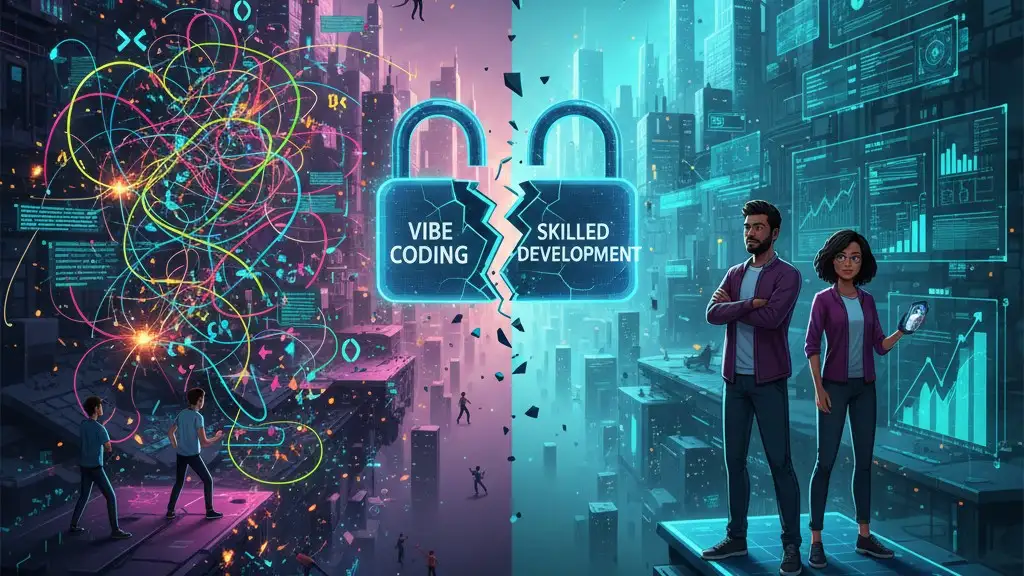
In the fast-paced world of startups, a tempting shortcut has emerged: "vibe coding." This approach prioritizes rapid, instinct-driven feature delivery over disciplined engineering. While it can produce quick prototypes, vibe coding becomes a major liability as user bases grow and systems complexify. Building a real, scalable platform requires a fundamental shift to skilled software development - a practice rooted in architecture, process, and long-term thinking.
The core issue is that vibe coding treats symptoms (the need for a feature) while skilled development addresses the underlying system (the need for a scalable, stable architecture). This distinction determines whether a startup scales successfully or collapses under technical debt.
Vibe Coding vs. Skilled Development: A Clear Comparison
The contrast between these two approaches becomes stark when examined side-by-side. The following table highlights the fundamental differences in philosophy and output:

The High Cost of "It Works on My Machine"
Vibe coding's informal nature leads to what engineers call "tribal knowledge"- critical information about how the system works exists only in the minds of the original developers. This creates a single point of failure. When that developer is unavailable or leaves, the team's ability to fix bugs or add features grinds to a halt. Furthermore, without automated testing, every new change risks breaking existing functionality, leading to a fear of deployment and slower innovation, not faster.
Skilled developers engineer for uncertainty. They build systems assuming requirements will change and traffic will grow. This involves:
- Clean Architecture: Separating concerns (UI, business logic, data) so changes in one area don't break others.
- Automated Pipelines: Using CI/CD (Continuous Integration/Continuous Deployment) to automate testing and deployment, making releases safe and routine.
- Observability: Baking in logging, monitoring, and metrics from day one to understand system behavior and diagnose issues.
- Purposeful Processes: Implementing code reviews, design discussions, and sprint planning not as bureaucracy, but as quality control and team alignment mechanisms.
Why Startups Need to Invest in Engineering from the Start
The misconception is that disciplined engineering is slow. In reality, it is the only path to sustained speed. A study by Stripe found that developers spend over 17 hours per week dealing with technical debt and bad code--time lost that could be spent building new value. Early investment in proper architecture and quality pays exponential dividends, preventing the "rewrite trap" that kills momentum.
For a startup, your software platform is not a cost center; it is the primary vehicle for delivering value, understanding customers, and outperforming competitors. Partnering with a team that practices skilled development from the outset, like Evalogical's custom software development services, de-risks this critical investment. It ensures your foundational technology accelerates growth instead of becoming the bottleneck.
FAQs
Q: We need to move fast to validate our idea. Isn't some vibe coding necessary at the start?
A: Speed is crucial, but there's a difference between a disciplined prototype and chaotic vibe coding. A skilled team can build a clean, focused MVP using best practices without over-engineering. This "good-fast" approach validates your idea and provides a solid foundation to scale upon, avoiding a costly, demoralizing rebuild later.
Q: How can I tell if my current team is vibe coding or practicing skilled development?
A: Ask these questions: Is the codebase getting harder to change? Are deployments fearful, big-bang events? Is knowledge siloed with one or two people? Do bugs in "old" features frequently appear when "new" features are added? Multiple "yes" answers strongly indicate vibe coding patterns.
Q: What's the first step to transition from a vibe-coded codebase to a well-engineered one?
A: Introduce automation and measurement. Start by implementing a basic CI pipeline to run automated tests. Then, add monitoring to understand your system's behavior. These tools provide objective data about quality and stability, creating a foundation for introducing better architecture and practices incrementally.
Q: We're not a tech company. Do we still need this level of engineering?
A: Today, every company is a software company. Whether you're in finance, healthcare, or retail, software is how you serve customers and operate efficiently. The risks of security breaches, data loss, or system downtime from poor software are just as severe, making skilled development a business necessity, not a tech luxury.
Q: Can't we just hire one "rockstar" developer to fix everything?
A: This is a common trap. Scale is achieved through systemic excellence, not individual heroics. A single developer, no matter how talented, cannot create a scalable, collaborative engineering culture alone. You need a team aligned on processes and standards, which is why partnering with an experienced firm can be more effective than relying on a lone genius.
Building a platform for the future requires more than just code - it requires engineering discipline. Move beyond the limitations of vibe coding and build a foundation that scales with your ambition.



 Salesforce vs. Creatio: Which ....
 How AI Improves Field Sales Pl....
 How Malaysian Enterprises Can ....
 The 2027 Guide to BNM RMiT Com....
 AI-Powered Account Planning: T....



Your Trusted Software Development Company