AI-Driven Sales Territory Planning: How to Balance Account Coverage and Rep Capacity
Published by: Nithin P JohnAug 12, 2026Blog
Every January, sales leaders divide accounts, assign representatives, and set quotas using spreadsheets and CRM data. By March, imbalances often emerge; some reps are overloaded with high-value opportunities, while others struggle with limited potential. This pattern highlights a critical issue: territory design directly impacts sales performance.
Research from the Sales Management Association and Xactly found that only 36% of companies consider their territory design effective, while companies with effective territory design can achieve significantly better sales results. Territory planning is more than an administrative exercise. It is a strategic process that influences account coverage, workload balance, sales productivity, and revenue performance.
Traditional planning methods often rely on manual analysis and historical data, making it difficult to respond quickly when markets, accounts, or sales capacity change. AI-driven territory planning offers a smarter approach by analyzing account potential, workload, performance, and coverage to identify imbalances and recommend better allocations.

Why Sales Territories Become Unbalanced
Territory imbalance is one of the largest controllable factors affecting quota attainment. However, an imbalance does not happen overnight. It develops through multiple factors that build up over time.
Uneven Account Potential: Not all accounts are created equal. A territory with 50 mid-market accounts may appear balanced against a territory with 50 enterprise accounts, but their revenue potential can be very different. Equal account counts do not necessarily mean equal opportunity.
Uneven Representative Workload: Workload is not just about the number of accounts. It also depends on account complexity, required touchpoints, travel time, and administrative effort. Some representatives may manage territories that require significantly more effort than others. In a study of 4,800 sales territories across 18 large sales forces, ZS Associates found that 25% of territories had too much work for a representative to handle effectively, while 31% had too little work to keep a representative fully occupied.

Business Impact of Poor Territory Allocation
The consequences of poor territory allocation extend far beyond administrative inconvenience.
Revenue Left on the Table
According to Harvard Business Review, optimized sales territory design can increase revenue by 2% to 7% without any change in total resources or strategy. For a $100 million organization, that represents millions in unrealized opportunity.
Representative Burnout and Turnover
When representatives are overburdened, they tend to burn out. When they're underutilized, they disengage. Either outcome drives turnover and turnover drives further territory instability.
Misaligned Quotas
According to Varicent's 2025 Market Spotlight study of over 1,400 sales and revenue leaders, 60% said their quotas aren't even aligned with the actual potential of their territories.
Internal Disputes
Territory changes trigger anxiety. Representatives lobby to keep their best accounts. Managers protect their teams. New hires get whatever is left overoften the accounts nobody else wanted. The result is a territory map shaped by organizational politics rather than market opportunity.
Lost Selling Time
Sales representatives today spend only 28-30% of their time on actual selling activities. The rest is consumed by administrative work, internal meetings, and, critically, inefficient account coverage driven by poor territory design. avoid gaps
The Business Impact of Poor Territory Allocation
The consequences of poor territory allocation extend far beyond administrative inconvenience.
Revenue Left on the Table
According to Harvard Business Review, optimized sales territory design can increase revenue by 2% to 7% without any change in total resources or strategy. For a $100 million organization, that represents millions in unrealized opportunity.
Representative Burnout and Turnover
When representatives are overburdened, they tend to burn out. When they're underutilized, they disengage. Either outcome drives turnover--and turnover drives further territory instability.
Misaligned Quotas
According to Varicent's 2025 Market Spotlight study of over 1,400 sales and revenue leaders, 60% said their quotas aren't even aligned with the actual potential of their territories.
Internal Disputes
Territory changes trigger anxiety. Representatives lobby to keep their best accounts. Managers protect their teams. New hires get whatever is left overoften the accounts nobody else wanted. The result is a territory map shaped by organizational politics rather than market opportunity.
Lost Selling Time
Sales representatives today spend only 28-30% of their time on actual selling activities. The rest is consumed by administrative work, internal meetings, and, critically, inefficient account coverage driven by poor territory design. avoid gaps
How AI Changes Sales Territory Planning
Traditional territory planning treats all accounts the same within a geographic or alphabetical range. AI flips this by starting with account potential and buying signals, then optimizing coverage to maximize revenue.
AI can help Revenue Operations teams:
- Analyze large volumes of CRM information that would be impossible to process manually.
- Identify patterns and correlations that are difficult to detect through spreadsheet-based reviews.
- Surface imbalances and coverage gaps before they become performance problems.
- Recommend potential adjustments based on multiple factors simultaneously.
- Explain the recommendation rationale so leaders can review proposed changes transparently.
The key shift is from asking "Where are our accounts?" to asking "Where should our accounts be allocated to balance opportunity and capacity?"
Critically, AI does not replace human decision-making. It handles the low-value research and analysis work so experienced Revenue Operations professionals can focus on high-value strategic decisions.
 AI Capabilities That Support Territory Optimization
Modern AI CRM platforms bring a range of capabilities to territory planning.
Account Profiling
AI can analyze account characteristics size, industry, growth trajectory, and technology adoption to build comprehensive profiles that inform territory decisions.
Account and Contact Insights
Beyond firmographics, AI can surface relationship intensity, engagement patterns, and contact-level activity that indicate where coverage is strong or weak.
Account Conversion Insights
Predictive signals about conversion likelihood can help prioritize which accounts deserve the most attention and which representatives are best positioned to win them.
Natural Language Analytics
Users can interact with CRM information using natural language, asking questions like "Show me territories with uneven enterprise account coverage" and receiving actionable answers.
Pipeline and Activity Summarization
Understanding recent activity and pipeline context is essential for coverage decisions. AI can summarize what is happening in each territory--not just how many accounts exist
How Creatio Supports AI-Assisted Territory Allocation
Creatio brings account, territory, workload, and sales-capacity information into a unified planning view. AI capabilities then surface imbalances, identify coverage gaps, recommend territory adjustments, explain the rationale behind recommendations, and prepare proposed changes for Revenue Operations review.
Unified Planning View
Creatio enables Revenue Operations teams to analyze:
- Account potential
- Regional coverage
- Representative workload
- Sales capacity
Territory Imbalance Identification
The platform highlights territories where:
- High-value accounts are under-covered
- Representatives are overloaded
- Coverage gaps exist
Territory Adjustment Recommendations
Recommendations are based on multiple factors:
- Account fit
- Location
- Pipeline potential
- Representative capacity
- Recommendation Explainability
Perhaps most importantly, Creatio explains the rationale behind each recommendation. Leaders can review proposed changes transparently rather than relying on spreadsheet-based guesswork.
Change Preparation
The platform prepares
- Proposed territory changes
- Impacted accounts
- Ownership shifts
- Rationale
Human Review and Governance
The interface includes review and application controls: Review Accounts, Apply Recommendation, and Save Territory Plan, ensuring that AI assists rather than replaces human judgment.
What the AI Finds
The analysis reveals two problems:
1. Overloaded territory: 42 high-potential accounts assigned to a single Account Executive.
2. Coverage gap: The Pacific Northwest has 18 Tier 1 accounts with low recent activity.
The Recommendation
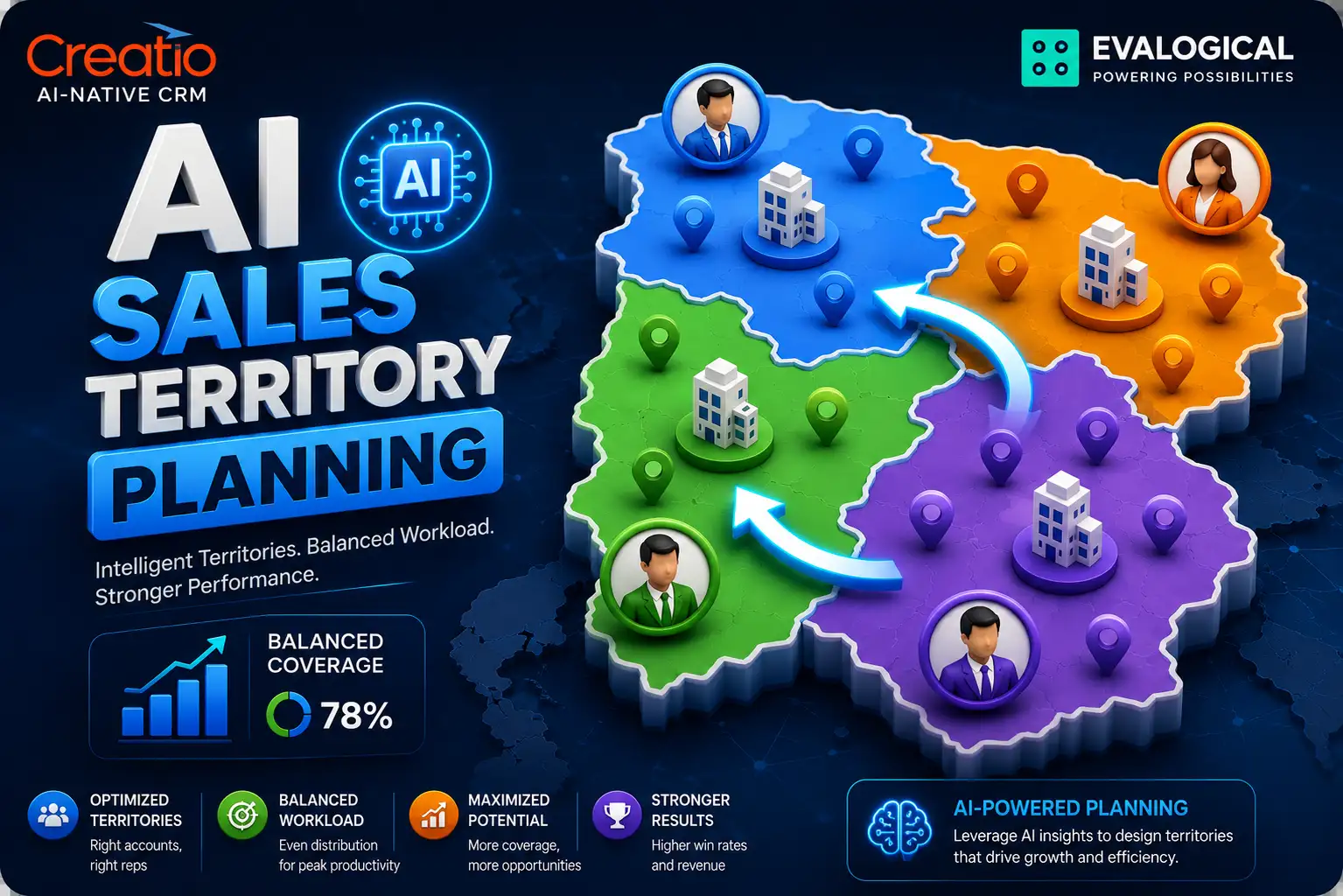
Move 12 enterprise accounts from West Coast Central to Pacific Northwest.
Expected Impact
- More balanced workload across the West Region
- Stronger coverage of high-value accounts in the Pacific Northwest
- Improved Coverage Balance score (displayed as 78%)
Review and Governance
The Revenue Operations Manager reviews the recommendation, examines the impacted accounts, and either applies the change or modifies it before saving the territory plan.

A Critical Distinction
Avoid measuring territory performance solely through revenue. Territory health and individual seller performance should be analysed separately. Gartner specifically recommends distinguishing territory potential from seller performance when evaluating territory effectiveness.
A representative might be underperforming because their territory has limited potential, not because they lack skill. Conversely, a representative might exceed targets because their territory is exceptionally rich, not necessarily because they are uniquely talented.
Define Territory Balance Criteria
Balance isn't about equal account counts. It's about aligning opportunity, workload, and capacity. Define what balance means for your organization.
Use Multiple Data Signals
Geography alone is insufficient. Incorporate account potential, pipeline activity, workload metrics, and capacity data into your analysis.
Keep Humans in the Review Loop
AI recommendations should be reviewed before application. The human-in-the-loop model ensures governance and builds trust.
Monitor Territory Performance
Territories should be reviewed periodically, not just annually. Quarterly reviews with defined metrics prevent months of compounding misalignment.
Revisit Territories Periodically
Markets shift. Reps leave. Accounts change. A territory plan should be a living document, not a once-a-year exercise.
How Revenue Operations Teams Can Implement AI Territory Planning
- Audit Current Territories
- Document existing territory structures, account assignments, and workload distribution. Understand where you're starting.
- .Establish Territory KPIs
- Define the metrics that matter for your organization. Coverage Balance? Workload equity? Account coverage?
- . Define Account Segmentation
- Not all accounts are equal. Segment accounts by potential, strategic value, and buying signals.
- Evaluate Representative Capacity
- Assess current workload, travel requirements, and administrative burden. Understand capacity before making changes.
- . Analyze Coverage
- Identify gaps. Where are high-value accounts receiving insufficient attention? Where are representatives overloaded?
- . Test Proposed Changes
- Model potential territory adjustments before applying them. Understand the impact before making changes.
- Obtain Leadership Approval
- Present data-driven recommendations with a clear rationale. Transparency builds trust.
- Monitor Results
- Track territory performance after changes. Adjust as needed.
- Common Challenges and How to Address Them
Poor CRM Data Quality
Territory optimisation is only as reliable as the data it uses. Address data quality before relying on AI recommendations.
Resistance to Account Ownership Changes
Representatives naturally resist losing accounts they've cultivated. Transparency and a clear rationale help mitigate resistance. When representatives understand why changes are proposed, they're more likely to accept them.
Overreliance on Geography
Geography is one factor among many. Don't let it dominate territory design at the expense of account potential and workload balance.
Lack of Consistent Territory KPIs
Without clear metrics, you can't measure improvement. Define your KPIs before you begin.
Treating Territory Design and Seller Performance as the Same Thing
A representative in a weak territory may underperform despite being highly capable. Separate territory health from seller performance in your analysis.
Automating Without Governance
AI should assist, not replace, human decision-making. Maintain review and approval processes.
Frequently Asked Question
Q: What is AI-driven sales territory planning?
A: AI-driven sales territory planning uses artificial intelligence to analyze account potential, representative workload, geographic coverage, and sales capacity to recommend balanced territory assignments. It combines CRM data with predictive analytics to surface imbalances and suggest adjustments.
Q: How does AI help balance sales territories?
A: AI analyzes multiple factors simultaneously--account potential, workload, capacity, location, pipeline activity, and account fit--to identify where imbalances exist and recommend adjustments that create more equitable distribution of opportunity and effort.
Q: What data is needed for territory optimization?
A: Effective territory optimization requires account data (size, industry, revenue potential), geographic data (location, region), workload data (accounts per rep, activity levels), capacity data (rep availability, travel requirements), and pipeline data (open opportunities, expected revenue).
Q: How do you identify territory coverage gaps?
A: Coverage gaps can be identified by comparing high-value accounts against recent activity levels. When valuable accounts show low engagement, they're likely under-covered. AI can surface these patterns automatically.
Q: How can territory planning reduce sales rep workload imbalance?
A: By analysing workload across territories and recommending adjustments--such as moving accounts from overloaded territories to those with capacity--territory planning can distribute effort more equitably.
Q: How can territory planning reduce sales rep workload imbalance?
A: By analysing workload across territories and recommending adjustments--such as moving accounts from overloaded territories to those with capacity--territory planning can distribute effort more equitably
Conclusion
Balanced territories require more than dividing accounts geographically. They require aligning account potential, coverage needs, workload, and representative capacity in a transparent, data-driven planning workflow.
The organisations that get this right see measurable results. Organisations with optimised territory plans report 10-20% greater sales productivity, 10-15% cost reduction and reallocation, and 20% more revenue growth opportunities.
The shift is already underway. The global Sales Territory Optimisation AI market was valued at $0.79 billion in 2025 and is projected to reach $2.59 billion by 2034--at a compound annual growth rate of 14.2%. Over 65% of organisations have adopted or are actively investigating AI technologies for data and analytics, and territory planning stands at the centre of that transformation.
But technology alone isn't the answer. The organisations that succeed will be those that combine AI-driven insights with human judgment--using data to inform decisions while keeping Revenue Operations leaders firmly in control.
See how Creatio can help your sales team optimise territories with AI-driven CRM insights.
Request a Creatio demo to explore AI-assisted territory planning and sales management.


 What Is Creatio CRM? A Practic....
 Salesforce vs. Creatio: Which ....
 How AI Improves Field Sales Pl....
 How Malaysian Enterprises Can ....
 The 2027 Guide to BNM RMiT Com....



Your Trusted Software Development Company