

AI-Powered Account Planning: Turn CRM Data Into Enterprise Growth
Published by: Haleel Abdul HameedSep 23, 2026Blog
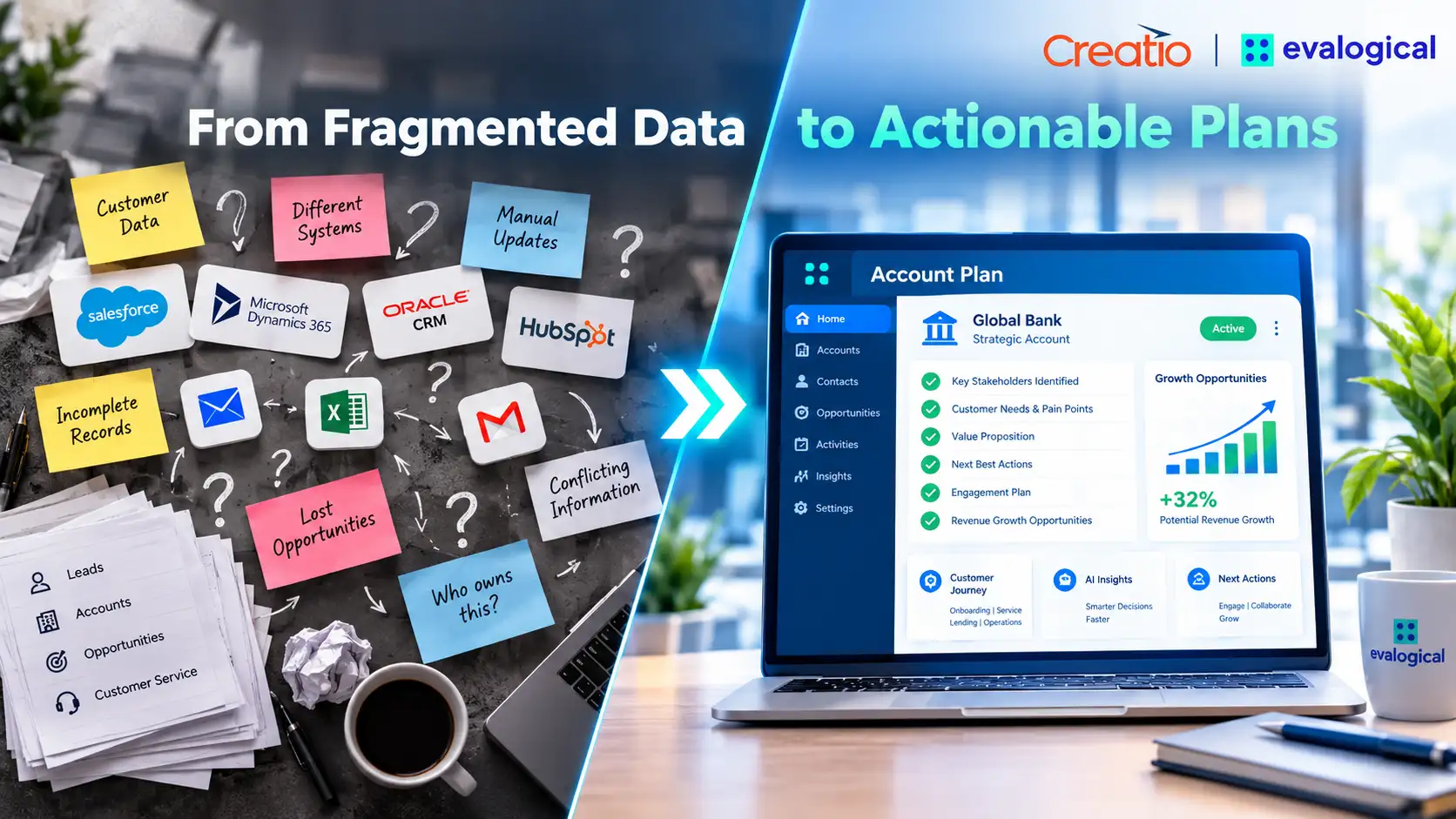
Enterprise account planning has a fundamental problem. Enterprise account planning has a fundamental problem. Not a lack of data. Not a lack of customer information. Not even a lack of skilled sales professionals.
Enterprise Account Executives sit on a mountain of account intelligence--opportunity history, stakeholder relationships, engagement signals, support tickets, and product usage data. Yet when it comes time to develop a strategic account plan, that information exists in scattered notes, individual memories, disconnected spreadsheets, and various CRM modules that rarely speak to each other.
The result is predictable: inconsistent planning, missed expansion opportunities, overlooked risks, and hundreds of hours of manual research that could have been spent building customer relationships.
AI-powered account planning addresses this by consolidating fragmented account information into structured, actionable plans. This isn't about replacing strategic thinking. It's about freeing account teams to focus on what matters--understanding customers, identifying growth opportunities, and managing complex stakeholder relationships.

The Hidden Cost of Inconsistent Account Planning
For most enterprise organizations, account planning is:
- Inconsistent across account teams--different Account Executives plan differently, or not at all
- Manual--requiring days of research and consolidation before each business review
- Disconnected from CRM data--plans exist separately from the systems that track customer interactions
- Memory-dependent--relying on individual account manager knowledge rather than structured account intelligence
- The cost of this inconsistency extends far beyond wasted time.
When account planning is inconsistent, important stakeholders get overlooked. Growth opportunities remain hidden in existing account data. Account risks aren't identified early. Business reviews rely on outdated or incomplete information. Strategic planning becomes dependent on individual seller knowledge, making it difficult for management to maintain a consistent view of account health and expansion potential.
When Account Planning Breaks Down
Consider the reality of a typical enterprise account team preparing for a quarterly business review:
- Day 1: The Account Executive begins reviewing account history manually, searching through emails, meeting notes, and CRM records
- Day 2: They identify opportunities and contacts, piece together stakeholder relationships, and review activities
- Day 3: They look for growth opportunities based on what they remember from recent conversations
- Day 4: They build the account plan in whatever format they typically use
- Day 5: They prepare for the QBR presentation
- Five days of effort. Five days not spent with customers. And the resulting plan is only as complete as one person's memory and research ability.
The Traditional Account Planning Workflow
The traditional account planning process follows a predictable path:
CRM/account information → Manual research → Scattered notes → AE interpretation → Manually created plan → Account review
This workflow creates several critical weaknesses:

The central issue isn't that enterprise organizations lack data. They have more customer information than ever before. The challenge is making that data useful at the moment an account team needs to make a decision.
How AI Transforms Account Planning
AI-powered account planning changes this dynamic by converting fragmented account intelligence into coordinated commercial action.
Where the traditional approach requires manual research, AI consolidates account context. Where individual account managers rely on memory, AI retrieves stakeholder context. Where account plans exist as static documents, AI enables CRM-connected planning that remains current.
The AI-Powered Workflow
The transformation is evident in the workflow itself:
CRM data + AI consolidation → Structured account view → Growth opportunity identification → Risk detection → Actionable plan → Account review
This isn't about replacing the Account Executive's judgment. It's about ensuring that judgment is applied to complete, structured information rather than fragmented, incomplete data.
The AI-Powered Account Planning Use Case
Let's examine a practical example.
An Enterprise Account Executive is preparing for a quarterly business review with HelioTel Communications, a strategic account. Rather than spending days consolidating information, the AE asks the system:
"Create an account plan for HelioTel Communications ahead of the quarterly business review."
The system immediately produces a comprehensive account plan draft containing:
Account Priority
Expand from sales automation into service and customer-retention workflows
Key Stakeholders
- VP Sales
- Director of Customer Operations
- CIO
Growth Opportunity
- Service-case automation for enterprise support teams--a clear expansion path based on the account profile and product fit.
Risk
- The CIO has not joined recent planning discussions--a relationship gap that needs attention before the QBR.
- Recommended Next Move
- Schedule an executive alignment meeting before the QBR to address stakeholder engagement.
Strategic Objective
- Position AI CRM as a way to connect revenue growth, service efficiency, and customer retention.
- Account Coverage
- 68%--providing a clear metric for visibility across the account.
- Expansion Potential
- High--indicating significant growth opportunity.
What Makes This Approach Different
- What's notable about this example is that the output isn't merely a summary. The AI-generated plan connects multiple elements:
Account context → Stakeholders → Opportunity → Risk → Next action → Strategic objective
- This represents a fundamental shift from information consolidation to strategic synthesis. The system doesn't just pull together data--it identifies relationships, surfaces gaps, and recommends actions.
Seven Core AI CRM Capabilities
- Effective AI-powered account planning relies on a set of core capabilities that work together to transform data into action:
- Account Profiling -- Automated consolidation of account history, opportunity data, contacts, activities, and external signals into a comprehensive planning view.
- Account and Contact Insights -- Identification of key stakeholders, relationship patterns, and engagement context across the account team.
- Opportunity Summarization -- Concise overview of open opportunities, deal progression, and potential roadblocks.
- Stakeholder Context Retrieval -- Quick access to stakeholder relationships, recent interactions, and engagement levels.
- Account News and Signals -- Real-time updates on account developments, including organizational changes, funding events, and product announcements.
- Cross-Sell and Upsell Recommendations -- Identification of expansion opportunities based on account profile, product fit, and recent engagement.
- Recommended Next Steps -- Actionable guidance on priority actions to advance account relationships and opportunities.
These capabilities are powered by purpose-built agents such as the Account Research Agent,, which enriches CRM records, identifies stakeholders, and generates ready-to-use account insights.
Business Outcomes That Matter
For enterprise decision makers, the value of AI-powered account planning must translate into measurable business outcomes:
Strategic Account Coverage
Better visibility across stakeholders, opportunities, relationships, risks, and account priorities. This isn't just about having more information--it's about having the right information structured for decision-making.
Enterprise Expansion Revenue
Identifying cross-sell, upsell, and product expansion opportunities that might otherwise remain hidden in existing account data. When account planning is consistent and comprehensive, expansion potential becomes visible rather than speculative.
Reduced Planning Burden
Dramatically reducing the manual effort required to research accounts, consolidate information, identify priorities, and structure account plans. This frees Account Executives to spend more time with customers and less time preparing.

How AI-Powered Account Planning Addresses Specific Challenges
- For Account Executives: No more spending days manually researching accounts before business reviews. Instead, comprehensive, structured plans are available when needed.
- For Sales Leadership: Consistent account visibility across the entire portfolio. No more relying on individual account manager knowledge to understand account health and expansion potential.
- For Revenue Operations: Standardized planning processes that connect to CRM data. No more managing planning chaos.
- For the Organization: Accelerated enterprise expansion revenue through systematic opportunity identification.
Key Differentiators of AI-Assisted Account Planning
What makes AI-powered account planning different from traditional approaches--or from basic CRM reporting?
CRM-Connected Planning -- Account planning is connected to account, contact, opportunity, and activity information. Plans aren't standalone documents--they're integrated into the core CRM environment.
Structured Output -- The system generates actual account plans containing goals, priorities, stakeholders, risks, opportunities, and recommended actions. Not summaries. Not reports. Actionable plans.
Context Synthesis -- Multiple pieces of account information are consolidated into a single planning view. This eliminates the fragmentation that characterizes traditional research.
Growth-Oriented Intelligence -- The use case doesn't stop at summarization. It identifies potential cross-sell, upsell, and expansion opportunities.
Action Orientation -- The system provides specific recommended next steps, helping account teams move from analysis to execution.
Consistency -- Account teams work from a common planning structure rather than individual notes and memory. This ensures alignment across the organization.
Can we trust AI-generated account plans?"
Trust requires multiple layers of validation:
- Human review--Account owners should always review and validate AI-generated plans
- CRM data quality--The quality of AI output depends on the quality of underlying data
- Governance--Establish clear processes for plan review and approval
- Transparent source context--The AI should indicate where information comes from
- Account-owner validation--Account teams should adjust and refine plans based on their relationship knowledge
AI-generated plans are starting points, not final products. They accelerate planning but don't replace account team judgment.
"Our CRM data is incomplete."
This is a critical distinction: AI capability is not automatic data quality. The AI is only as useful as the underlying information and signals available to it.
However, AI-powered account planning can actually highlight data gaps. When a plan notes that key stakeholder engagement is unknown or that opportunity data is missing, it signals where data collection needs improvement.
"Our account managers already have their own planning process."
Position AI as a way to accelerate research, structure information, standardize planning, and augment seller judgment--not replace strategic account management.
AI handles the time-consuming work of consolidating information. Account managers apply their relationship knowledge and strategic thinking to the resulting plan.
"Will this replace account managers?"
No. Strategic relationship management remains human-led. The AI provides decision support and workflow augmentation, not replacement.
- Account managers are still essential for:
- Building and maintaining stakeholder relationships
- Understanding nuanced customer needs and dynamics
- Negotiating complex enterprise deals
- Navigating organizational politics
- Applying judgment to strategic decisions
"How do we integrate this with existing systems?"
This connects to broader CRM and workflow orchestration capabilities. AI-powered account planning should integrate with existing CRM systems, automating data flow and ensuring plans stay current.
"How do we measure ROI?"
Establish clear metrics for measuring success, covering efficiency, coverage, and revenue impact.
Measuring ROI
To demonstrate the value of AI-powered account planning, organizations should measure across multiple dimension

Implementation Considerations
For enterprise organizations considering AI-powered account planning, a few implementation factors deserve attention:
Data Foundation
AI-powered account planning is only as effective as the underlying CRM data. Organizations should assess data quality before implementation, focusing on completeness and accuracy of account, contact, opportunity, and activity records.
Stakeholder Alignment
Implementation requires buy-in from account teams, sales leadership, and revenue operations. Engage key stakeholders early, demonstrate value through pilots, and gather feedback for continuous improvement.
Change Management
Adoption of AI-powered account planning requires change management. Account teams need to understand not just how the technology works, but how it changes their workflow and decision-making.
Continuous Improvement
AI systems improve with use. Plan for ongoing feedback loops where account teams validate and refine AI-generated insights, improving accuracy over time.
Frequently Asked Questions
Q:What is AI-powered account planning?
AI-powered account planning uses artificial intelligence to consolidate customer data, analyze account relationships, identify growth opportunities, and generate structured account plans. It transforms fragmented CRM data into actionable strategic guidance for enterprise account teams.
Q:How does AI-powered account planning differ from traditional CRM reporting?
Traditional CRM reporting provides data summaries and dashboards. AI-powered account planning goes further by synthesizing multiple data sources, identifying patterns, surfacing risks and opportunities, and generating specific recommendations for action.
Q:Who benefits most from AI-powered account planning?
Enterprise Account Executives, Strategic Account Managers, Key Account Managers, and Relationship Managers benefit most directly. Sales leadership and Revenue Operations also benefit from increased visibility and consistency across account portfolios.
Q:How much time can AI-powered account planning save?
Many organizations report saving days of manual research and consolidation time for each major account review. Instead of spending days preparing, account teams can focus on strategy and customer relationships.
Q:Does AI-powered account planning work across industries?
Yes, AI-powered account planning applies to any B2B enterprise organization managing complex, multi-stakeholder customer accounts. While specific use cases may vary, the core challenge of fragmentation exists across industries.
Conclusion
Enterprise account planning has long been constrained by fragmentation. Account data exists in multiple systems. Stakeholder relationships reside in individual memory. Opportunities and risks remain hidden in scattered information. The result is inconsistent planning, missed expansion revenue, and hundreds of hours of manual effort.
AI-powered account planning addresses this by turning fragmented account information into structured, actionable plans. It consolidates context, identifies growth opportunities, surfaces risks, recommends actions, and ensures consistency across account teams.
For enterprise organizations managing complex customer relationships, the question isn't whether AI will reshape account planning--it's how quickly they can capture the value.
 What Is Creatio CRM? A Practic....
 Salesforce vs. Creatio: Which ....
 How AI Improves Field Sales Pl....
 How Malaysian Enterprises Can ....
 The 2027 Guide to BNM RMiT Com....



Your Trusted Software Development Company