PHP Security Vulnerabilities: Why You Should Upgrade Your Legacy PHP Application
Published by: Gautham Krishna RNov 02, 2026Blog
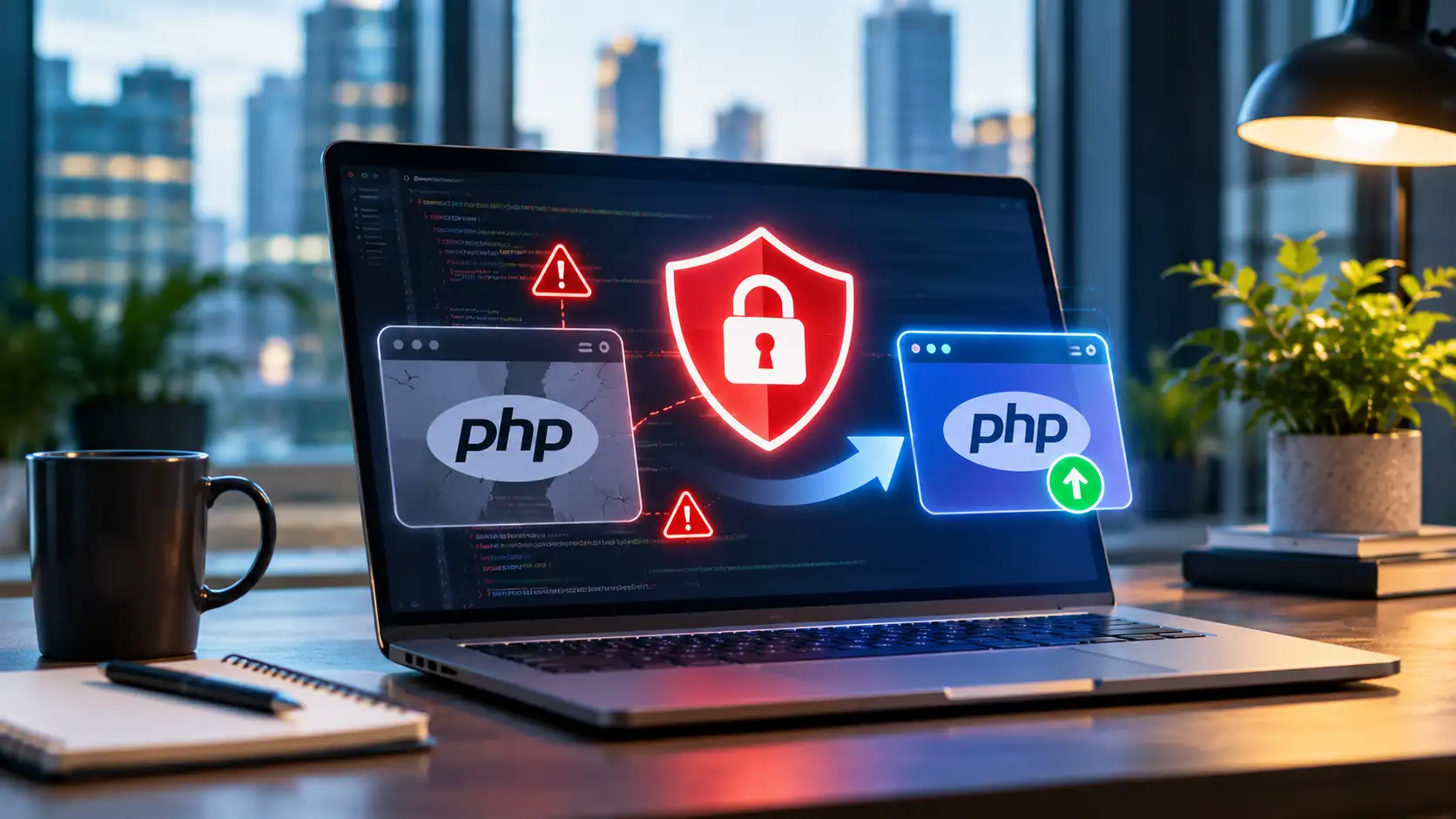
Legacy PHP applications remain deeply embedded in enterprise environments. They handle customer records, process transactions, manage authentication, and support operational workflows that businesses depend on daily. Because they continue to function, they are often left running on the same runtime version for years after that version has stopped receiving security updates.
That creates a risk profile that is easy to underestimate. An outdated PHP runtime does not automatically mean an application is compromised, but it does mean the underlying software no longer receives fixes for newly discovered vulnerabilities. When an application handles sensitive data, the gap between "still working" and "still supported" becomes a business risk that deserves a structured response.
Where that response involves legacy assessment, compatibility evaluation, migration planning, code modernization, security improvements, testing, and deployment support, Evalogical's PHP migration and application modernization services can help technology teams move from an unsupported runtime to a maintained one without treating the upgrade as a simple version swap. Upgrading PHP addresses the runtime layer, but it is only one part of application security -- code-level vulnerabilities, dependency health, framework support, and server configuration also require attention.
Why Running an Outdated PHP Version Can Become a Security Risk
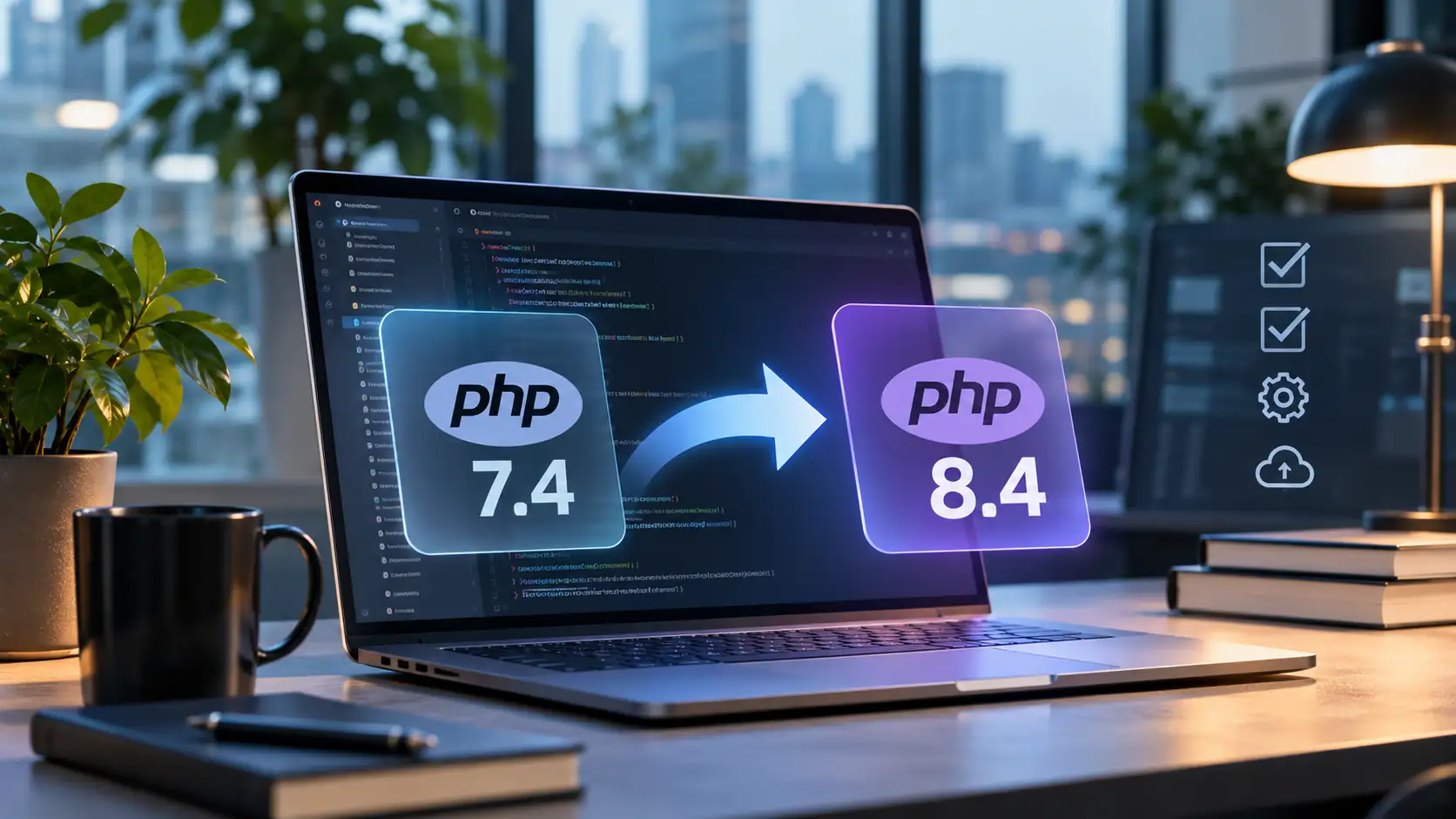
The PHP project publishes a clear support policy: each release branch receives two years of active support and two additional years of critical security fixes before reaching end of life. After that point, newly reported vulnerabilities are not patched in that branch. PHP 7.4 reached end of life on 28 November 2022 and has received no further security fixes since that date.
The practical consequence is cumulative. Research cited by HeroDevs found that an average end-of-life software image accumulates 218 new vulnerabilities every six months after support ends, and that vulnerabilities in end-of-life systems are four times more likely to be weaponized by attackers. The same analysis notes that nearly half of CISA's Known Exploited Vulnerabilities catalog is linked to end-of-service software. These are not abstract concerns; they describe the operational reality of running unpatched runtime software in production.
Outdated frameworks and third-party dependencies compound the problem. A framework that no longer supports PHP 8.x may itself be outside its security support window. Composer packages that were abandoned or pinned to PHP 7.x continue to carry known vulnerabilities that cannot be resolved without updating the runtime and the dependency chain.
Common Security Risks in Legacy PHP Applications
Unsupported PHP Versions
An unsupported runtime does not create vulnerabilities by itself, but it removes the mechanism for fixing them. When a CVE is reported in PHP, unsupported branches do not receive patches. Applications running on those branches must either absorb the exposure or isolate it through compensating controls that are rarely as effective as a supported runtime.
SQL Injection
SQL injection remains one of the most damaging application-level risks. It occurs when untrusted input is interpreted as part of a database query. Legacy code that concatenates strings into SQL, rather than using parameterized queries or prepared statements, can expose entire database tables to unauthorised reads or modification. OWASP classifies injection as a top application security risk, covering SQL, NoSQL, OS command, and LDAP injection. Upgrading PHP does not fix SQL injection; the vulnerable query pattern must be corrected in the application code.
Cross-Site Scripting (XSS)
XSS occurs when untrusted input is rendered into a page without proper output encoding, allowing malicious scripts to execute in a user's browser. Legacy applications often lack consistent output escaping, particularly in older templating or concatenated HTML output. As with SQL injection, this is an application-level issue, not a runtime issue. OWASP includes XSS under injection-related risks and recommends output encoding and content security policy as mitigations.
Insecure Authentication and Session Management
Weak password hashing, predictable session identifiers, missing session expiration, and insecure cookie attributes are common in older codebases. OWASP's authentication failures category covers broken identity, session, and credential handling. Modern PHP versions provide improved password hashing APIs and session configuration options, but the application must actually use them. A runtime upgrade alone does not retrofit secure authentication into legacy code.
Outdated Frameworks and Third-Party Dependencies
Frameworks and libraries have their own support lifecycles. A framework version that was current when the application was built may no longer receive security patches. Composer dependencies may have known CVEs with no fix available in the versions the application can install. Dependency health is a separate security dimension from PHP version, and it requires its own assessment.
Misconfigured Servers and Application Environments
Exposed configuration files, verbose error reporting in production, overly permissive file permissions, and debug modes left enabled are configuration risks that exist independently of the PHP version. Legacy deployments often accumulate configuration drift over time. A migration is an opportunity to review and harden these settings, but the review must be planned as part of the project rather than assumed.
The business impact of delayed modernization is not limited to the technical vulnerability itself. The distinction matters: a vulnerability is a weakness in code or configuration; a business consequence is what happens when that weakness is exploited or when the unsupported state constrains operations.
Continued use of an unsupported runtime increases exposure to security incidents because fixes are unavailable. It can create compliance and audit challenges where regulatory frameworks require supported software or timely patching. It increases maintenance complexity because dependencies fall further out of date, making future upgrades larger and riskier. It can limit integration with modern services that require current TLS libraries or runtime features. And it accumulates technical debt that eventually forces a larger, more expensive intervention.
None of these outcomes are guaranteed for every application. But they describe the direction of travel when an unsupported runtime remains in production without a remediation plan.
PHP Migration vs. PHP Upgrade - What Is the Difference?
The terms are often used interchangeably, but they describe different scopes of work.
A PHP upgrade changes the runtime version while retaining most of the existing application architecture, dependencies, and functionality. It is the minimum viable path from an unsupported branch to a supported one, and it still requires compatibility testing.
A PHP migration is broader. It may involve changing the PHP version, the hosting environment, the database driver, framework versions, dependency sets, or deployment architecture. Migration implies a transition across environments or platform components, not just a runtime swap.
PHP application modernization goes further again. It addresses architecture, code quality, security practices, integrations, and maintainability beyond version compatibility. A modernization initiative might refactor legacy patterns, replace abandoned dependencies, introduce automated testing, and improve observability -- work that a version upgrade alone does not cover.
The right approach depends on the condition of the application, its complexity, and the business requirements it supports. A small application with clean dependencies may only need an upgrade and testing. A large enterprise application with years of accumulated technical debt may need a structured migration or modernization programme.
How Much Does It Cost to Modernize or Migrate a Legacy PHP Application?
There is no reliable fixed price for PHP migration because cost is driven by scope. The factors that most influence effort include application size and complexity, the age and quality of the codebase, the number of third-party dependencies, framework and CMS compatibility constraints, database and integration requirements, security remediation needs, testing scope, hosting and infrastructure changes, and post-migration support.
PHP website upgrade cost and enterprise PHP migration cost can differ by orders of magnitude for these reasons. A focused application with strong test coverage and current dependencies is a different project from a decade-old custom platform with undocumented behaviour and multiple external integrations.
An initial technical assessment is the most reliable way to estimate effort and surface risks before committing to a budget. Assessment output -- dependency inventory, compatibility findings, integration mapping, test coverage gaps -- provides the basis for a realistic plan rather than a generic estimate.
How to Approach Legacy PHP Modernization Securely
A secure modernization effort follows a sequence that separates assessment from remediation and remediation from deployment.
- Assess the application and its security condition. Establish the runtime version, framework and dependency inventory, extension list, integration map, and test coverage baseline.
- Identify unsupported components. Determine which PHP versions, frameworks, libraries, and extensions are outside support and which have known unresolved vulnerabilities.
- Review application-level security risks. Examine code and configuration for injection, output encoding, authentication, session handling, and error disclosure issues that a runtime upgrade will not fix.
- Select a supported target version. Choose a PHP branch with a security support window that aligns with the organization's planning horizon. As of 2026, PHP 8.4 remains supported until 31 December 2028, and PHP 8.5 is also available with support extending to 2029.
- Plan the migration or upgrade strategy. Decide whether the work is a runtime upgrade, a broader migration, or a modernization programme, and sequence the changes accordingly.
- Update code, dependencies, and configuration. Remediate compatibility issues, update packages, and harden server and application configuration.
- Perform security, functional, and regression testing. Validate both the runtime behaviour and the security controls, including the vulnerabilities identified in the assessment.
- Deploy carefully and monitor. Use staged deployment, maintain rollback capability, and monitor error logs and application health after release.
This is a strategic sequence, not a substitute for the detailed compatibility work required for a specific PHP version transition.
How to Choose the Right PHP Migration Company
Selecting a PHP upgrade company is a diligence exercise. The relevant criteria include demonstrated experience with legacy PHP applications, PHP version compatibility expertise across the branches involved, understanding of application security beyond runtime versioning, experience with the frameworks and dependency ecosystems in use, testing and quality assurance capability, migration planning and rollback methodology, and post-migration maintenance and support arrangements.
A partner that treats migration as a version-flag change is not equipped for a legacy environment. The right partner will want to assess the application before quoting, will distinguish runtime upgrades from application-level remediation, and will plan testing and rollback as part of the engagement rather than as optional extras.
Final Thoughts - Why Legacy PHP Modernization Should Be a Business Priority
Upgrading an unsupported PHP version is an important step, but it is not a complete security strategy. The runtime, the application code, the dependency chain, the framework, and the server configuration are separate layers of risk, and each requires its own attention. An application that moves to PHP 8.4 but retains SQL injection patterns, abandoned dependencies, and permissive server configuration has improved its runtime support posture without resolving its application security posture.
A structured modernization assessment identifies all of these layers, sequences the work, and gives the business a realistic view of effort and risk. If your organization is running a legacy PHP application and needs to understand the migration path, Evalogical's application modernization and PHP migration capabilities can support assessment, planning, code remediation, security improvement, testing, and deployment.
Frequently Asked Questions
Q: What are the security risks of using an outdated PHP version?
A: An outdated PHP branch no longer receives fixes for newly reported vulnerabilities. Known flaws remain unpatched, and the runtime may lack modern security features required by current libraries. The risk is compounded when outdated dependencies and frameworks are also in use.
Q: Is PHP 7.4 still supported?
A: No. PHP 7.4 reached end of life on 28 November 2022 and has received no security fixes since that date. Running it in production means running unpatched runtime software.
Q: Can upgrading PHP fix existing application security vulnerabilities?
A: No. Upgrading PHP changes the runtime. SQL injection, XSS, insecure authentication, and configuration weaknesses exist in application code and settings. They must be remediated separately. A runtime upgrade is necessary but not sufficient for application security.
Q: What is the difference between PHP migration and PHP upgrade?
A: A PHP upgrade changes the runtime version while retaining most of the existing architecture. A PHP migration is broader and may include changes to hosting, dependencies, frameworks, or application components. Migration generally involves more planning and testing than a runtime upgrade.
Q: How much does PHP application migration cost?
A: Cost depends on application size, codebase quality, dependency count, framework constraints, integration requirements, security remediation scope, testing needs, and infrastructure changes. There is no reliable fixed price; an initial technical assessment is the appropriate way to estimate effort.
Q: When should a business modernize its legacy PHP application?
A: When the runtime or framework is outside security support, when dependencies can no longer be updated safely, when integration with current services is constrained, or when accumulated technical debt makes routine maintenance disproportionately expensive. A structured assessment can determine whether an upgrade, migration, or broader modernization is the right scope.
Q: How do I choose the right PHP migration company?
A: Evaluate experience with legacy PHP environments, version compatibility expertise, application security capability, framework and dependency knowledge, testing and QA maturity, migration planning and rollback methodology, and post-migration support. A partner should assess before quoting and should distinguish runtime upgrades from application-level remediation.


 How to Upgrade PHP 7.4 to PHP ....
 Creatio No-Code Platform: What....
 CRM Migration: Why Process Red....
 Is Salesforce to Creatio Migra....
 What Is Creatio CRM? A Practic....

Your Trusted Software Development Company