

AI-Powered Churn Prediction: From Reactive Renewal to Proactive Retention
Published by: Abhilash AnandanAug 17, 2026Blog
The Cost of Discovering Churn Too Late
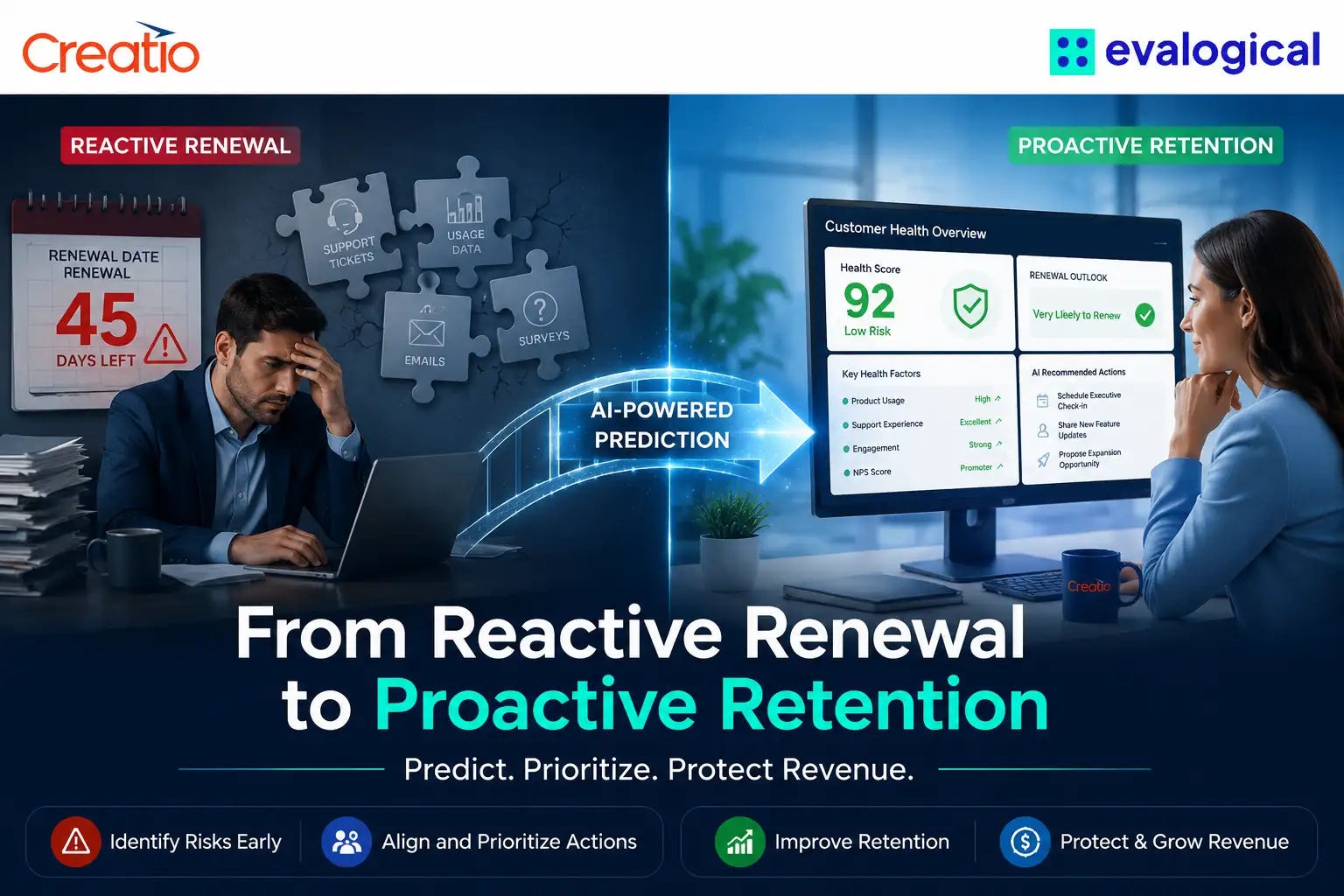
A customer success manager opens an account record. The renewal is due in 45 days. There are two unresolved service cases. No executive has spoken with the account in the past 60 days. A new COO has just announced a member experience improvement initiative.
The account is at high risk of churning--and the team is only discovering it now. This scenario plays out in organisations every day. Customer churn becomes visible only when the renewal conversation is already approaching. By then, customer success teams have limited time to investigate the underlying causes, engage the right stakeholders, resolve
service problems or build a retention strategy. The business problem is fundamentally reactive customer retention management. A more proactive model combines customer signals, renewal context, and operational data so teams can identify risk earlier and decide where intervention is most valuable. AI-powered churn prediction addresses this challenge by surfacing risk signals earlier--combining account activity, renewal context, service cases, engagement patterns, and account changes into a single, actionable risk view. Platforms such as Creatio are increasingly built to support this shift: Creatio.ai, Creatio's native AI layer, can analyze account behavior and engagement in real time and flag customers at risk of churning, giving teams the same kind of consolidated view described throughout this article. The goal is not simply to predict which accounts might leave. It is to help sales and customer success teams intervene before the renewal conversation becomes a last-minute recovery effort. Done well, this shift shows up directly in the metrics that matter to the business: fewer customers leaving, and more revenue retained and expanded from the accounts that stay. We look at how to measure that impact directly later in this article.
This article explores how organizations can move from reactive renewal management to proactive, signal-driven retention--how AI-powered CRM capabilities in Creatio can support that transformation, and how an implementation partner like Evalogical helps put these capabilities to work.
Why Reactive Churn Management Is No Longer Enough
The Problem with Reactive Renewal
Traditional customer retention relies heavily on relationship management. Customer success managers build personal connections with their accounts, and those relationships often serve as the primary early warning system for potential churn. But relationship-led management has significant limitations. Different CSMs may interpret signals differently. Important information can exist across multiple touchpoints--account activity, renewal information, opportunities, service cases, engagement metrics, and account changes--without being consolidated into a single view. The result? Churn risk is identified too late to intervene effectively.
TSIA's 2026 customer growth and renewal research highlights a shift toward profitable growth, net revenue retention (NRR), unified revenue operations, and "human-on-the-loop" approaches to AI-assisted renewal and risk management. (Source: TSIA, "The State of Customer Growth & Renewal 2026")
Relationship Management Isn't Enough
Experience is valuable. Seasoned CSMs often develop strong instincts about which accounts are healthy and which are at risk. But relying on individual judgment alone creates challenges. Different CSMs apply different criteria. One might priorities relationship warmth, while another emphasises product usage, and a third focuses on executive engagement. These variations make it difficult to maintain consistent risk assessment across a portfolio.
The Hidden Cost of Fragmented Account Context
- Late risk identification -- teams discover account risk too close to renewal to take meaningful action.
- Fragmented context -- important information exists across account activity, renewal information, opportunities, service cases, engagement, and account changes.
- Reactive renewal management -- renewal teams respond to visible problems rather than proactively addressing emerging risk.
- Cross-functional visibility gaps -- sales and customer success lack a shared view of account risk.
- Difficulty understanding why an account is at risk -- a risk score is more useful when accompanied by the underlying signals and recommended action
What Customer Churn Signals Should Teams Monitor?
Effective churn prediction starts with understanding the signals that indicate account risk. While every business has unique risk indicators, several categories of signals are consistently valuable.
Unresolved Service Issues
Service problems can become relationship risks. When customers experience issues that aren't resolved promptly, their confidence in the relationship erodes. The impact is particularly acute when service issues persist as renewal approaches.In the Lakeside scenario, two unresolved cases related to online banking support delays contributed to a high-risk assessment for an account app
Service signals to monitor include:
- Open case count and ageing
- Case severity and priority
- Case resolution time trends
- Customer satisfaction with service interactions
- Escalation patterns
- Declining Engagement
Engagement changes provide critical context for account health. When engagement declines--particularly at the executive level--it often signals shifting priorities, dissatisfaction, or reduced strategic alignment. In the Lakeside scenario, "no executive touchpoint in the last 60 days" was identified as a contributing risk
Engagement signals to monitor include:
- Executive meeting frequency
- Overall meeting cadence
- Response rates to outreach
- Content consumption patterns
- Event attendance
- Website activity from the account domain
- Account Changes and Organisational Signals
Organisational changes can significantly affect customer priorities and renewal likelihood. New leadership may introduce new strategic initiatives that shift priorities away from your solution. Mergers, acquisitions, or restructuring can create uncertainty and change decision-making processes. In the Lakeside scenario, a newly announced COO initiative to improve member experience served as a risk signal, suggesting that the account's priorities were shifting in ways that could affect renewal.
- Account change signals to monitor include:
- Executive leadership changes
- Strategic initiative announcements
- Mergers and acquisitions
- Restructuring or reorganization
- Hiring patterns in relevant functions
- Financial performance changes
- How AI Churn Prediction Turns Signals Into Account Risk Intelligence
- The Lakeside scenario illustrates this progression:
Account data is consolidated -- account activity, renewal context, opportunities, service cases, engagement, and account changes are brought together.
- AI identifies signals -- the system highlights unresolved cases, declining engagement, account changes, and other risk indicators.
- Risk is scored -- the account receives a risk level (High, Medium, Low) based on the combination of signals.
- Context is provided -- renewal timing, service issues, engagement patterns, and account changes are surfaced alongside the risk score.
- Recommendations are made -- suggested next steps help teams move from analysis to action.
- AI Capabilities for Churn Prediction
- In Creatio, several native Creatio.ai capabilities support a churn-prediction strategy:
- Account and contact insights -- Creatio.ai provides a comprehensive view of each account, combining firmographic information, engagement history, relationship mapping, and stakeholder identification.
- Opportunity summarization -- concise context for open opportunities, including deal stage, key risks, stakeholder engagement, and next steps.
- Activity summarization -- reduces the cognitive load on CSMs by providing concise overviews of account engagement, relationship health, and recent interactions.
External account signals -- such as news, leadership changes, or job postings can be incorporated where the implementation and available data sources support it.
Case context retrieval -- surfaces service case information alongside account context, helping teams understand how service issues may be affecting account health.
- • Custom churn-risk logic -- configured around the signals that are relevant to the organisation's business model and customer base; the exact implementation depends on the data, model, and workflow design chosen during configuration (see Creatio's predictive scoring documentation).
- Recommended next steps -- connect risk identification to action, helping teams translate signals into practical retention activities.
- The Role of CRM in Proactive Customer Retention
- AI-powered churn prediction doesn't exist in isolation. It depends on a CRM foundation that can consolidate account context and support cross-functional collaboration. This is where Creatio's role as the underlying platform matters: the AI signals are only as good as the account data model, workflow configuration, and process design built on top of it.
- Consolidating Account Context
- Consolidate account activity, renewal context, and open opportunities into one risk view.
Provide a shared view of account risk.
- Highlight signals such as unresolved cases, declining engagement, delayed follow-ups, and negative account changes.
- Summarise the key reasons an account may be at risk before the renewal conversation.
- Suggest practical retention actions.
- Help sales and customer success teams intervene earlier.
- Creating a Shared Sales and Customer Success View
- Earlier intervention -- both teams can see risk signals as they emerge, rather than discovering them at different times.
- Coordinated action -- sales and customer success can align on retention strategies and account coverage.
- Consistent messaging -- both teams understand the account situation and can communicate accordingly.
- Better resource allocation -- teams can prioritise at-risk accounts for appropriate attention.
From Churn Prediction to Recommended Retention Actions
Many organisations can identify at-risk accounts. Fewer can translate that identification into effective intervention. The gap between knowing an account is at risk and taking action to retain it is where value is created--or lost.
Actionable Recommendations
- In this scenario, the workflow supports three specific actions:
- Create Retention Plan -- develop a structured plan for retaining the account.
- Draft Executive Email -- prepare outreach to the account's executive leadership.
- View Open Cases -- review and address service issues contributing to risk.
- These actions represent a shift from passive risk monitoring to active retention management. Rather than simply knowing an account is at risk, the team has clear next steps.
Measuring the Business Impact of AI Churn Prediction
AI churn prediction should deliver measurable business outcomes. Two metrics should sit at the center of any churn-prediction initiative, with several supporting metrics providing additional visibility into effectiveness.
How to Build an AI-Driven Churn Prediction Strategy
Implementing AI-driven churn prediction requires more than technology. It requires a clear strategy that connects business outcomes to signals, workflows, and measurement -- and, in Evalogical's experience, requires real decisions about data quality, ownership, and adoption well before any model or scoring logic is switched on.
Start With Business Outcomes
- Reducing customer churn by a specific percentage
- Improving net revenue retention
- Identifying risk earlier in the renewal cycle
- Increasing renewal rates for strategic accounts
- Reducing time-to-intervention for at-risk accounts
- Identify Relevant Churn Signals
- Determine which signals matter most for your business. While the Lakeside scenario highlights service issues, engagement declines, and account changes as key signals, your organisation may have additional or different indicators.
- Service signals: open cases, resolution time, satisfaction
- Engagement signals: meeting frequency, executive touch, response rates
- Account signals: leadership changes, strategic shifts, financial performance
- Renewal signals: timing, intent indicators, competitive pressure
- Activity signals: usage patterns, adoption metrics, support interactions
- Opportunity signals: pipeline health, expansion potential
AI Churn Prediction in Action -- The Lakeside Example
The Lakeside scenario is an illustrative composite, not a single named customer, used throughout this article to make the concepts concrete. It shows how the ideas discussed above can work together in an AI-supported Creatio workflow.
The Account Situation
Account: Lakeside
- Risk Level: High
- Renewal Due: 45 days
- Service Signal: Two unresolved cases related to online banking support delays
- Engagement Signal: No executive touchpoint in the last 60 days
- Account Change: New COO announced a member experience improvement initiative
The AI Risk Review
- Risk is identified -- the account is flagged as high risk.
- Renewal context is provided -- the 45-day renewal window is visible.
- Service issues are surfaced -- two unresolved cases are highlighted.
- Engagement declines are noted -- no executive touchpoint in 60 days.
- Account changes are flagged -- the new COO and strategic initiative are surfaced.
What to Look for in an AI CRM for Churn Prediction
Key Capabilities to Evaluate
Account Insights
- The system should provide a comprehensive view of each account, including firmographic information, engagement history, relationship mapping, and stakeholder identification.
- Activity Summarization
- CSMs should be able to quickly assess account status without digging through extensive activity histories.
- Opportunity Summarization
- The system should provide concise context for open opportunities, including deal stage, key risks, and next steps.
- Case Context Retrieval
- Service case information should be surfaced alongside account context, helping teams understand how service issues may be affecting account health.
- Account News and Signals
The system should monitor for external signals--news coverage, press releases, job postings--that may indicate changing account conditions, where the implementation and available data sources support it.
Custom Churn Signal Detection
Organisations should be able to define and monitor signals specific to their business model and customer base
Common Challenges When Implementing AI Churn Prediction
AI recommendations are only as good as the data they're built on. Incomplete or inaccurate data can produce misleading risk signals. In practice, this is the most common reason a churn-prediction rollout stalls -- not the AI model itself, but inconsistent case-logging, missing meeting records, or account fields that were never kept current.
Addressing the challenge:
- Audit account data completeness and accuracy
- Implement data enrichment to fill gaps
- Establish data governance processes
- Cleanse and standardize existing data
False Positives
- AI systems may flag accounts as at risk when they're actually healthy. Too many false positives can lead to alert fatigue and reduced trust in the system.
- Addressing the challenge:
- Validate signals against actual outcomes
- Refine risk thresholds based on business context
- Incorporate human review of risk assessments
- Continuously evaluate and improve the risk model
Alert Fatigue
CSMs may receive too many risk alerts, leading to desensitization and reduced response.
Addressing the challenge:
- Prioritize alerts based on risk severity and urgency
- Provide context that helps CSMs understand which alerts matter most
- Allow CSMs to customize alert preferences
- Review alert volume and adjust thresholds
Lack of Explainability
If risk assessments cannot be explained, CSMs may not trust them. This is one of the most common adoption blockers Evalogical sees: a risk score that appears without visible reasoning tends to get ignored within a few weeks, regardless of how accurate it is.
Addressing the challenge:
- Surface the signals behind each risk assessment
- Provide visibility into weighting and methodology
- Allow for review and adjustment of risk assessments
- Offer training on the model and its outputs
Inconsistent Processes
Without clear processes for responding to risk alerts, even the best predictions won't produce results.
Addressing the challenge:
Define response workflows for different risk levels
- Assign ownership for risk response
- Track follow-through on recommended actions
- Continuously improve processes based on outcomes
- Over-Reliance on AI
- AI recommendations should support--not replace--human judgment.
- Treat recommendations as decision support
- Allow for override based on additional context
Continuously evaluate recommendation quality
Maintain human oversight of risk decisions
The Future of Proactive Customer Retention
Looking ahead, several trends are shaping the evolution of AI-driven customer retention.
From Reactive to Predictive Retention
Organizations are moving from responding to churn as it happens to predicting and preventing it. This shift requires a combination of better data, more sophisticated AI, and more effective action workflows.
TSIA's 2026 customer growth research indicates that the future of renewal management lies in NRR expansion, unified revenue operations, and human-on-the-loop AI approaches. (Source: TSIA, "The State of Customer Growth & Renewal 2026")
From Static Health Scores to Dynamic Risk Signals
Traditional customer health scores provide a snapshot of account health at a point in time. Dynamic risk signals provide continuous visibility into changing account
The shift from static scoring to dynamic signalling enables more responsive retention strategies and earlier intervention.
From Siloed to Cross-Functional Retention
Retention is becoming a cross-functional revenue discipline rather than solely a customer success responsibility. Sales, service, and revenue operations all have roles to play. The Lakeside example reinforces this trend by showing a shared risk
From Prediction to Action
The most significant evolution is the shift from prediction to action. Organizations are moving beyond simply identifying at-risk accounts to providing actionable recommendations for retention.
The Lakeside example demonstrates this evolution: risk identification is connected to recommended actions, creating a clear path from awareness to intervention.
Frequently Asked Questions
Q: What is AI churn prediction?
AI churn prediction uses artificial intelligence to analyze account data and signals, helping sales and customer success teams identify which accounts are at risk of churning and why.
Q: What customer signals can indicate churn risk?
Common signals include unresolved service issues, declining engagement, account changes (such as new leadership or strategic shifts), renewal timing, and activity patterns.
Q: How does CRM support churn prediction?
CRM provides the account context needed for churn prediction, including account activity, renewal information, opportunities, service cases, engagement history, and account changes. In Creatio, this context is combined with Creatio.ai's predictive capabilities to surface risk signals directly inside the account record.
Q: Does churn prediction require a specific CRM platform?
No single platform is required, but the underlying CRM needs to consolidate account, service, and engagement data in one place for AI-driven risk scoring to work well. Creatio's Creatio.ai capabilities are built to support this natively; organizations on other platforms can achieve similar outcomes with the right data model and integrations.
Q: How can AI help customer success teams?
AI helps customer success teams by surfacing risk signals earlier, providing context for why an account is at risk, and recommending practical retention actions.
Q: What is the role of renewal timing in churn prediction?
Renewal timing provides critical context for risk assessment. The closer an account gets to renewal without clear indicators of renewal intent, the more attention it deserves.
Q: How should companies measure AI-driven retention programs?
Key metrics include churn rate, renewal rate, net revenue retention (NRR), gross revenue retention (GRR), time-to-intervention, and at-risk account coverage.
Q: Can churn prediction replace customer success managers?
No. Churn prediction is designed to augment--not replace--customer success managers. The goal is to provide CSMs with better intelligence and recommendations, enabling them to be more effective in their roles.
Q: How accurate is AI churn prediction?
Accuracy depends on data quality, signal selection, and model sophistication. Organizations should validate predictions against actual outcomes and continuously refine their models.
Conclusion
Customer churn often becomes visible only when it's too late to intervene effectively. The renewal conversation arrives, and the team discovers that service issues, engagement declines, and account changes have been building for months.
AI-powered churn prediction addresses this challenge by surfacing risk signals earlier--combining account activity, renewal context, service cases, engagement patterns, and account changes into a single, actionable risk view. In Creatio, this is largely a configuration and adoption challenge rather than a technology gap: the underlying Creatio.ai capabilities exist, and the work is in deciding which signals matter for your business, connecting them into a shared view, and building the response workflows that turn a risk score into a real intervention.
That configuration and adoption work is where Evalogical typically partners with organizations already running, or evaluating, Creatio -- from initial signal selection and data readiness through to rollout, CSM training, and ongoing governance as the risk model
 What Is Creatio CRM? A Practic....
 Salesforce vs. Creatio: Which ....
 How AI Improves Field Sales Pl....
 How Malaysian Enterprises Can ....
 The 2027 Guide to BNM RMiT Com....



Your Trusted Software Development Company