Insurance 2.0: Scaling Claims Processing for 500+ Employee Firms in Malaysia
Published by: Gautham Krishna RMay 07, 2026Blog
The Scaling Ceiling in Claims Processing
Malaysian insurance firms scaling past 500 employees hit a processing wall. The early days of growth are forgiving. A small claims team handles a manageable volume, spreadsheets suffice, and manual handoffs work well enough. But somewhere around the 500-employee mark, the machinery starts to seize. Claims volumes multiply. Adjusters drown in administrative work, policyholders wait longer, and the backlog becomes a permanent fixture on the quarterly dashboard.
This isn't a manpower problem. The reality is that 60 percent of operational costs in claims adjudication are still driven by manual processing, with fragmented data systems and siloed legacy platforms creating pervasive agility bottlenecks. Manual claims handling consumes time, introduces errors, and actively erodes the customer trust that insurance depends on. For larger firms, each inefficiency scales disastrously.
The data shows the scale of the gap. Despite rapid digital expansion, many insurers still rely heavily on manual processing across claims adjudication, underwriting, and policy servicing. Only 45 percent of insurers currently use AI-driven analytics in underwriting, and the industry continues to struggle with data quality, governance, and system integration. Enterprise-level architecture remains the missing piece. As Deloitte's research highlighted, organizations often ignore the infrastructure required to support AI at scale--which is why 85-90 percent of AI initiatives stall at the proof-of-concept stage without reaching production.
For a 500+ employee insurer operating in the Malaysian market, that gap between pilot and production is the difference between staying competitive and falling permanently behind.
Service Creatio: Automating the Triage Phase
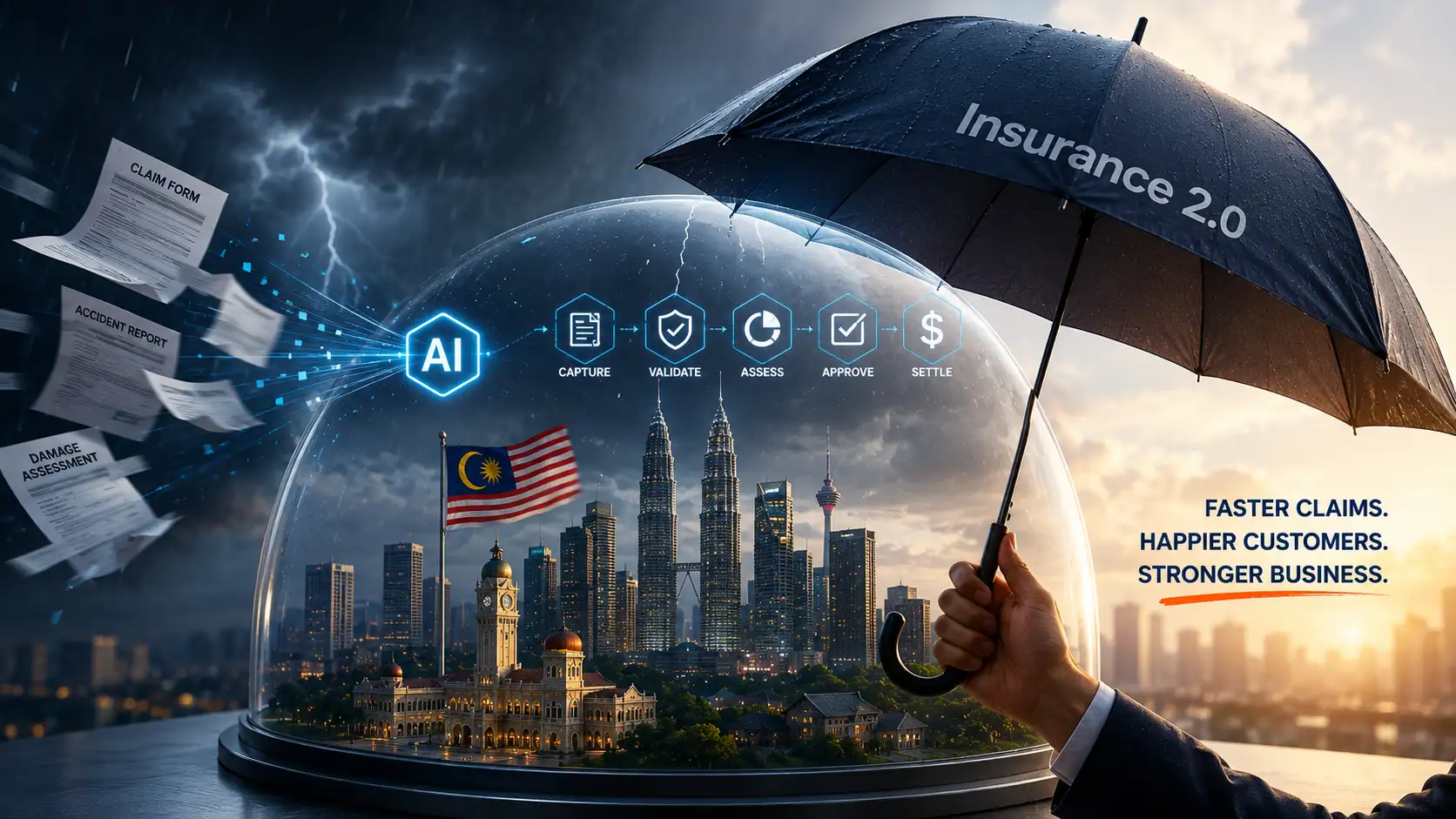
Claims processing automation isn't a single product--it's an orchestration layer. modern workflow orchestration platforms unify the intake, validation, fraud detection, adjudication, and settlement stages into a single, auditable pipeline, powered by AI agents embedded directly into processes .
Creatio's Service Creatio application is designed for this specific challenge. The platform includes pre-built processes based on industry best practices, featuring a unified service desk that consolidates every customer interaction channel--email, phone, web portals, and field reports--into a single queue. Instead of adjusters toggling between fragmented systems, all requests, escalations, and supporting documentation sit in one centralized hub. Route the claim to the right specialist automatically. Track resolution SLA in real time. Escalate overdue tasks without manual intervention.
What does that actually change for the claims handler? An adjuster at a mid-sized firm in the Klang Valley currently spends an estimated 40 percent of their time on administrative tasks like data entry, document retrieval, and status tracking--time drained away from actual decision-making. With an orchestrated workflow, that administrative drag largely disappears. First Notice of Loss is captured digitally. Field reports and supporting documents are automatically appended. Fraud and risk assessment runs in the background using AI models. The adjuster sees a complete, validated case file and focuses exclusively on the judgment that requires human expertise.
The numbers from adjacent markets illustrate what's possible: a case study from an insurer implementing low-code automation increased its self-service capabilities by 20 and achieved a 25 percent increase in applications, directly impacting both customer experience and operational efficiency. For a 500+ employee firm in Malaysia, those kinds of returns translate directly to faster settlement times, lower loss adjustment expenses, and policyholders who don't feel the need to chase for updates.
Bank Negara Malaysia (BNM) Compliance Workflows
Speed in claims processing is worthless if it fails regulatory scrutiny. And in Malaysia, the scrutiny has intensified. BNM has explicitly warned insurers and takaful operators that medical claims must be handled on a fair and timely basis and that companies cannot unreasonably delay claims or enforce terms that were never disclosed to policyholders.
The operational implication is straightforward: every delay, every manual bottleneck, every lost document is now a potential regulatory action. For a growing firm, the risk multiplies across thousands of open claims. The only sustainable defense is not to rely on humans to remember the rules. Embed the rules directly into the workflow.
This is where no-code compliance automation becomes a strategic necessity. On Service Creatio, BNM's fair-settlement obligations can be configured as automated guardrails within the claims process. Escalate any pending resolution that exceeds internal service standards. Flag incomplete documentation before the claim proceeds. Log every approval, every status change, and every stakeholder communication in a tamper-evident audit trail.
The regulatory environment in Malaysia continues to tighten. BNM's Risk Management in Technology (RMiT) policy, updated in November 2025, now mandates a shift from compliance-based oversight to proactive, risk-informed resilience. Institutions must adopt zero-trust architecture principles, and the board bears explicit responsibility for approving cybersecurity strategic plans and engaging directly in cyber drills. When an insurer's claims system maintains real-time, auditable records of every decision point, it isn't just an operational efficiency--it's audit insurance.
Breaking the Ceiling
The scaling ceiling isn't a natural law of insurance growth. It's a consequence of legacy architectures that treat claims processing as a series of disconnected handoffs rather than an intelligent, orchestrated whole.
For Malaysian insurers with 500+ employees, the path through that ceiling now exists. Service Creatio provides the orchestration layer that unifies intake, validation, triage, and settlement on a single no-code platform--with compliance guardrails built directly into the workflow. By automating the triage phase, eliminating administrative drag, and embedding BNM's fair-settlement requirements directly into the process, firms can process higher volumes without scaling headcount linearly.
The 1,000-employee firms aren't smarter than the 500-employee firms. They simply stopped accepting manual friction as inevitable.
FAQs
Q: When do insurance firms typically hit the limits of manual processing?
A: Most insurers start feeling operational strain around the 300-500 employee mark. Claims volumes grow faster than manual workflows can handle, systems become fragmented, and adjusters spend a large portion of time on administrative work instead of decision-making. In markets like Malaysia, regulatory frameworks such as BNM's DITO make scaling without automation increasingly difficult.
Q: How does Creatio reduce manual claims work without replacing adjusters?
A: Creatio streamlines the entire triage process--digitizing First Notice of Loss, validating policy data automatically, running background fraud checks, and routing claims to the right specialist. This allows adjusters to focus on complex decisions rather than repetitive admin tasks.
Q: What BNM requirements can be built into no-code claims workflows?
A: Key compliance requirements--such as timely claim settlement, fair processing, and full transparency--can be embedded directly into workflows. Automation can trigger escalations for delays, flag incomplete documentation, and maintain secure, auditable records for every decision.
Q: Do we need to replace our core insurance system to implement this?
A: No. Platforms like Creatio are designed to integrate with existing policy and claims systems, acting as an orchestration layer without requiring a full system overhaul.
Q: Can business teams configure claims workflows without IT support?
A: Yes. With no-code tools, business analysts can design workflows, update approval rules, and embed compliance logic using visual interfaces--reducing reliance on development teams.
Q: How are data residency and compliance handled for Malaysian insurers?
A: Enterprise platforms support secure, in-country deployments along with role-based access, audit logging, and data localization. This helps insurers align with BNM technology risk guidelines and maintain regulatory compliance.
Q: Can Evalogical support claims automation for large insurance firms?
A: Yes. Evalogical helps insurers evaluate, implement, and scale no-code automation solutions tailored to high-volume claims environments. Their expertise supports everything from workflow design to enterprise rollout for Enterprise CRM for 500+ employees.
Q: How should a large insurer get started with claims automation?
A: Begin with a workflow audit to identify high-friction claim types like motor, medical, or travel. Launch a focused pilot--such as automating triage and document collection--measure efficiency gains, and then scale across operations with expert support from partners like Evalogical.
The 500-employee ceiling isn't permanent. It's a legacy architecture problem that no-code workflow orchestration finally solves. By automating triage, embedding BNM compliance guardrails, and unifying fragmented data, Service Creatio helps Malaysian insurers process claims faster, settle policies more fairly, and grow past the manual bottleneck.



 Salesforce vs. Creatio: Which ....
 How AI Improves Field Sales Pl....
 How Malaysian Enterprises Can ....
 The 2027 Guide to BNM RMiT Com....
 AI-Powered Account Planning: T....



Your Trusted Software Development Company