Optimizing Indonesian Supply Chains with AI-Powered Workflow Agents
Published by: Gautham Krishna RMay 13, 2026Blog
The numbers are staggering. Indonesia's logistics costs currently stand at 14.2% of GDP -- and when export logistics components are included, total costs climb to a staggering 23.08% of GDP. To put that in perspective, developed economies average 8-10%, and many ASEAN neighbors operate significantly leaner supply chains. Kadin, Indonesia's Chamber of Commerce and Industry, puts the gap even starker: "our logistics costs are still at 17 percent higher than the Asian average" . For every rupiah moving through the supply chain, a substantial portion is burning on inefficiency rather than profit.
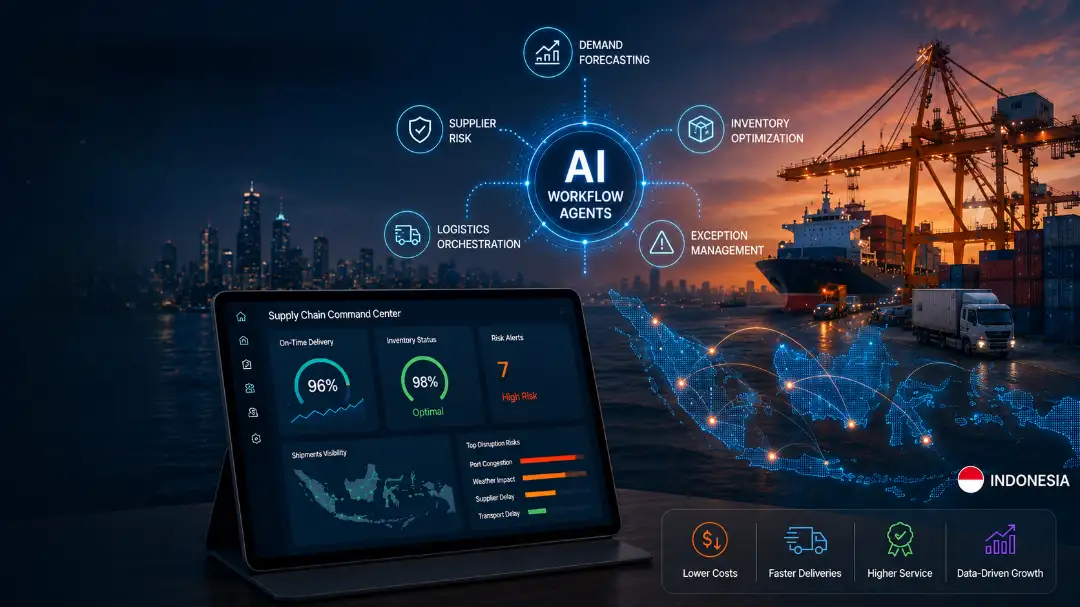
Navigating Indonesia's complex logistical landscape requires more than static tracking. Traditional rule-based systems -- processing just 10-20 constraints against networks now generating 180-250+ real-time variables per hour -- are failing. AI-powered workflows provide proactive supply chain resilience. And the platform enabling this transformation is Creatio, now deeply embedded in Indonesia's digital transformation ecosystem through strategic partnerships with PT Mastersystem Infotama Tbk and PT Metrodata Electronics Tbk, with a Jakarta-based data center ensuring data sovereignty and compliance. In 2026, managing supply chains without agentic AI is no longer a technology gap -- it's a competitive liability with a direct, measurable impact on EBITDA.
Logistical Complexities in SE Asia
Understanding why Indonesian supply chains bleed margin requires looking at the structural factors, not just the surface symptoms. High logistics costs have long been driven by several interconnected challenges: fragmented infrastructure where clearance time differences between major ports like Tanjung Priok in Jakarta, Tanjung Perak in Surabaya, and Belawan in Medan create unpredictable lead times; over-reliance on major ports creates bottlenecks; weak interregional connectivity drives up last-mile costs; inadequate modern storage facilities force companies into expensive spot warehousing; and bureaucratic complexities in import-export add layers of administrative drag.
Kadin's 2025 National Leadership Meeting identified these as "structural issues that require concrete solutions," ranking supply chain inefficiency alongside labor mismatches and AI disruption as the top threats to Indonesia's industrial competitiveness. For enterprise COOs, the gap between available technology and actual execution is the biggest pain point. Indonesia's business community is acutely aware of the need for AI-driven solutions, with Kadin itself reshaping its internal processes to be "30 percent human-led, 70 percent tech-enabled".
The cost of doing nothing is mounting. Logistics costs are squeezing industrial productivity, with Kadin noting that "industrial productivity has yet to reach the next level". Meanwhile, global competitors are adopting AI-native supply chains that detect disruptions and reroute in real time. Indonesia's reliance on legacy systems places it at a structural disadvantage -- one that the Chamber of Commerce is actively urging businesses to close.
AI Orchestration for Routing and Inventory
The transition from static tracking to proactive orchestration represents a generational leap in supply chain capability. Traditional rule-based routing engines -- the kind still embedded in ERP-native TMS modules -- follow if/then logic processed in overnight batches. They cannot learn from outcomes or adapt to real-time disruptions, and they typically handleonly 10-20 simultaneous constraints. Performance degrades 15-25% during disruptions because the system simply cannot recompute dynamically. Twenty to thirty-five percent of fleet capacity goes underutilized daily under manual planning, and manual route replanning takes 4-8 hours for what advanced AI computes in minutes.
Agentic AI changes the operating model entirely. Agentic systems do not just suggest routes -- they autonomously decide, dispatch, and adapt across every mile, carrier, and constraint in real time. Instead of reacting to disruptions after they happen, an agentic workflow reasons against business constraints, makes decisions, and executes actions without waiting for human instruction. A logistics agent can detect a tier-two supplier failure at 2 AM, cross-reference alternative vetted sources, and initiate a purchase order by morning. It can recalculate shipping routes mid-journey, update delivery ETAs in the CRM, and notify customers -- all without manual intervention.
For Indonesian enterprises, the implications are profound. A multicarrier logistics network spanning thousands of islands generates variables -- road conditions, port clearance times, weather disruptions, fuel price fluctuations -- that no human team could optimize manually. Project44's research notes that by combining brute-force processing power with analyst expertise, agentic workflows transform fragmented data into actionable roadmaps for global supply chains.
Inventory orchestration follows the same logic. Instead of safety stock padded against unknown variability, AI agents can predict demand based on real-time sales data, supplier lead times, and production schedules. When a raw material shortage is detected, the agent automatically triggers reorder workflows, adjusts production forecasts, and notifies downstream partners. In an Indonesian manufacturing context, where JIT practices are often impossible due to infrastructure variability, this kind of predictive orchestration is not an efficiency gain -- it's a survival tool.
Creatio is bringing this capability to Indonesia through strategic partnerships with PT Mastersystem Infotama Tbk and PT Metrodata Electronics Tbk (MII). MII's President Director noted: "Partnering with Creatio is a strategic step to bring innovative and flexible business automation solutions to Indonesian companies. With Creatio's composable no-code platform, we provide businesses with the freedom to design and manage their automation according to their needs, without technical constraints".
Mastersystem, which dominates enterprise banking, oil and gas, and telecommunications in Indonesia, is leveraging Creatio's no-code platform to enhance operational efficiency and drive digital transformation across these sectors. For COOs evaluating supply chain automation, this means the implementation partner is not a theoretical option -- it's an established entity with decades of integration experience in Indonesia's most demanding industries. Recognizing this opportunity, Creatio has strategically expanded its local footprint. This was further cemented by the launch of a Jakarta-based data center hosted on AWS, which enhances software performance and allows businesses to keep their data local while leveraging the flexibility of the public cloud.
The financial math is measurable. A Locus guide for CXOs estimates that AI-powered route optimization (10-15% savings), carrier allocation optimization (5-10%), and fleet utilization recovery (5-8%) combine for 25-30%+ total logistics cost reduction at enterprise scale. For an Indonesian distributor moving millions of units annually, these are not marginal improvements -- they are margin-restoring transformations.
OJK Regulations and Enterprise Data Security
Any COO implementing supply chain automation must navigate Indonesia's increasingly stringent data protection and cybersecurity regulations. The regulatory environment in 2026 demands that digital supply chains be architected with compliance as a core feature, not an afterthought.
The Otoritas Jasa Keuangan (OJK) has been active. Regulation No. 34 of 2025 governs IT implementation for rural banks (BPR and BPR Syariah), mandating strict cyber resilience and data localization requirements -- including mandatory disaster recovery plans and data center placement within Indonesian territory. In August 2025, OJK launched new Cyber Security Guidelines for Digital Financial Asset Trading Operators, strengthening integrity and resilience in financial ecosystems. For supply chains intersecting with financial services -- supplier financing, trade credit, digital payments -- these rules directly apply.
Beyond OJK, Indonesia's Personal Data Protection Law (PDP Law No. 27 of 2022) imposes significant compliance obligations. Importantly, a 2025 Constitutional Court ruling re-interpreted the law's DPO requirements: organizations meeting any one of three criteria must now appoint a Data Protection Officer, removing a previous "and" loophole that had limited applicability.
For enterprise COOs, the operational implications are clear: supply chain data must be managed with auditability, access controls, and breach notification protocols. Creatio's Jakarta-based data center enables businesses to keep their data local, maintaining compliance with Indonesia's data protection regulations without compromising agility. Alexander Kuntoro, President Director of MII, framed this correctly: "With Creatio's composable no-code platform, we provide businesses with the freedom to design and manage their automation according to their needs, without technical constraints. In today's rapidly changing business world, these customizable and rapidly deployable solutions will help Indonesian companies adapt, improve efficiency, and strengthen their competitiveness in the global market".
The compliance advantage is not just avoidance of fines. OJK explicitly requires financial institutions to report cybersecurity incidents within 24 hours and submit detailed reports within five business days. A supply chain platform with automated logging and real-time monitoring turns a compliance burden into an operational asset.
The Bottom Line
Indonesia's logistics cost crisis is not a mystery -- it's a structural reality that has resisted solution for decades. The difference in 2026 is that the technology to finally fix it has arrived not as a theoretical possibility, but as a deployable platform with local partners, local data centers, and local expertise.
Agentic AI workflows break the cycle of reactive, manual supply chain management. They unify fragmented data across ports, warehouses, and distribution centers. They optimize routing and inventory in real time, not overnight batches. And they embed compliance and security into the architecture, not as a bolt-on afterthought.
Creatio, through its Indonesian partnerships and Jakarta-based cloud infrastructure, is enabling this transformation now. For enterprises ready to stop bleeding margin on inefficiency and start leading with resilient, AI-powered supply chains, the path is clear.
FAQs
Q: Why are Indonesia's logistics costs higher than many regional markets?
A: High logistics costs are driven by fragmented infrastructure, heavy dependence on major ports, inconsistent inter-island connectivity, limited warehousing modernization, and complex import-export administration. Variations in clearance times across ports also create delays and unpredictable supply chain performance.
Q: What financial impact can agentic AI have on supply chain operations?
A: Agentic AI can significantly reduce logistics costs through intelligent route optimization, better carrier allocation, improved fleet utilization, and real-time operational adjustments. Tasks that traditionally take hours of manual replanning can be automated and optimized within minutes.
Q: Is Creatio active in the Indonesian market?
A: Yes. Creatio has established partnerships with major Indonesian technology integrators and supports local deployment requirements, including regional data residency and enterprise-scale implementation capabilities.
Q: How does agentic AI differ from traditional supply chain software?
A: Traditional supply chain systems rely on fixed rules and scheduled batch processing. Agentic AI continuously evaluates real-time operational variables, adapts dynamically to disruptions, and can autonomously execute decisions without waiting for manual intervention.
Q: What compliance and data security regulations apply in Indonesia?
A: Organizations must comply with Indonesia's PDP Law No. 27 of 2022, along with industry-specific cybersecurity and governance requirements where applicable. Enterprise platforms must support secure access controls, auditability, and compliant data handling practices.
Q: How quickly can agentic supply chain workflows be deployed?
A: Modern no-code platforms like Creatio can be deployed alongside existing ERP and TMS systems within weeks rather than years, enabling faster automation without major infrastructure replacement.
Q: Can Evalogical help implement AI-powered supply chain automation?
A: Yes. Evalogical helps organizations modernize logistics and supply chain operations through workflow automation, system integration, and agentic AI implementation tailored to enterprise-scale operations.
Q: What services does Evalogical provide for supply chain transformation?
A: Evalogical offers CRM implementation, ERP and TMS integration, workflow automation, dashboard development, compliance-focused process orchestration, and continuous optimization. Their solutions support scalable operations, including Enterprise CRM for 500+ employees environments.
Indonesia's logistics cost crisis is finally solvable. Agentic AI workflows -- unified through Creatio's no-code platform and deployed by local partners with decades of integration experience -- turn fragmented supply chain data into real-time, autonomous orchestration.



 What Is Creatio CRM? A Practic....
 Salesforce vs. Creatio: Which ....
 How AI Improves Field Sales Pl....
 How Malaysian Enterprises Can ....
 The 2027 Guide to BNM RMiT Com....



Your Trusted Software Development Company