Connecting the Shop Floor to the C‑Suite: Real‑time Manufacturing CRM in the US
Published by: Gautham Krishna RMay 11, 2026Blog
By 2026, the hidden cost of fragmented enterprise technology has become a permanent line item on US manufacturing P&L statements. Research shows that data silos between front-office and back-office systems cost manufacturers 20-30% in lost revenue annually from operational inefficiencies alone. For a 50 million company,that's $10 - 20 million bleeding away every year . A SAP-Salesforce integration gap isn't a minor inconvenience; it's a direct drain on margins and competitiveness.
The root cause is straightforward: ERP systems track production and inventory. CRM systems log sales conversations. MES systems supervise machines. And because none of them talk to one another, sales teams promise delivery dates that the shop floor can't fulfill, operations teams scramble to reconcile forecasts that don't match, and the C-suite operates with stale, contested data. The only way out of this mess is not another point solution -- it's a unified orchestration layer. Agentic workflows finally unite the shop floor with the C-suite, and platforms like Creatio are redefining how US manufacturers compete.
The ERP-CRM Divide
The divide between manufacturing's operational and commercial systems isn't a new problem -- but it has become one of the most expensive. According to Deloitte's 2026 research, digitally mature organizations exceed annual sales goals by 6.1%, compared to just 2.9% for low-maturity peers. ERP upgrades dominate capital allocation, yet their full revenue impact depends almost entirely on front-office integration .
Without that integration, here's what breaks:
- The blind quote. A sales rep closes a deal promising a two-week delivery. Unknown to them, the ERP is flagging a raw-material shortage that will push production to six weeks. The customer learns only when the order fails to arrive.
- The missing signal. A long-time customer's order volume drops 30% over six months. This data sits buried in the ERP, invisible to the CRM. No outreach occurs, and the customer quietly moves to a competitor.
- The service breakdown. A customer service rep accesses a complaint history but cannot see the current order status, payment terms, or recent sales interactions. The customer experiences this as disorganization and begins reevaluating the relationship.
The financial impact compounds. Research shows that disconnected commercial systems create a "hidden tax" on growth: manual rework, delayed approvals, and inconsistent governance . SAP and Salesforce -- or any ERP-CRM pair -- sitting on separate data models forces organizations to fill the gap with manual effort, shadow tools, and spreadsheet workarounds . The result isn't just inefficiency. It's the slow erosion of customer trust and internal alignment.
A recent real-world example underscores the risk: when Tennant rolled out an ERP system without adequate front-office integration, the disruption triggered approximately $30 million in lost sales and remediation costs exceeding $20 million . That's not a vendor problem -- it's an integration problem.
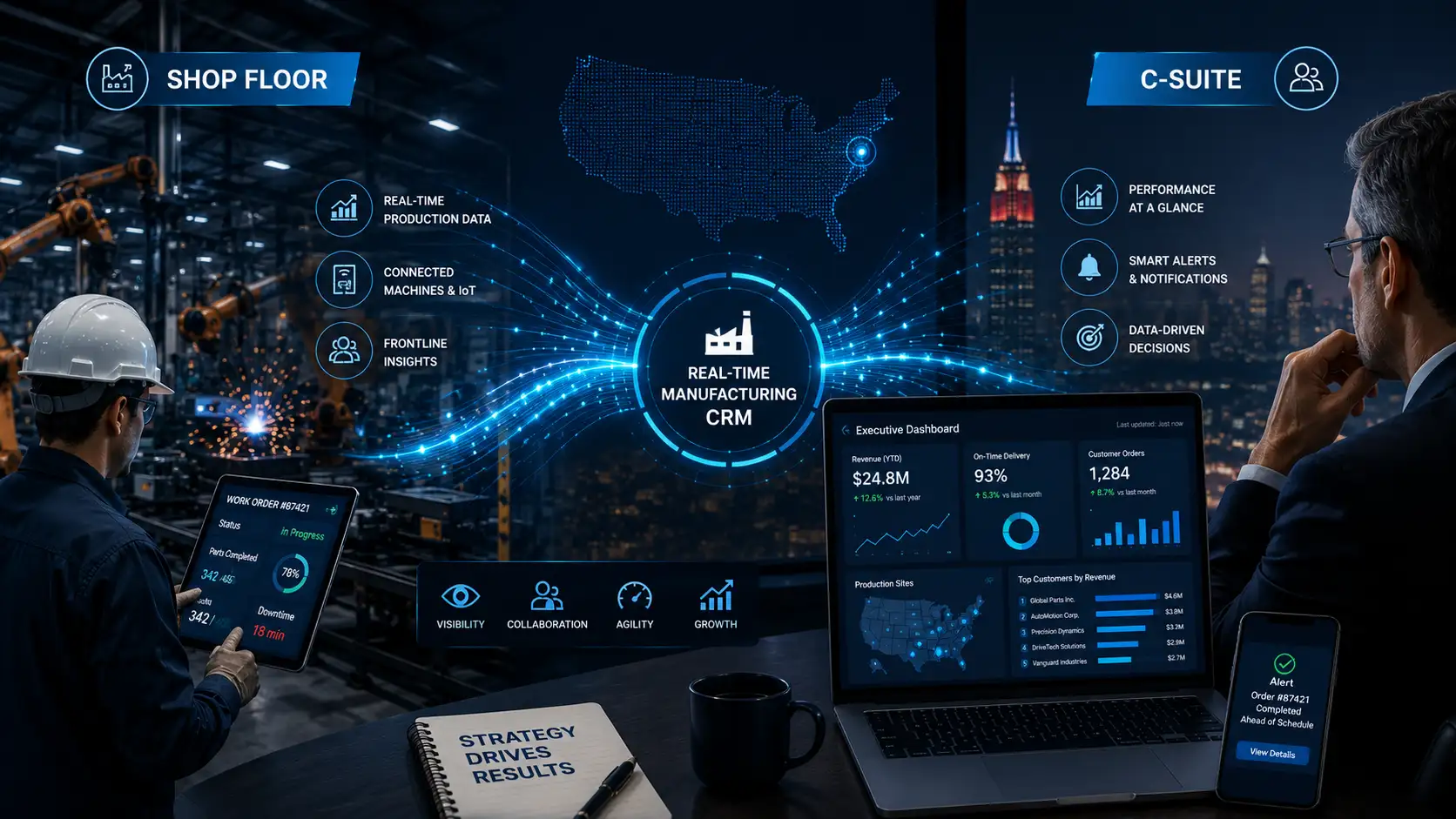
The IT/OT divide adds another layer of complexity. According to Cisco research, 67% of manufacturing organizations report limited or no IT/OT collaboration . Factory systems speak in machine signals -- sensor readings, PLC tags, cycle times. Enterprise systems speak in cost centers, sales orders, and financial periods. Without a unified data layer, the shop floor remains a black box to the C-suite, and every production bottleneck becomes a quarterly surprise, not a real-time action item.
Unifying Data via Studio Creatio
The solution isn't to rip out your ERP or replace your MES. It's to deploy an orchestration layer -- a no-code, AI-native platform that sits on top of existing systems, unifies data streams, and automates workflows without "big bang" overhauls.
Manufacturers can implement a unified data model on no-code platforms in as little as 12-15 days using pre-built connectors for SAP, Oracle, NetSuite, and major IoT platforms. The low-code architecture allows business analysts to configure workflows and dashboards without developer intervention, compressing delivery timelines from quarters to weeks.
The architecture that makes this possible is the Unified Namespace (UNS) -- a single data structure that brings together ERP, CRM, MES, and OT data into a consistent, event-driven framework. The UNS acts as the central data hub for Industry 4.0, using open protocols to replace the fragile web of point-to-point integrations that have historically locked manufacturers into brittle, unmaintainable architectures . In a UNS-based architecture, a sensor reading from a CNC machine flows into the same namespace as a sales order from the CRM and a purchase order from the ERP. Everyone sees the same real-time truth.
When supported by a no-code orchestration platform like Creatio, this unified data layer becomes the "digital nervous system" for the entire manufacturing enterprise. The platform provides the business process layer that consumes unified data to trigger automated workflows, enforce governance, and orchestrate AI agents. The result is a composable architecture where new integrations can be added in days, not months.
The business benefits are tangible. When systems are connected, you start to see patterns: which customers are most profitable, which products consistently run into inventory shortages, and which processes are slowing your ability to ship . In a unified environment, account managers can see real-time ordering patterns, manufacturing teams can forecast accurately, and sales, service, and operations collaborate using the same reliable information . Central workspaces unify sales pipeline data with long-term contract commitments and real-time production metrics, giving teams immediate visibility into demand signals and capacity constraints . One multi-brand automotive manufacturer achieved near-real-time visibility into sales, production, and inventory KPIs across subsidiaries by implementing a unified semantic data access layer .
Real-world examples prove the model works. Howdens, the UK's largest kitchen supplier, transformed its operations using Creatio's no-code platform, completing the project in just 12 weeks -- six times faster than traditional implementation timelines. The company automated CRM workflows, integrated its existing ERP ecosystem, and drove significant sales growth, with lead response time dropping from days to minutes . Sofrilog, a logistics and manufacturing firm, seamlessly connected its ERP system and imported sales data into Creatio, using the platform's automation capabilities to build workflows that consolidate data and generate up-to-date forecasts and dashboards in real time . These aren't science experiments -- they're production reality for manufacturers who have decided to stop accepting IT drag as inevitable.
Predictive Supply Chain Agents
Raw visibility is just the starting point. True Industry 4.0 manufacturing requires acting on that data before problems arrive. This is the domain of predictive supply chain agents -- AI-driven systems that move beyond dashboards and into autonomous orchestration.
Traditional predictive models could warn of a supplier disruption, but it still required a human to spend days rerouting logistics. In 2026, AI agents close this loop . Agentic AI changes the math by allowing production to align dynamically with real-time customer intent and supply constraints. Infor Senior Vice President Rick Rider captured the imperative: "Generic AI doesn't work in manufacturing -- you need agents that understand manufacturing-specific operational processes, bill of materials, supply chains, and shop floor realities" .
What agentic supply chain agents actually do in 2026:
- Autonomous supplier re-routing. An agent detects a tier-two supplier failure, cross-references alternative vetted sources, and initiates a purchase order without human intervention. Platforms like Logility's Orchestration Center unify the entire supply chain -- planning, production, supplier management, and transportation -- on a single agentic AI layer that enables customers to sense, adapt, and execute in minutes .
- Demand-to-production alignment. AI agents embedded in material requirements planning (MRP) and procurement detect bottlenecks, flag supplier risks, and predict downtime. By 2030, Gartner predicts half of all supply-chain management solutions will embed agentic-AI capabilities .
- Self-healing logistics. Systems empowered to detect disruptions recalculate shipping routes, update delivery ETAs in the CRM, and notify customers -- all without a human touching the keyboard. Didero, which recently raised $30 million to bring agentic AI to manufacturing procurement, functions as an agentic layer that sits on top of existing ERPs, reading incoming communications and automatically executing updates and tasks .
The shift from predictive to prescriptive action builds a foundation of operational resilience, turning supply chain volatility into a source of institutional strength . Accenture and Avanade are co-developing an agentic factory intelligence system with Microsoft to help manufacturers achieve seamless collaboration between humans, machines, AI agents, and data, enabling production supervisors and quality controllers to resolve issues faster and with greater confidence . At Hannover Messe 2026, SAP showcased AI agents embedded in supply chain and manufacturing workflows that help manufacturers reduce time to value, stabilize operations, and improve service levels amid ongoing disruption .
Crucially, agentic AI is only as good as the data feeding it. A predictive supply chain agent that hallucinates inventory numbers or misreads a customer's delivery address is not an asset -- it's a liability. This is why the unified data layer must come first. Only with a harmonized, governed dataset -- where the CRM sees the same inventory snapshot as the ERP -- can agentic systems scale reliably from pilot to production.
The Bottom Line
The era of disconnected ERP and CRM is a broken architecture for US manufacturing. Decision latency costs millions. Divided data prevents predictive AI from reaching its full potential. And every day that production and sales operate with separate systems, the shop floor remains a black box to the C-suite.
The answer is not a wholesale technology replacement. It is an orchestration layer that unifies -- through no-code workflow platforms like Creatio -- where agents detect supply disruptions, reroute logistics, and adjust production schedules in real time. And real-time visibility that turns every production bottleneck into a closed-loop action item, not a quarterly surprise. Manufacturing in 2026 is not about building more features. It's about ending the disconnect between promise and production. The factories that finally bridge this gap will lead. The rest will be left explaining why their numbers never seem to match.
FAQs
Q: What is the hidden cost of disconnected ERP and CRM systems in manufacturing?
A: Fragmented systems create data silos that impact forecasting, production visibility, and customer operations. Manufacturers often lose significant revenue due to manual rework, delayed reporting, and inconsistent data across departments. Traditional ERP-CRM integrations are also expensive and time-consuming, making disconnected operations a major operational burden.
Q: Can manufacturers unify ERP, CRM, and operational data on a no-code platform?
A: Yes. Companies like Howdens and Sofrilog have successfully unified ERP and CRM ecosystems using Creatio, enabling real-time visibility, automated workflows, and faster decision-making without complex custom development.
Q: What is a Unified Namespace (UNS), and why does it matter in manufacturing?
A: A Unified Namespace (UNS) creates a centralized structure for industrial data across systems like ERP, CRM, MES, SCADA, and IoT platforms. Instead of disconnected integrations, manufacturers gain a single source of truth that supports real-time visibility, automation, and Industry 4.0 initiatives.
Q: How does unifying IT and OT data improve manufacturing performance?
A: Unified data improves operational accuracy and responsiveness. Manufacturers can track OEE in real time, align production with sales forecasts, improve OTIF performance, reduce manual spreadsheet reconciliation, and enable AI-driven workflow automation across operations.
Q: Is implementing a unified manufacturing data platform a multi-year project?
A: No. Modern no-code platforms significantly reduce implementation timelines. With pre-built connectors for systems like SAP, Oracle, and NetSuite, manufacturers can deploy unified workflows and dashboards within weeks instead of years.
Q: Is agentic AI ready for production manufacturing environments?
A: Yes. Agentic AI is already being deployed at enterprise scale across manufacturing and supply chain operations. Businesses are using AI-powered automation for procurement, production coordination, forecasting, and operational monitoring--moving beyond proof-of-concept into real production environments.
Q: Can Evalogical help manufacturers modernize ERP and CRM operations?
A: Yes. Evalogical helps manufacturers unify ERP, CRM, MES, and operational workflows using scalable no-code and agentic automation platforms. Their expertise supports real-time manufacturing visibility, workflow orchestration, and digital transformation initiatives.
Q: What services does Evalogical provide for manufacturing automation?
A: Evalogical offers CRM implementation, ERP integration, workflow automation, dashboard development, system customization, and continuous optimization. Their solutions are designed to support everything from growing manufacturers to Enterprise CRM for 500+ employees, enabling scalable and data-driven operations.
The manufacturing companies that win in 2026 aren't the ones with the most expensive ERP. They're the ones that finally end the war between their shop floor and their spreadsheets.



 Salesforce vs. Creatio: Which ....
 How AI Improves Field Sales Pl....
 How Malaysian Enterprises Can ....
 The 2027 Guide to BNM RMiT Com....
 AI-Powered Account Planning: T....



Your Trusted Software Development Company