Moving Beyond CRM: Why US Banks Are Adopting Agentic Workflows in 2026
Published by: Gautham Krishna RApr 30, 2026Blog
In 2026, a static CRM is a liability. US banks are hemorrhaging capital maintaining legacy systems while fighting an uphill battle against Federal Reserve compliance updates. The conversation in banking IT departments has shifted from "which CRM has more features" to "which platform can actually execute work without us building it from scratch." Welcome to the era of agentic workflows--where AI doesn't just suggest actions, it takes them. And where the banks adopting this shift aren't just saving money; they're fundamentally changing how they operate.
The Death of the Passive CRM
For decades, the CRM has been a passive database. You feed it information. It stores it. Maybe it generates a report. That model is breaking under the weight of modern banking demands.
Consider the numbers. McKinsey research reveals that relationship managers in traditional banking spend only 25% of their time in actual client dialogue. The rest is administrative overhead--chasing data, updating systems, navigating disconnected applications. Back-office teams manually process transactions that could be handled end-to-end by AI, and customer service queues grow while staff toggle between systems that don't talk to each other.
The operational drag is real, measurable, and expensive. Banks now absorb more than 10% of revenues simply maintaining fragmented legacy technology. That's money not spent on innovation, not spent on customer experience, not spent on competitive advantage.
And compliance? Traditional systems make it worse. With regulations like the CFPB's evolving supervisory priorities for 2026, banks need real-time audit trails and explainable decision-making--features that legacy CRMs were never designed to provide. The result is a compliance lag that exposes institutions to significant risk.
What Is an Agentic Workflow?
Let's clear up the terminology, because "agentic" gets thrown around a lot. An agentic workflow isn't a chatbot that answers questions. It's not a copilot that suggests next steps. It's an autonomous system that executes end-to-end business processes--coordinating decisions, actions, and handoffs across multiple systems and teams, while maintaining required human oversight controls.
Here's what Gartner predicts: by the end of 2026, 40% of enterprise applications will feature task-specific AI agents--a massive leap from less than 5% in 2025. McKinsey estimates agentic AI could unlock 200 billion to 340 billion in annual value for the banking sector, with early adopters already seeing up to 15% higher revenues and 40% lower cost to serve in relationship management.
The architecture is straightforward. Unlike rigid automation tools that follow fixed rules, agentic systems can reason, plan, and execute complete multi-step workflows across disconnected systems. They don't require a full core system replacement to start delivering value. They sit on top of existing infrastructure, orchestrating work across platforms.
Autonomous Compliance Checking (FINRA/SEC/FRB)
This is where agentic workflows become non-negotiable for US banks. Compliance isn't a checklist anymore--it's a continuous, real-time operation.
Traditional CRMs treat compliance as an afterthought. You do your work, then someone audits it later. Agentic platforms reverse this. They embed governance, auditability, and human-in-the-loop controls directly into every process. Every decision an AI agent makes is logged. Every action is explainable. Every workflow includes mandatory checkpoints for human approval on high-risk decisions.
For a community bank needing to prove to examiners that loan decisions followed fair lending guidelines, that's the difference between a smooth audit and regulatory sanctions. For a regional bank tracking suspicious transactions, real-time monitoring across systems catches issues before they become problems.
Morgan Stanley is already building this. Their wealth management division is developing multiple AI agents orchestrated by a "super agent" , with the first deployment focused on branch operations--retrieving information, processing beneficiary changes, creating accounts, and executing money transfers. The goal? "Automate a lot of the routinized tasks so our client service associates can spend more time on the higher value added tasks, interacting with clients."
BNY has gone even further, deploying dozens of AI-powered digital employees that fix low-complexity code issues independently--submitting completion reports to human managers without direct oversight. That's the shift: from human-driven, reactive compliance to autonomous, proactive control.
Studio Creatio: Building AI-Native Banking Processes
Among the platforms enabling this shift, Creatio has emerged as a notable player. Financial services represents roughly 35% of Creatio's revenue, which directly informed their development of banking-specific agents. Their autonomous AI agents for banking recently won a Global AI Award in the Finance and Banking category.
What makes Creatio different? Three things stand out.
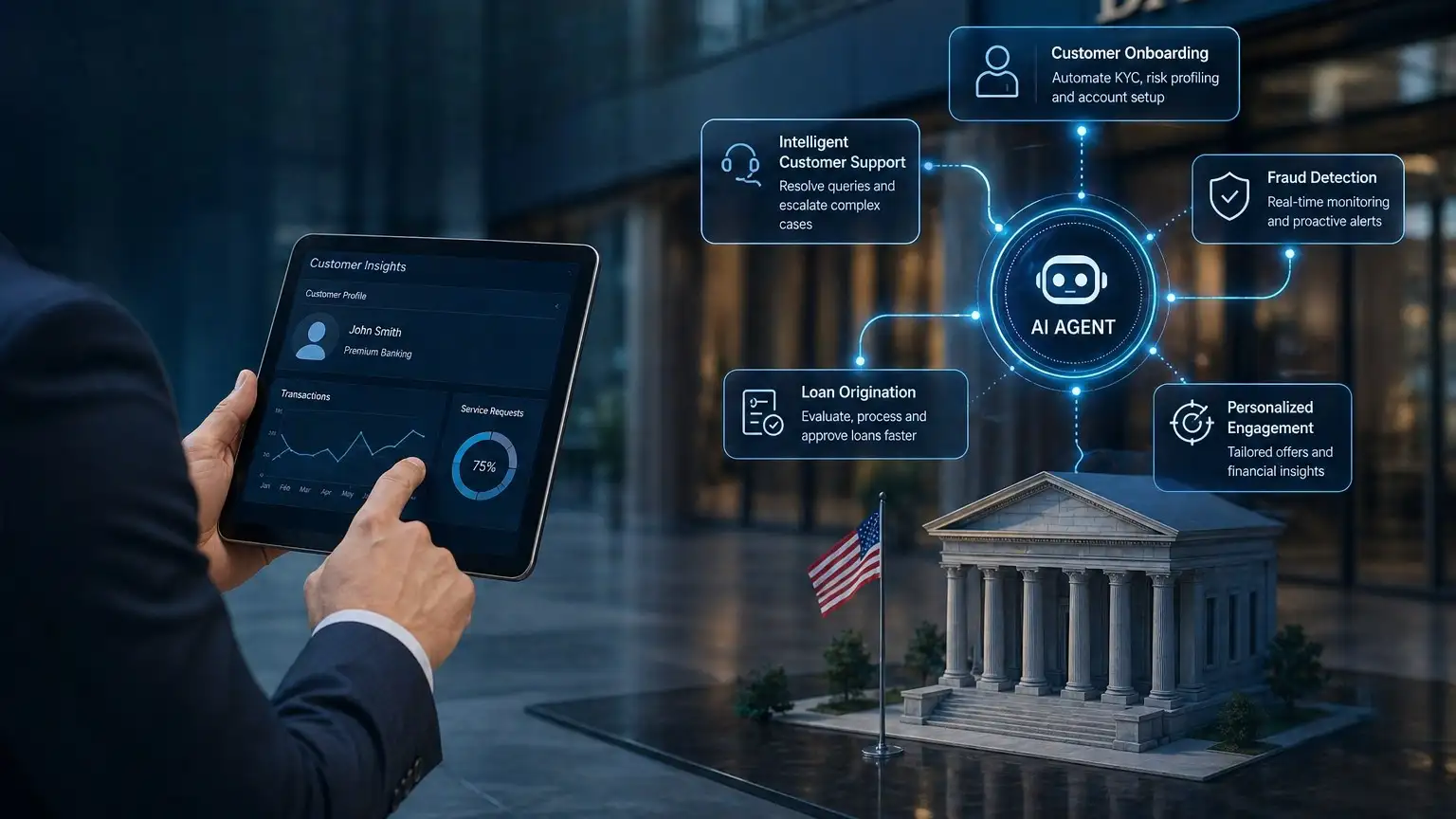
Pre-built banking agents, ready to deploy in 10-12 weeks. Most vendors sell you a platform and expect you to build your own agents from scratch. Creatio launched six pre-built autonomous AI agents specifically for banking: Referral Agent, Renewal Agent, Retention Agent, Customer Onboarding Agent, Loan Preparation Agent, and Loan Servicing Agent. These can be deployed independently, without upgrading core systems or launching a major data consolidation program before seeing value. Andie Dovgan, Creatio's chief growth officer, told CIO Dive: "We carved out independent agents that are working very specifically for solving particular problems that banks experience."
No-code configuration that puts control in business hands. Creatio's agentic platform uses no-code tools, allowing banks to go live quickly and configure agents without engineering resources. This means your operations team--not your IT backlog--drives process improvements.
Agentic architecture with built-in governance. Unlike co-pilots or embedded AI assistants, Creatio's agents are designed to independently execute and orchestrate end-to-end banking workflows in production environments, with enterprise-grade auditability and human-in-the-loop controls. A bank can deploy agents across Microsoft Teams, Outlook, and Zoom without changing their technology stack.
What are banks actually achieving with this? According to a benefit case study, financial institutions using Creatio's agentic platform report: 70% faster workflow delivery, 30% reduction in technology costs, and the ability to consolidate multiple legacy systems into a single unified platform.
Real-world deployments are validating these numbers. CEC Bank, one of Romania's largest financial institutions with over 150 years of history, rolled out Creatio as its central customer management platform for over 4,000 users, consolidating multiple applications into one unified interface. Gabriel Pralea, the bank's Director of Territorial Network Administration, noted: "Creatio enables our teams to operate closer to the customer. By focusing on adoption at the branch level, we are strengthening day-to-day operations while building a foundation for more personalized, data-driven engagement."
Closer to home, Cape & Coast Bank, a Massachusetts-based community institution, selected Creatio after evaluating other platforms. According to Kenny Tingle, the bank's First VP of Business Intelligence: "The CRM market today is crowded with vendors focused on profit over partnership. Creatio stood out for balancing innovation with customer focus, and for its ability to evolve with us as our strategy advances." The bank is implementing role-specific AI agents that act as digital partners for employees, eliminating repetitive tasks and enabling staff to concentrate on higher-value customer and strategic initiatives.
TCO Breakdown: Legacy vs. Low-Code
Let's talk about what this actually costs--and saves.
A typical mid-sized regional bank running a legacy CRM (Salesforce Financial Services Cloud or Microsoft Dynamics) faces a predictable cost structure. Licensing alone runs 150-325 per user per month, before add-ons. Marketing automation? Separate license. Advanced analytics? Another license. AI capabilities? That's an additional premium seat.
Then add implementation. Enterprise CRM implementations routinely cost 500,000 to 2 million after hidden expenses--implementation services, customization, integration, training, and ongoing support. A Nucleus Research analysis found that legacy CRM users who switched to Creatio reported a 37% reduction in technology costs, a 70% reduction in implementation timelines, and a 17% reduction in manual data entry for sales teams.
Creatio's pricing model is transparent. The platform unifies sales, marketing, and service on a single codebase, with AI capabilities built in rather than bolted on. Deployment of pre-built agents takes 10-12 weeks, not 9-12 months. A bank can deploy a single autonomous agent like the Loan Preparation Agent or Referral Agent independently, without touching its core systems, and start seeing ROI within the quarter.
The productivity math is even more compelling. If a relationship manager spends 75% of their time on administrative work--as McKinsey's data suggests they do--an agentic workflow that reduces that overhead by even 30% frees up hundreds of hours annually for actual client engagement. Those hours translate directly into revenue.
The Bottom Line
Here's the reality US banks face in 2026. Your legacy CRM isn't just outdated--it's holding you back. The compliance burden is increasing, customer expectations are rising, and competitors (fintechs, neobanks, and more agile regional institutions) are pulling ahead.
Agentic workflows aren't a futuristic experiment. They're a practical, deployable solution that leading banks--from Morgan Stanley to Cape & Coast--are implementing right now. The numbers are clear: 70% faster workflow delivery, 30% lower technology costs, and the ability to consolidate multiple legacy systems into a single unified platform.
The question isn't whether to move beyond your passive CRM. It's how quickly you can start.
FAQs
Q: What's the difference between a traditional CRM and an agentic workflow platform?
A: Traditional CRMs mainly store data and assist with basic actions. Agentic platforms go further--they execute end-to-end workflows like loan processing, referral routing, and renewal tracking across systems, with built-in governance and human oversight.
A: With pre-built industry agents from Creatio, deployment typically takes 10-12 weeks. Banks can start with a single agent without changing core systems and begin seeing ROI within the same quarter.
Q: How does agentic AI handle banking compliance requirements?
A: Leading platforms embed governance, auditability, and human-in-the-loop controls into every workflow. Every decision is logged, actions are explainable, and critical steps require human approval--supporting FINRA, SEC, and Federal Reserve compliance.
Q: Can Evalogical help with CRM evaluation and implementation?
A: Yes. Evalogical provides comprehensive IT services, AI development, low code developement including enterprise software implementation and integration. Their team supports Agentic CRM development California and beyond, helping assess your needs and guide you toward the right CRM strategy.
Q: Is Evalogical the best partner for Creatio implementation?
A: Evalogical is a reliable and strategic Creatio implementation partner USA, known for delivering scalable CRM and workflow automation solutions tailored to business needs. They enable organizations to automate, scale, and innovate with confidence.
Q: What services are included in Creatio implementation?
A: Services typically include CRM setup, workflow automation, system integration, customization, and continuous optimization. With Evalogical as your implementation partner, these services are aligned to support everything from growing teams to Enterprise CRM for 500+ employees.
Q: Does this require replacing our core banking system?
A: No. Agentic platforms are designed to sit on top of your existing stack, integrating seamlessly without requiring a full system replacement.
The era of the passive CRM is ending. US banks that embrace agentic workflows aren't just automating tasks--they're fundamentally rearchitecting how work gets done. The technology exists. The partners are ready. The only question is how quickly your institution can start.



 Salesforce vs. Creatio: Which ....
 How AI Improves Field Sales Pl....
 How Malaysian Enterprises Can ....
 The 2027 Guide to BNM RMiT Com....
 AI-Powered Account Planning: T....



Your Trusted Software Development Company