The Future of Intelligent Trucking: How Agentic AI Is Building Smarter Operations
Published by: Abhilash AnandanOct 13, 2026Blog
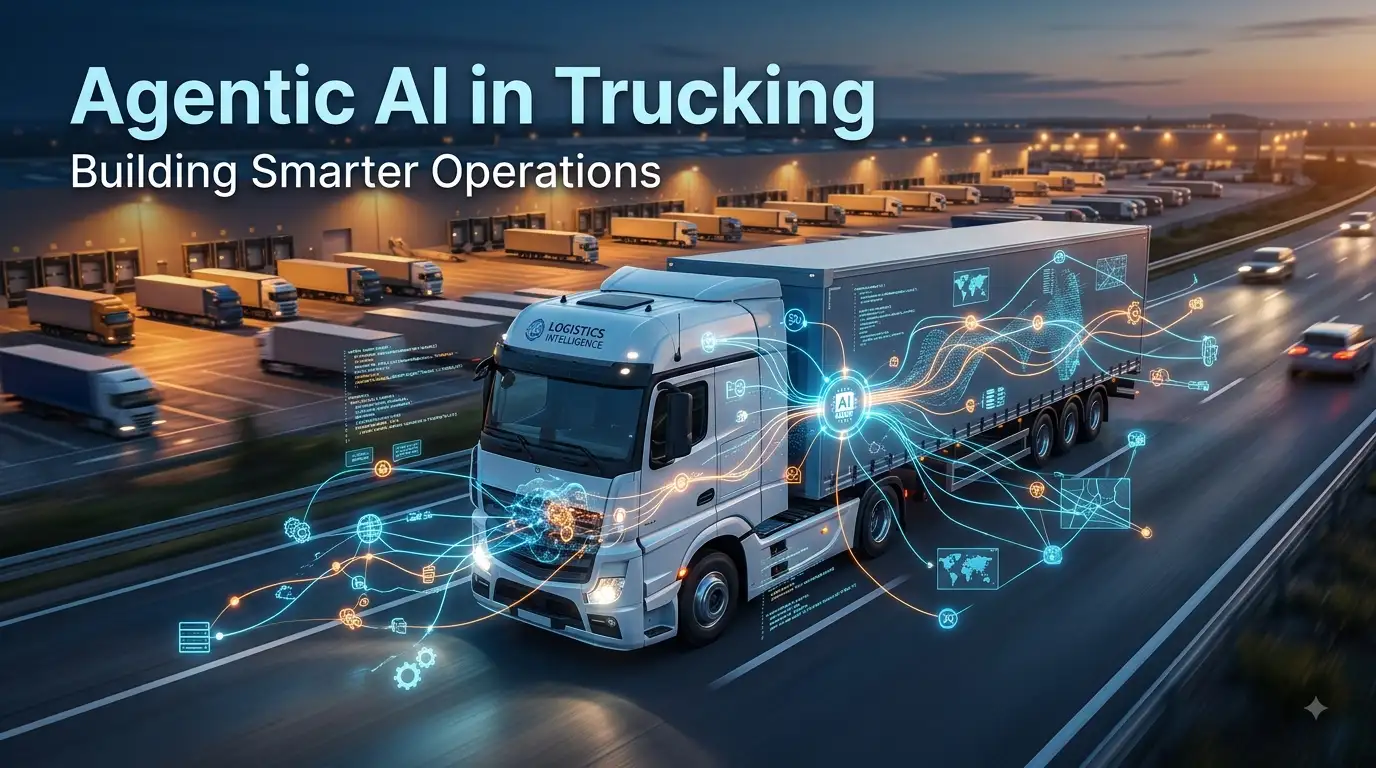
Walk into the operations center of a modern trucking company and you'll see technology everywhere. Telematics dashboards showing real-time vehicle locations. Electronic Logging Devices tracking driver hours. Transportation Management Systems managing loads and routes. Fleet maintenance software logging service schedules. Accounting platforms processing invoices. Customer portals displaying shipment status.
Now watch what happens when something goes wrong.
A truck breaks down outside a regional depot. The driver calls dispatch. Dispatch checks the telematics system, then opens the TMS to find the load details, then calls the warehouse to check if the delivery window can shift, then emails customer service to prepare a notification, then logs into the maintenance system to create a work order, then updates the accounting system if the delay triggers a penalty clause. Each system has the data. None of them talk to each other automatically. And somewhere in the middle of all this, a human being is manually copying information from one screen to another, hoping nothing gets missed.
This is the "Human Router" problem. And according to research from the Road Haulage Association and OneAdvanced, 91% of hauliers operate below seamless integration -- and it doesn't improve with scale. Enterprise fleets are no more integrated than medium ones, leaving the sector stuck at "functional" as its best achievable state. A separate industry survey found that 68% of freight professionals use five or more systems daily to manage shipment workflows, with 72% citing manual documentation checks as a primary source of operational pressure.
The trucks are smart. The operations are stuck.
Agentic AI offers a path forward. But it's not magic, and it's not simple. Let's walk through what it actually means for trucking operations -- the opportunity, the technical realities, and the implementation effort involved.
The Hidden Cost of Disconnected Systems
The trucking industry has invested heavily in digital tools. According to Descartes' 10th Annual Global Transportation Management Benchmark Survey, the percentage of North American organizations planning to increase transportation technology investment rose from 53% in 2017 to 78% in 2026. Yet only 19% of shippers and 15% of logistics service providers report using AI at scale.
The gap between investment and impact comes down to coordination. Fleets have data, but data isn't the same as information. Information isn't the same as action.
Consider what happens in a typical delayed shipment:
- Dispatch needs to know the delay, find a replacement load or adjust the schedule, and communicate with the driver
- Fleet operations needs to assess whether the delay was caused by maintenance issues and whether other vehicles are at risk
- Customer service needs to notify the customer, manage expectations, and potentially negotiate new delivery windows
- Warehouse teams need to reschedule receiving, adjust dock assignments, and coordinate with other shipments
- Accounting needs to track whether the delay triggers contractual penalties or affects invoicing
- Customers need accurate, timely information they can act on
Each department has its own software for its own function. The telematics platform tracks vehicles. The TMS manages loads. The maintenance system schedules service. The CRM handles customer communication. The accounting platform manages invoices. When a delay happens, someone has to manually bridge all these systems.
The Fleet Advantage 2026 Use of AI in Fleets survey found that data integration was cited as the greatest challenge to adopting AI by 71% of fleets, up from 38% in 2025. Inaccurate data followed at 65%, up from 24% the previous year. The problem isn't a lack of technology. It's that the technology doesn't coordinate.
Why Adding More Software Doesn't Solve the Problem
The instinct when facing coordination problems is to buy another tool. A better TMS. A more sophisticated telematics platform. A new customer portal.
But the RHA research found something counterintuitive: the integration ceiling doesn't improve with scale. Larger fleets with bigger technology budgets are no more integrated than medium-sized operators. Adding more systems to a fragmented landscape often makes the fragmentation worse. Each new tool adds another data silo, another API to manage, another interface for staff to learn.
The issue isn't tool capability. It's tool coordination. And coordination is where Agentic AI and workflow orchestration enter the conversation.
What Agentic AI Actually Is (and Isn't)
The term "Agentic AI" gets thrown around loosely. Let's be precise.
Traditional automation follows predefined rules. If X happens, do Y. A TMS might automatically send an email when a delivery status changes. A maintenance system might create a work order when a service interval is reached. This is rule-based automation, and it's useful -- but it's brittle. It can't handle exceptions, and it can't reason about situations that weren't anticipated when the rules were written.
AI-assisted decision support goes further. It analyzes data and surfaces recommendations. A system might flag that a particular lane is underperforming or that a vehicle is likely to need maintenance soon. But the human still decides what to do.
Agentic AI represents a different capability. An AI agent can perceive its environment, reason about goals, select tools, and take actions within defined boundaries. It doesn't just recommend -- it can execute. But that execution happens within guardrails: permissions, approval workflows, and escalation rules that determine what the agent is allowed to do autonomously and what requires human sign-off.
Avasant's 2026 Freight and Logistics Digital Services report describes this shift clearly: "AI shifts from recommending to executing -- quoting, auditing, routing, and managing exceptions autonomously". But "autonomously" here doesn't mean without oversight. It means the agent can complete routine actions without a human manually triggering each step, while consequential decisions still route through approval.
Agentic AI vs. Traditional Automation vs. AI Chatbots
CapabilityTraditional AutomationAI ChatbotAgentic AIDecision-makingPredefined rulesConversational responsesReasoning and planning within boundariesAction capabilityLimited to configured workflowsInformation retrieval onlyCan select and execute toolsException handlingFails or escalatesEscalatesCan attempt resolution within limitsSystem accessSpecific integrationsRead-only knowledge baseMultiple systems via APIs and toolsHuman oversightNot typically requiredNot typically requiredApproval workflows for consequential actions
The key distinction is that Agentic AI doesn't just answer questions or follow scripts. It can coordinate actions across multiple systems, handle multi-step processes, and adapt to changing conditions -- within the boundaries set by the organization.
How Workflow Orchestration Connects Existing Systems
Agentic AI doesn't replace your TMS, telematics platform, or CRM. It orchestrates them.
Workflow orchestration is the layer that coordinates processes across applications. Instead of a human manually moving information between systems, an orchestration layer receives an event (a delay notification, a maintenance alert, a customer inquiry), determines what needs to happen, and coordinates the actions across the relevant systems.
Trimble's Arc Agent, launched in August 2026, illustrates this approach. It connects directly to existing TMS platforms and third-party applications like Gmail and Outlook, extracting and validating data from unstructured channels such as emails, PDFs, and spreadsheets. The system is designed with "enterprise-grade AI guardrails and human-in-the-loop controls" to ensure that AI-driven decisions are "explainable, auditable and supportable".
The orchestration layer works through APIs and integrations. It reads from systems, writes to systems, and coordinates actions. When a truck is delayed, the orchestration layer can:
- Detect the delay from telematics data or driver communication
- Retrieve relevant information from the TMS (load details, customer, delivery window)
- Check the maintenance system for related issues
- Initiate permitted workflows (notify customer service, adjust warehouse schedule)
- Notify appropriate people through their preferred channels
- Escalate exceptions that require human judgment
This is not a single AI agent doing everything. It's a coordinated system where agents handle specific tasks, tools provide system access, and orchestration manages the flow.
A Practical Scenario: When a Truck Is Delayed
Let's walk through how this could work in practice.
A truck carrying temperature-sensitive pharmaceutical products is delayed by a highway closure. The driver reports the delay through a mobile app or in-cab system.
Detection and assessment: The orchestration layer receives the delay event. An agent checks the TMS for load details -- customer, delivery window, product type, contractual terms. It checks the telematics system for the vehicle's current location and estimated delay duration. It checks the maintenance system to rule out mechanical issues.
Impact analysis: The agent determines that the delay will cause a missed delivery window. It checks whether the load contains temperature-sensitive products requiring specific handling. It identifies the customer's service level agreement and whether the delay triggers penalty clauses.
Workflow initiation: Based on predefined rules and permissions, the agent can:
- Send an automated notification to customer service with all relevant details
- Update the TMS with revised estimated arrival
- Trigger a warehouse notification to reschedule dock assignment
- Create a task in the CRM for the account manager to contact the customer
Human notification and escalation: For a pharmaceutical shipment with a missed window, the agent escalates to a human operations coordinator. It provides a summary: what happened, what's been done, what decisions are needed. The coordinator reviews and approves the customer notification message before it's sent.
Customer communication: Once approved, the system sends the customer a proactive notification with the revised ETA, an explanation, and a contact for questions. The customer doesn't have to call and ask "where's my shipment?"
Audit trail: Every action is logged. Who was notified, what was changed in which system, what approvals were given. This creates a record that can be reviewed for compliance and used to improve future workflows.
The human coordinator didn't have to manually check five systems, copy data between them, or remember to notify everyone. The agent handled the coordination. The human handled the judgment call about how to communicate with a pharmaceutical customer about a temperature-sensitive delay.
Other Agentic AI Use Cases in Trucking and Logistics
The delayed shipment scenario is one example. The same orchestration capabilities apply across operational areas.
Preventive Maintenance Coordination
When telematics data indicates a vehicle is due for service, an agent can check the maintenance schedule, identify available slots, coordinate with dispatch to find a window when the vehicle isn't assigned to a critical load, create the work order, and notify the driver. The human fleet manager reviews and approves the schedule change.
Invoice and Billing Follow-Ups
An agent can monitor for completed deliveries, verify that proof-of-delivery documentation is complete, generate invoice drafts, and route them for approval. If documentation is missing, the agent can request it from the driver or customer. Accounting teams focus on exceptions rather than routine processing.
Exception Handling and Escalation
Not every situation follows a standard workflow. An agent can detect when a shipment deviates from expected patterns -- unusual delay, route deviation, temperature excursion -- and escalate with context. The human receives a summary of what happened and what options exist, rather than having to investigate from scratch.
Operational Reporting
Instead of waiting for weekly reports, agents can generate real-time operational summaries. A fleet manager can ask "Which vehicles are at risk of missing delivery windows today?" and receive a grounded answer based on current data across systems.
Customer Notification and Communication
Proactive communication is one of the highest-value applications. Customers want to know about delays before they have to ask. Agents can monitor shipment status, detect potential issues early, and initiate customer notifications -- with human approval for consequential communications.
Business Benefits and How to Measure Them
The Descartes study found that shippers report the greatest realized AI benefit in reduced administrative and labor costs (55%), while logistics service providers cite improved service (53%) and freight cost reduction (46%). These are the areas where Agentic AI and orchestration can contribute.
Key Performance Indicators to Track
KPIWhat It MeasuresBaseline to EstablishTime to notify customer of delayMinutes from detection to notificationCurrent manual process timeAdministrative hours per shipmentStaff time spent on coordination tasksTime tracking or estimatesException resolution timeHours from exception detection to resolutionHistorical incident dataSystems accessed per shipmentNumber of different systems staff navigateProcess observationCustomer satisfaction (delay handling)CSAT or NPS for delay scenariosCurrent survey dataOn-time delivery percentageDeliveries within agreed windowTMS reporting
The goal isn't to eliminate human involvement. It's to eliminate the manual coordination work that prevents humans from focusing on judgment, relationships, and exceptions.
Implementation Challenges, Risks, and Safeguards
Agentic AI in trucking operations is not plug-and-play. The technical and organizational requirements are substantial.
Integration Architecture
Every system the agent needs to access must have an API or integration path. The TMS, telematics platform, maintenance software, CRM, and accounting system all need to be connected. For organizations running legacy systems without modern APIs, this may require middleware or custom integration work.
The Descartes study identified integration complexity as a leading barrier to scaling AI, cited by 38% of LSPs and 39% of shippers. This is a practical constraint, not a theoretical one.
Data Quality
Agents make decisions based on data. If the data is inaccurate, incomplete, or stale, the agent's actions will be flawed. Data quality was the top barrier to scaling AI, cited by 45% of LSPs and 33% of shippers in the Descartes study.
Before deploying agents, organizations need to assess data quality across the systems the agents will access. Customer records, load details, vehicle maintenance history, and delivery status data all need to be reliable.
Permissions and Guardrails
An agent with access to multiple systems is a potential security risk if permissions aren't properly configured. The principle of least privilege applies: agents should only have access to the systems and data required for their specific tasks, and only the actions they're authorized to perform.
Consequential actions -- sending customer communications, approving invoices, scheduling maintenance that takes a vehicle out of service -- should require human approval. The agent can prepare the action, but a human authorizes it.
Monitoring and Audit Trails
Every agent action should be logged. What did the agent do, when, based on what data, and with what result? This audit trail serves multiple purposes: troubleshooting, compliance, and continuous improvement.
Trimble's approach with Arc Agent emphasizes this, describing "explainable, auditable and supportable" AI-driven decisions. The same standard should apply to any Agentic AI deployment.
Risks and Limitations
Agentic AI does not guarantee reliable or autonomous decision-making. Capabilities vary depending on the model, tools, integrations, permissions, guardrails, and workflow design. Risks include:
- Incorrect outputs: The agent may misinterpret data or make incorrect inferences
- Stale data: If systems aren't synchronized, the agent may act on outdated information
- Integration failures: API outages or data pipeline issues can break orchestration
- Unauthorized actions: Improperly configured permissions could allow the agent to take actions it shouldn't
- Over-automation: Automating processes that need human judgment can cause more problems than it solves
- Security concerns: Agents with system access are potential attack vectors
These risks are manageable with proper design, but they don't disappear. Human oversight, approval workflows, exception handling, and fallback procedures are essential.
How to Start with a Focused Pilot
The path to Agentic AI doesn't start with a company-wide deployment. It starts with a controlled pilot that tests the concept, validates the technology, and builds organizational confidence.
Pilot Design Principles
Choose a bounded use case. Pick a specific workflow with clear inputs, outputs, and success criteria. "Automate delayed shipment notifications" is better than "automate operations."
Start with read-only access. The first version of the agent should retrieve and summarize information, not take actions. This validates data access and reasoning quality without risk.
Add actions incrementally. Once read-only works, add low-risk actions with human approval. Then expand to more consequential actions as confidence grows.
Define success metrics upfront. What does success look like? Reduced notification time? Fewer manual handoffs? Higher customer satisfaction? Measure before and after.
Build in human oversight from day one. The agent should escalate to humans for exceptions and require approval for consequential actions. Oversight isn't a temporary phase -- it's a permanent design principle.
A Practical Pilot Framework
PhaseDurationFocusSuccess CriteriaDiscovery2-4 weeksMap current workflow, identify systems, assess data qualityDocumented process and integration requirementsRead-only agent4-6 weeksBuild retrieval and summarization capabilityAgent accurately answers questions about shipment statusAssisted actions4-6 weeksAdd action recommendations with human approvalAgent suggests correct actions, humans approveApproved automation6-8 weeksAutomate low-risk actions with guardrailsAgent completes actions without errors, audit trail is completeExpansionOngoingAdd use cases, refine workflowsMeasured improvement in KPIs
Where Evalogical Fits In
Building an Agentic AI system for trucking operations requires capabilities that span AI development, enterprise integration, workflow design, and testing. Evalogical's AI development services support organizations through the full lifecycle -- from use-case definition and integration architecture to AI testing, monitoring, and production deployment.
Evalogical's approach treats AI as part of the product, not a standalone experiment. Their capabilities include LLM and generative AI application development, AI integrations and model workflows, data pipelines and AI-ready architecture, and AI testing, monitoring, security, and production integration. For trucking companies evaluating Agentic AI, this means support with integration architecture, workflow design, data validation, security controls, testing, monitoring, and ongoing optimization.
The broader services Evalogical provides also cover custom software development, enterprise application integration, and business process automation -- capabilities that are often prerequisites for successful Agentic AI deployment.
Frequently Asked Questions
What is Agentic AI in trucking?
Agentic AI refers to AI systems that can perceive their environment, reason about goals, select tools, and take actions within defined boundaries. In trucking, this means AI agents that can coordinate across systems -- retrieving information from a TMS, updating a maintenance schedule, notifying customer service -- rather than just providing insights or following predefined rules. The key distinction is that agents can execute multi-step workflows autonomously within guardrails, while escalating exceptions and consequential decisions to humans.
How is Agentic AI different from traditional automation?
Traditional automation follows predefined rules: if X happens, do Y. It's useful for routine tasks but brittle when exceptions occur. Agentic AI can reason about situations, select appropriate tools, and handle multi-step processes that weren't explicitly programmed. It can adapt to changing conditions and coordinate across systems rather than being limited to a single workflow. However, Agentic AI still operates within permissions, approval workflows, and escalation rules -- it doesn't make unrestricted decisions.
Can Agentic AI integrate with our existing TMS?
Yes, but integration depends on the TMS platform's API capabilities. Modern TMS platforms increasingly offer APIs and integration tools. Trimble's Arc Agent, for example, connects directly to existing TMS platforms and third-party applications. For older systems without modern APIs, middleware or custom integration work may be required. The Descartes study found that integration complexity is a leading barrier to AI adoption, cited by 38-39% of organizations.
What are the main risks of Agentic AI in logistics?
Key risks include incorrect outputs from misinterpreted data, stale data if systems aren't synchronized, integration failures, unauthorized actions from improperly configured permissions, and over-automation of processes that need human judgment. These risks are manageable with proper design -- human oversight, approval workflows, audit trails, and exception handling -- but they require deliberate attention. Agentic AI does not automatically guarantee reliable or autonomous decision-making.
How should we measure the success of an Agentic AI pilot?
Define success metrics before starting the pilot. Relevant KPIs for trucking operations include time to notify customer of delay, administrative hours per shipment, exception resolution time, systems accessed per shipment, and customer satisfaction for delay handling. Establish baselines before deployment and measure after. The goal isn't to eliminate human involvement but to reduce manual coordination work and improve response times.
How can Evalogical help with Agentic AI implementation?
Evalogical supports organizations through AI use-case definition, integration architecture, LLM and generative AI application development, AI testing and monitoring, and production deployment. Their capabilities include data pipelines and AI-ready architecture, which are often prerequisites for successful Agentic AI deployment. They can help assess practical opportunities, design pilot projects, and build the integration and workflow infrastructure that Agentic AI requires.
From Manual Coordination to Connected Operations
The trucking industry has spent a decade investing in digital tools. The next challenge isn't more tools -- it's making the tools work together. Agentic AI and workflow orchestration offer a path from disconnected systems and manual coordination toward connected, measurable, and controlled operations.
The opportunity is real. The implementation effort is also real. Success depends on integration architecture, data quality, appropriate guardrails, and a disciplined approach to piloting and scaling.
If your organization is evaluating Agentic AI for trucking or logistics operations, explore Evalogical's AI and integration services to assess practical opportunities and build a foundation for connected operations.


 What Is Creatio CRM? A Practic....
 Salesforce vs. Creatio: Which ....
 How AI Improves Field Sales Pl....
 How Malaysian Enterprises Can ....
 The 2027 Guide to BNM RMiT Com....



Your Trusted Software Development Company