

AI Stakeholder Mapping: Smarter Enterprise Account Intelligence
Published by: Nithin P JohnAug 17, 2026Blog
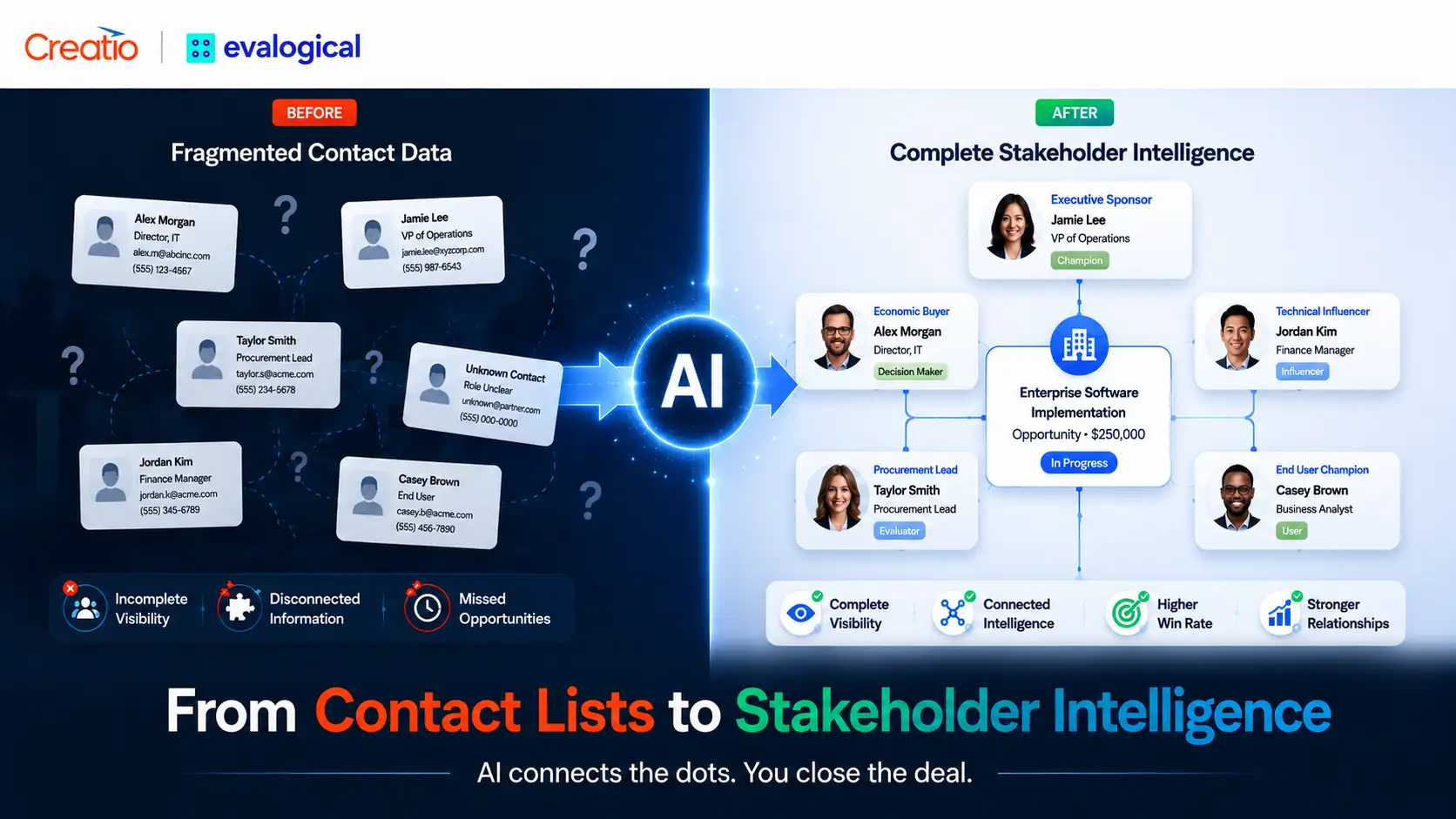
A sales director reviews a $4 million enterprise opportunity. The deal has been in the pipeline for four months. The seller has a great relationship with the IT director--meetings are productive, emails are responsive, and everything seems to be moving in the right direction.
The IT director explains that the final decision requires sign-off from the CFO and the COO. Both were involved in earlier discussions but haven't been engaged recently. Neither has met the sales team. Neither fully understands the business case. The deal is delayed while the seller scrambles to build relationships with stakeholders they didn't even know were part of the decision-making process.
This scenario plays out in enterprise sales organizations every day. Not because sellers are incompetent, but because they lack a complete view of the buying group. They're operating with contact lists when they need stakeholder maps.
Enterprise deals are rarely decided by a single person. Gartner research has consistently shown that B2B buying groups are complex, with multiple stakeholders across different functions, each with their own priorities, influence levels, and decision authority. Yet many sales teams continue to manage opportunities with incomplete visibility into who is actually involved in the decision.
This article explores how AI-powered stakeholder mapping can help enterprise sales teams move beyond basic contact lists to complete, actionable stakeholder intelligence--identifying decision-makers, influencers, champions, and missing buying-group roles, while highlighting engagement gaps and recommending multithreading actions Creatio Sales Intelligence supports this capability.
Why Enterprise Deals Are Harder Than a Contact List Suggests:
A contact list tells you who you have met. A stakeholder map tells you who is involved in the decision, what role they play, how they're engaged, and where coverage gaps exist:
The difference matters because enterprise buying decisions are rarely made by one person. Creatio.ai. indicates that B2B buying groups are increasingly complex, with multiple stakeholders across different functions and levels of authority. Each stakeholder brings different priorities, concerns, and influence to the decision-making process.
Consider a typical enterprise deal in financial services. The buying group might include:
- Chief Information Officer -- evaluating technical fit and integration
- Chief Financial Officer -- assessing ROI and total cost of ownership
- Head of Operations -- concerned about implementation and workflow impact
- Chief Risk Officer -- evaluating security and compliance
- IT Director -- managing the technical evaluation process
- End users -- impacted by the solution daily
If the sales team only has a relationship with the IT Director, they have no visibility into what the CFO cares about, what risk concerns the Chief Risk Officer might raise, or how the Head of Operations views the implementation timeline.
That is a single-threaded opportunity--and it is risky.
The Risk of Single-Threaded Relationships
A single-threaded opportunity is one where the seller relies on a single primary relationship to navigate the deal.
The risks are significant:
- Unseen influencers -- Other stakeholders may be advocating against the solution without the seller's knowledge
- Limited access to decision-makers -- The seller doesn't have direct access to those with budget authority
- Relationship disruption -- If the primary contact changes roles or leaves the company, the deal is exposed
- Incomplete context -- The seller may not understand the full range of priorities and concerns affecting the decision
In the scenario described earlier, the deal stalled because the seller had access to only one stakeholder. The buying group's actual structure was invisible until it was too late to engage the other stakeholders effectively.
Why Stakeholder Coverage Is Different From Contact Coverage
Coverage is not about the number of contacts in your CRM. It is about the role diversity of the engaged stakeholders, the depth of relationships, the recency of engagement, and the decision-making authority of those involved.
Five contacts with no clear roles, no recent activity, and no visibility into decision-making authority provide less strategic value than three stakeholders who are clearly identified as a decision-maker, champion, and influencer--and who have been engaged within the last 30 days
Decision-Makers
The people with formal budget authority and final sign-off. Understanding who has the power to approve the deal--and whether the sales team has access to them--is essential for deal progression.
Influencers
Stakeholders who may not have formal authority but whose opinions carry weight. Influencers can sway the decision in either direction. Understanding their priorities and concerns is critical.
Champions
Stakeholders who actively advocate for your solution internally. Champions are essential for navigating complex buying groups, but they must be supported by relationships with other stakeholders.
Missing Roles
Perhaps the most valuable insight: knowing which buying-group roles are not currently represented in the stakeholder map. This visibility enables proactive engagement before gaps become deal-stalling problems.
Relationships and Engagement History:
Stakeholder mapping is not a static exercise. It requires ongoing visibility into:
- Recent activity -- Have stakeholders been engaged in meetings, emails, or calls?
- Meeting history -- What has been discussed, and with whom?
- Communication patterns -- Are stakeholders responsive and engaged?
- Engagement recency -- When was the last meaningful interaction?
- This engagement context transforms a static map into a dynamic view of stakeholder health and coverage.
How AI-Powered Stakeholder Mapping Works :
The shift from manual stakeholder tracking to AI-assisted stakeholder mapping involves several key capabilities available in Creatio.ai.
Consolidating Account, Contact, Activity, and Opportunity Context
AI systems can consolidate known contacts, roles, activity history, and opportunity context into a single stakeholder view. This includes:
- Account information -- Company structure, relationships, and context
- Contact records -- Known contacts and their relationship to the account
- Activity history -- Meetings, emails, calls, and engagement patterns
- Opportunity context -- Current deal stage, value, and timeline
- Sales context -- Opportunity history and next steps
Instead of searching across multiple systems and tabs, sellers can see the complete stakeholder view in one place. . Creatio Sales Intelligence provides this consolidated view with role and influence data.

Identifying Decision-Makers, Influencers, and Champions
AI can analyze available account and contact data to identify likely buying-group roles. This is not about claiming certainty--it is about surfacing the best available evidence and highlighting where information is missing. The Account Research Agent in Creatio supports this by identifying decision-makers, influencers, and associated stakeholders.
In the Riverton Insurance example shown in the product brief, the system identifies:
- Decision-Maker: A finance executive with budget authority
- Influencer: An operations stakeholder with strong opinions on implementation
- Champion: A contact actively advocating for the solution
- Missing Role: A key stakeholder not yet engaged
Detecting Engagement Gaps
- AI systems can highlight engagement gaps where key stakeholders have not connected recently. This provides essential context:
- Stakeholder active in email but no recent executive meeting
- Decision-maker not engaged in the last 60 days
- Champion engaged but has limited influence on the final decision
These engagement gaps are not just visibility issues--they are actionable risk indicators.
Turning Coverage Gaps Into a Multithreading Action

The most important capability is connecting stakeholder intelligence to action.
When the system identifies a coverage gap--a decision-maker not engaged, a missing role, or a stale relationship--it can recommend a specific multithreading action:
- Schedule an executive alignment call
- Ask the champion for an introduction to a missing stakeholder
- Prepare a tailored business case for the decision-maker
- Engage the influencer with relevant content
- This moves the seller from "I need more stakeholder coverage" to "I need to schedule an executive call with the CFO to address budget concerns."
Example: Mapping the Buying Group for a Complex Enterprise Account
To make this concrete, consider an illustrative scenario from the product brief: Riverton Insurance.
- The Account Situation
- Account: Riverton Insurance (illustrative)
- Opportunity: Enterprise policy management solution
- Current stakeholder map reveals:
- Champion: VP of Operations -- actively advocating for the solution
- Decision-Maker: CFO -- not directly engaged, budget authority
Influencer: Head of Underwriting -- no recent engagement
Missing Role: Chief Risk Officer -- not in the stakeholder map
The Stakeholder Coverage Assessment
The system shows:
- Stakeholder Coverage: 64%
- Decision-Maker Coverage: Partial (identified but not engaged)
- Missing Buying-Group Role: Chief Risk Officer
- Single-Threaded Risk: High
- Recommended Action: Schedule an executive alignment call and engage the Chief Risk Officer before advancing the deal

How Stakeholder Mapping Supports Multithreading
Multithreading is the practice of building relationships with multiple stakeholders across a buying group. It is the opposite of single-threaded selling.
Why multithreading matters:
- Broader access -- Relationships with multiple stakeholders provide multiple paths to decision-makers
- Reduced relationship concentration -- The deal isn't dependent on a single relationship
- Improved buying-group coverage -- Understanding the full range of priorities and concerns
Increased deal resilience -- If one relationship changes, others remain
Gartner research has consistently shown that buying-group consensus is a critical factor in B2B purchase decisions. Multithreading is the sales practice that enables sellers to understand and influence that consensus.
How AI Supports Multithreading: Measurement Approach : Organizations should
- Establish a baseline -- Measure current stakeholder coverage and single-threaded rate
- Track improvement -- Monitor coverage and engagement metrics over time
- Connect to outcomes -- Correlate stakeholder coverage with deal progression and win rates
- Review regularly -- Assess stakeholder coverage as part of opportunity reviews
Data Quality, Governance, and Human Judgment
AI-powered stakeholder mapping is powerful, but it requires responsible implementation.
Data Quality Matters
Stakeholder mapping depends on the quality of underlying CRM data. Stale contacts, incomplete roles, and inconsistent activity logging will limit the quality of stakeholder intelligence.
Organizations should invest in:
- Data enrichment to maintain current contact information
- Activity tracking to capture stakeholder engagement
- Role identification to clarify buying-group responsibilities
Human Judgment Remains Essential
AI-generated stakeholder insights should support--not replace--seller judgment. The seller knows the account context, the relationship dynamics, and the nuances that AI cannot see.
Gartner research reinforces this distinction: AI is well suited to activities such as account research, personalized messaging, and signal monitoring, while sellers remain differentiated in empathy, judgment, contextual understanding, and value framing.
Privacy and Compliance
Organizations should apply the same data governance and privacy policies to stakeholder intelligence that they apply to any other CRM data. This includes:
- Clear policies on contact data usage
- Transparency with customers about data tracking
- Compliance with applicable privacy regulations
How to Evaluate an AI Stakeholder Mapping Capability:
- Data Consolidation
- Does the system consolidate contacts, roles, activity, and opportunity context?
- Can it surface stakeholder information from multiple sources?
- Role Identification
- Can the system identify decision-makers, influencers, champions, and missing roles?
- Is the identification supported by evidence?
Engagement Analysis
- Can the system highlight engagement recency and relationship gaps?
- Is stakeholder engagement context clear?
Action Recommendations
- Does the system recommend specific multithreading actions?
- Are recommendations based on the specific stakeholder gaps identified?
Workflow Integration
- Is stakeholder mapping embedded in the account and opportunity workflow?
- Can sellers act on insights without switching systems?
Governance and Measurement
- Are there clear policies for data quality and privacy?
- Can the organization measure stakeholder coverage and deal risk?
Conclusion: From Contact Lists to Strategic Stakeholder Intelligence
The shift from contact lists to stakeholder intelligence represents a fundamental change in how enterprise sales teams manage complex accounts.
Instead of operating with incomplete visibility into buying groups, sellers can see the full stakeholder picture--roles, influence, engagement, and gaps.
Instead of discovering missing stakeholders when deals stall, sellers can proactively identify and engage them before they become problems.
Instead of relying on single relationships, sellers can build multithreaded coverage that makes deals more resilient.
confirms the strategic importance of buying-group visibility and stakeholder engagement. Organisations that invest in understanding their buying groups--and equipping their sellers with the tools to do so--are better positioned to navigate complex enterprise deals.
AI-powered stakeholder mapping is not about replacing sales judgment. It is about augmenting it--giving sellers better visibility into buying groups, clearer insight into coverage gaps, and more actionable recommendations for building the relationships that matter.
Primary CTA: See how AI-powered account intelligence can help your sales team strengthen stakeholder coverage and multithread strategic accounts. Explore Creatio Sales.
Secondary CTA: Talk to an enterprise CRM specialist about improving account and opportunity visibility.
Frequently Asked Questions
Q: What is stakeholder mapping in B2B sales?
Stakeholder mapping is the process of identifying all the individuals involved in a B2B buying decision, understanding their roles, influence levels, and engagement status, and visualising the relationships between them.
Q: What is AI-powered stakeholder mapping?
AI-powered stakeholder mapping uses artificial intelligence to consolidate contacts, roles, activity history, and opportunity context into a comprehensive stakeholder view. It identifies decision-makers, influencers, champions, and missing buying-group roles, and recommends multithreading actions.
Q: Why do enterprise sales teams need stakeholder maps?
Enterprise deals involve multiple stakeholders across different functions. Without a stakeholder map, sellers may have incomplete visibility into who is involved in the decision, what matters to each stakeholder, and where coverage gaps exist.
Q: What is a single-threaded opportunity?
A single-threaded opportunity is one where the seller relies on a single primary relationship to navigate the deal. This creates risk because the deal is dependent on that one relationship.
Q: What is multithreading in enterprise sales?
Multithreading is the practice of building relationships with multiple stakeholders across a buying group. It reduces relationship concentration and improves deal resilience.
Q: How can AI help identify decision-makers?
AI can analyse available account and contact data to identify likely decision-makers based on roles, titles, activity patterns, and other evidence. It is an AI-supported insight, not a certainty.
Q: What should a stakeholder map contain?
A complete stakeholder map should include roles, relationships, influence levels, engagement history, and coverage gaps--not just a list of contacts.
Q: How do you measure stakeholder coverage?
Stakeholder coverage is typically measured by the percentage of identified buying-group roles that are engaged, the recency of engagement, and the depth of relationships.
Q: What is the difference between account mapping and stakeholder mapping?
Account mapping typically focuses on organizational structure and reporting lines. Stakeholder mapping focuses on the specific individuals involved in a buying decision, their roles, influence, and engagement.
Q: Can stakeholder mapping replace CRM data?
No. Stakeholder mapping depends on the quality of underlying CRM data. Data quality and governance remain essential for effective stakeholder intelligence.
Official Creatio Product Reference Links
Creatio.ai: https://www.creatio.com/ai
 What Is Creatio CRM? A Practic....
 Salesforce vs. Creatio: Which ....
 How AI Improves Field Sales Pl....
 How Malaysian Enterprises Can ....
 The 2027 Guide to BNM RMiT Com....



Your Trusted Software Development Company