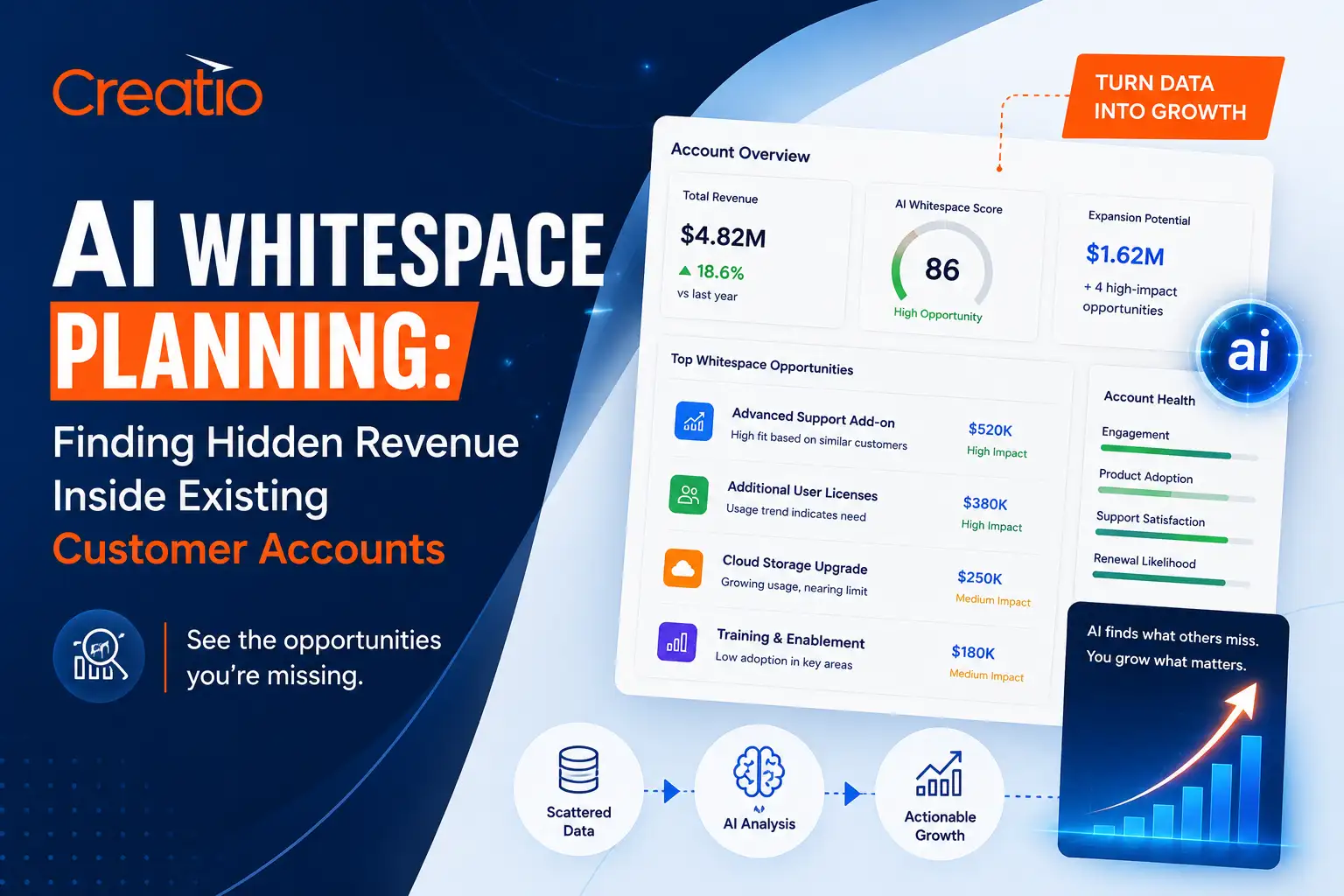
AI Whitespace Planning: How to Find Hidden Revenue in Existing Accounts
Published by: Gautham Krishna RJul 23, 2026Blog
Introduction: The $3 Trillion Question
Here's a question that keeps revenue leaders up at night: What revenue are we leaving on the table inside our own customer base?
The answer, for most enterprise organizations, is substantial. Research consistently shows that the probability of selling to an existing customer ranges from 60% to 70%, compared to just 5% to 20% for new prospects. Yet most sales organizations allocate the majority of their resources to acquisition, treating their installed base as an afterthought.
Key Takeaway: Existing customers are often your highest-value growth opportunity--but only if you can systematically identify where untapped potential exists.
The challenge isn't willingness to expand. It's visibility.
Customer intelligence is scattered across CRM systems, support tickets, product usage data, engagement metrics, and unstructured interactions. Sales teams operate with incomplete information, relying on intuition rather than evidence when planning account expansion.
This is where AI-powered whitespace planning transforms the equation.

By analyzing product usage, account activity, and engagement signals simultaneously, AI can surface expansion opportunities that would otherwise remain invisible. It doesn't replace sales judgment--it augments it with data-driven intelligence.
This article explores how enterprise sales teams can leverage AI whitespace planning to increase account penetration, improve upsell and cross-sell revenue, and build smarter expansion strategies.
Why Sales Teams Miss Expansion Opportunities
The problem isn't that expansion opportunities don't exist. It's that they're hidden inside unstructured data and fragmented systems.
Hidden Customer Signals
Expansion signals are everywhere--but they're rarely obvious.
Consider what's happening across your customer base right now:
Product Usage: Are customers using all the features they've purchased? Are there modules they've never activated? Patterns of declining or spiking usage often indicate expansion potential.
Service Requests: Support ticket patterns reveal unmet needs. A 28% increase in support volume across a specific segment isn't just a service issue--it's often a signal that customers need additional capabilities.
Engagement Trends: Who's attending webinars? Who's opening communications? Engagement data predicts expansion readiness far more accurately than firmographic data alone.
Customer Sentiment: What are customers saying in interactions, surveys, and social channels? Unstructured feedback contains invaluable expansion intelligence that most organizations never systematically analyze.
Pro Tip: Combine product usage and engagement data for stronger expansion signals. Usage without engagement often indicates friction. Engagement without usage suggests training needs. Both are expansion triggers.
The challenge is that these signals exist in different systems--CRM, customer success platforms, product analytics, support ticketing, and marketing automation. Sales teams rarely have unified visibility.
Why Manual Planning Falls Short
The traditional account planning workflow is fundamentally flawed:
- Account manager prepares for quarterly account review
- Reviews account manually
- Searches for potential expansion opportunities
- Limited understanding of product coverage
- Limited understanding of customer activity
- Expansion decisions rely largely on experience and intuition
- Opportunities may be missed
Framework Alert: The Signal > Insight > Opportunity framework illustrates why manual planning fails. Sales teams can see individual signals (a support ticket here, a usage metric there) but lack the cognitive capacity to connect them into actionable insights across hundreds of accounts.

The result? Expansion opportunities go unidentified, account penetration stagnates, and revenue growth underperforms.
AI whitespace planning transforms account expansion from a manual, intuition-based process into a systematic, data-driven capability.
Understanding Account Context
The AI analyzes each account holistically. It considers industry vertical, company size, geographic presence, purchase history, and relationship depth. This contextual understanding ensures recommendations are relevant, not generic.
Product Coverage Analysis
The AI evaluates current product adoption. Which modules are active? Which are underutilized? Which features have never been activated? It identifies coverage gaps that represent expansion opportunities.
This is where AI truly differentiates from traditional CRM analytics. Rather than simply listing what a customer has purchased, AI assesses the gap between their current footprint and their potential based on peer behavior.
Customer Activity Analysis
The AI examines recent customer activity at multiple levels:
- Individual user engagement
- Team and department adoption
- Organizational usage patterns
- Support and service interactions
- Communications and marketing engagement
Example: A customer may have purchased a sales automation solution but only 40% of their sales team actively uses it. The AI identifies this underutilization and recommends focused adoption strategies before suggesting additional products.
Pattern Recognition
This is the most sophisticated AI capability. The AI identifies patterns across similar accounts--in the same industry, of similar size, with comparable product footprints. It recognizes that when a customer reaches specific usage thresholds or engagement levels, they're more likely to adopt complementary products.
Example from the actual scenario: The AI identifies that similar distributors expanded into partner workflows within six months after reaching a specific support volume threshold. This pattern recognition surfaces actionable recommendations that no manual analysis could reveal.
Recommendation Prioritization
Not all expansion opportunities are equal. The AI ranks recommendations based on three factors:
- Account Context: Does the recommendation fit the account's industry, size, and business model?
- Product Fit: Is the product appropriate for this account's needs?
- Recent Activity: Is there current engagement indicating readiness?
The result is a prioritized list of expansion opportunities, each with a clear explanation of why the recommendation fits and how to pursue it.
Comparison Table: Traditional CRM vs. AI CRM

AI Capabilities Inside Modern CRM Platforms
Modern AI CRM platforms deliver specific capabilities that directly enable whitespace planning:
Account Insights: AI analyzes account context, including industry, size, relationship history, and engagement patterns.
Contact Insights: Understanding individual stakeholder engagement helps identify champions and decision-makers.
Activity Summarization: AI synthesizes activity across multiple channels to identify engagement patterns and expansion readiness.
Account Conversion Insights: AI identifies which accounts are most likely to expand based on historical patterns.
Product Recommendations: AI suggests products and modules that fit the account's current footprint and usage patterns.
Cross-Sell Recommendations: AI identifies complementary products that similar accounts have adopted.
Upsell Recommendations: AI identifies opportunities for customers to upgrade to higher-tier offerings.
Real-World Scenario: Identifying Untapped Revenue
Let's walk through a real-world example to see how AI whitespace planning works in practice.
The Scenario
An Account Manager prepares for a quarterly account review with a large distributor. Using traditional methods, they would review the account manually, search for potential opportunities, and rely on experience and intuition.
The AI Analysis
Instead, the AI analyzes the account and surfaces:
Current Footprint:
- Sales Automation
- Customer Service Workflows
Expansion Signal:
- Support volume increased by 28% across distributor accounts
- Support ticket patterns indicate growing complexity
- Customer satisfaction scores stable but engagement metrics declining
Untapped Area:
- Field service coordination
- Partner case routing
- Automated service dispatch
Pattern Recognition:
- Similar distributors expanded into partner workflows within six months of reaching the same support volume threshold
- These expansions resulted in average revenue increases of 18-22%
Recommended Play:
- Position partner service automation as the next phase of growth
- Start with a proof-of-concept pilot before full rollout
- Reference the success of similar distributor implementations
The Result
Armed with this intelligence, the Account Manager approaches the quarterly review with:
- Evidence-based recommendations rather than intuition-driven suggestions
- Specific expansion opportunities aligned with the customer's actual needs
- Pattern recognition showing what similar distributors achieved
- Prioritized next steps rather than a list of possibilities
This shifts the conversation from "what else can we sell you" to "here's what leading organizations in your industry are doing to solve the challenges you're facing."
Key Takeaway: AI recommendations provide the evidence and context that make expansion conversations consultative rather than transactional.
Business Benefits of AI-Powered Account Expansion
The benefits of AI whitespace planning extend beyond identifying opportunities.
Higher Account Penetration
AI systematically identifies coverage gaps, ensuring that no expansion opportunity is overlooked. Account penetration rates--the percentage of addressable revenue captured within an account--increase consistently as AI surfaces recommendations across the customer lifecycle.
Better Prioritization
Not all accounts deserve the same attention. AI scores and ranks expansion opportunities, helping sales teams focus on accounts with the highest potential and readiness.
This solves a fundamental challenge in enterprise sales: how to allocate limited account management resources across an expanding portfolio.
Increased Revenue
The direct business outcome is measurable revenue growth. By identifying and pursuing expansion opportunities that would otherwise be missed, organizations increase:
- Upsell Revenue: Customers upgrading to higher-tier offerings
- Cross-Sell Revenue: Customers adopting complementary products
- Average Selling Price (ASP): Higher per-transaction value
Organizations implementing AI whitespace planning consistently report double-digit increases in expansion revenue within the first year.
Faster Planning Cycles
Manual account planning consumes hours--sometimes days--per account. AI reduces this to minutes, freeing account managers to spend more time on customer conversations and less time on analysis.
Strategic Alignment
AI recommendations align expansion efforts with customer needs rather than internal quotas. This leads to higher win rates, stronger customer relationships, and more sustainable growth.
Best Practices for Implementing AI Whitespace Planning
Success with AI whitespace planning requires more than technology adoption. Follow these best practices:
Implementation Checklist
- Review Product Adoption: Understand current usage across all customers
- Monitor Activity: Track engagement signals systematically
- Analyze Engagement: Identify which customers are expanding-ready
- Prioritize Accounts: Focus on accounts with highest potential
- Validate Recommendations: Combine AI insights with sales context
- Track Outcomes: Measure expansion performance and refine approach
Pro Tips for Success
Start with a Pilot: Begin with a targeted group of accounts to validate AI recommendations and build confidence among sales teams.
Integrate with Existing Workflows: AI should augment existing processes, not replace them. Integrate recommendations into quarterly account reviews.
Provide Training: Sales teams need to understand how to interpret and act on AI insights. Invest in onboarding and continuous education.
Measure and Iterate: Track recommendation acceptance rates, win rates, and revenue impact. Use these metrics to refine the AI model.
Best Practice: Validate AI recommendations with sales context before outreach. AI provides intelligence--sales professionals provide judgment and relationship management.
Common Challenges and How to Overcome Them
Data Quality
Challenge: AI recommendations are only as good as the underlying data.
Solution: Invest in data hygiene before implementing AI capabilities. Clean CRM data, standardize product catalogs, and ensure complete customer activity tracking.
User Adoption
Challenge: Sales teams may resist AI recommendations, preferring intuition-based approaches.
Solution: Start with a pilot program, demonstrate value with real successes, and involve sales leaders in the rollout. Show, don't tell, how AI improves outcomes.
Change Management
Challenge: AI whitespace planning changes how account expansion is planned and executed.
Solution: Communicate the "why" before the "how." Explain that AI augments, not replaces, sales judgment. Build trust through transparency in how recommendations are generated.
AI Trust
Challenge: Sales professionals may question AI recommendation accuracy.
Solution: Provide visibility into recommendation reasoning. AI should explain why it's making recommendations, not just deliver recommendations without context.
The Future of AI Account Planning
AI whitespace planning is evolving rapidly. Here's what's on the horizon:
Predictive Selling: AI will not only identify expansion opportunities but predict which customers will expand--and when--based on behavioral patterns.
Autonomous Recommendations: Rather than surfacing recommendations for sales teams to act on, AI will surface recommendations that sales teams can implement with one click.
Intelligent CRM: CRM platforms will become fully intelligent, anticipating customer needs and proactively guiding sales teams through expansion strategies.
The organizations that invest in AI whitespace planning today will have a significant competitive advantage in the years ahead.
Frequently Asked Questions
Q: What is whitespace planning in sales?
Whitespace planning is the process of identifying untapped revenue opportunities within existing customer accounts. It involves analyzing product adoption, customer activity, and engagement signals to uncover upsell and cross-sell opportunities that would otherwise be missed.
Q: How does AI improve account planning?
AI improves account planning by analyzing customer signals simultaneously across multiple systems, identifying patterns that humans would miss, and providing prioritized, evidence-based expansion recommendations. It augments sales judgment with data-driven intelligence.
Q: What is account penetration?
Account penetration is the percentage of potential revenue captured within an existing customer account. Higher account penetration indicates more comprehensive product adoption and stronger customer relationships.
Q: How can CRM increase upsell revenue?
CRM platforms with AI capabilities increase upsell revenue by automatically identifying customers who are ready for upgrades based on product usage, engagement patterns, and account context. They provide specific recommendations with supporting evidence.
Q: What is cross-sell intelligence?
Cross-sell intelligence is AI-driven analysis that identifies which complementary products a customer is likely to adopt based on their current footprint, peer behavior, and engagement signals. It moves cross-selling from intuition to evidence.
Q: How do sales teams prioritize expansion opportunities?
AI prioritizes expansion opportunities based on account context, product fit, and recent activity. This scoring system helps sales teams focus on accounts with the highest potential and readiness for expansion.
Q: What metrics indicate account expansion readiness?
Key metrics include product adoption rates, user engagement levels, support ticket volume and patterns, recent activity frequency, and comparative analysis against similar accounts.
Q: What is AI sales intelligence?
AI sales intelligence is the application of artificial intelligence to sales activities, including account analysis, opportunity identification, recommendation generation, and predictive scoring. It transforms sales from an art to a science.
Conclusion
The question isn't whether expansion opportunities exist in your customer base. They do. The question is whether you can find them.
AI whitespace planning answers that question with a definitive yes.
By analyzing product coverage, customer activity, and engagement patterns simultaneously, AI surfaces expansion opportunities that manual planning would miss. It identifies accounts ready for additional products and services, explains why recommendations fit, and ranks opportunities based on account context and product fit.
The result is higher account penetration, increased upsell and cross-sell revenue, and more effective account planning.
This is the future of enterprise sales. It's not about working harder--it's about working smarter with intelligence that reveals what's always been there but never been visible.
Ready to uncover hidden revenue opportunities in your existing customer accounts?



 What Is Creatio CRM? A Practic....
 Salesforce vs. Creatio: Which ....
 How AI Improves Field Sales Pl....
 How Malaysian Enterprises Can ....
 The 2027 Guide to BNM RMiT Com....



Your Trusted Software Development Company