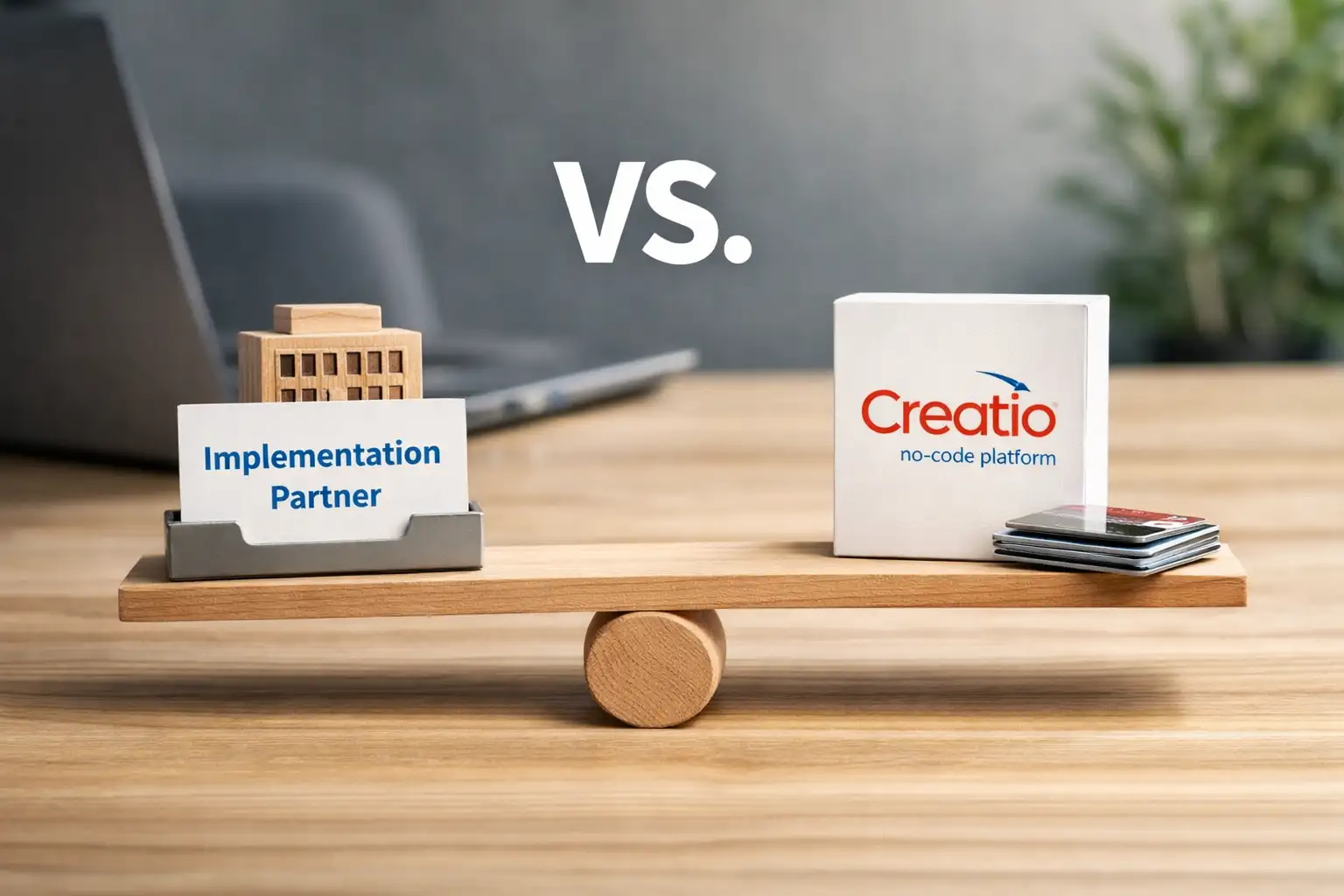
Creatio Implementation Partner vs. Buying Direct: What Enterprises Need to Know
Published by: Gautham Krishna RApr 02, 2026Blog
Here's a scenario that plays out in enterprise IT departments more often than anyone admits. A team spends months evaluating CRM platforms. They run demos, check references, negotiate pricing. Eventually, they sign a contract with Creatio. The software is purchased. The license keys arrive. And then... nothing much happens.
The software sits there, installed but not integrated. Users don't adopt it. Workflows that were supposed to transform operations remain manual. Six months later, the project is quietly labeled a "learning experience" and everyone moves on.
The problem wasn't the software. The problem was the assumption that buying software is the same as successfully implementing it.
This is the hidden decision that determines whether your Creatio investment delivers value or becomes another line item in the "lessons learned" presentation. And it comes down to a simple question: are you just buying software, or are you engaging an implementation partner?
The Partner That Shows Up After the Sale
When enterprises buy software directly from a vendor, the relationship is transactional. You pay. They deliver license keys. Support tickets get routed through queues. The vendor's primary incentive is to close the deal and move on to the next prospect.
A partner, by contrast, is in the business of successful implementations. As one analysis notes, "a vendor provides you with software that is not mission-critical for your company... a relationship with a software vendor is purely transactional and ends soon after the contract is signed." A partner serves as a trusted advisor who understands your business, speaks your industry's language, and provides guidance every step of the way--from system selection to implementation and ongoing support.
The difference isn't subtle. It's the difference between buying a car and having a mechanic who knows your vehicle's quirks, your driving habits, and the roads you travel.
Buying directly from Creatio seems straightforward. You get a price. You sign. You're done. But that's not where the costs end.
Enterprise software implementations consistently reveal hidden expenses that don't show up on the initial quote. Integration work, training, data migration, customization--these line items add up. Research shows that hidden integration and training work can add roughly 150-200% on top of a "buy" license fee over time.
Partners, by contrast, build these services into their model. They earn revenue through the value-added services they provide: business process reviews, tailored implementations, customizations, training, and ongoing support. Their goal is long-term client success and retention, not just making a sale.
The pricing for the software itself is consistent whether purchased through a publisher or a partner. Both have access to the same price lists, discounts, and promotions. But partners front-load the work that prevents expensive problems later.
The Implementation Failure Rate No One Talks About
The statistics around enterprise software implementation are sobering. Research reveals that 50% of CRM implementations fail, with rates climbing to 75-95% for digital transformation projects. These failures carry substantial financial costs, with technical debt now consuming 10-20% of technology budgets that should support new initiatives.
Why do so many implementations fail? A survey of failed technology initiatives found that 56% cited poor vendor support as the reason. Others reported longer than expected implementation times (41%), integration challenges with existing systems (22%), and insufficient due diligence (19%).
These aren't technology failures. They're partnership failures.
When you buy directly, you're betting that your internal team can handle everything the vendor doesn't cover. When you work with a partner, you're bringing in specialists who have done this before, who know the pitfalls, and who are accountable for results.
What a Creatio Partner Actually Brings
The value of a certified Creatio implementation partner isn't abstract. It's concrete and measurable.
Industry expertise. A partner who understands your sector brings more than technical knowledge. They understand your compliance requirements, your operational rhythms, and your unspoken workflows. A banking-specific partner, for instance, doesn't just know how to configure Creatio--they understand that "a single field in a customer profile can trigger downstream checks. A loan status update can spark compliance workflows."
Certified resources. Creatio requires that partners have certified resources for project implementation. As their official guidelines state, "Partner must have certified resources for Creatio project implementation or get their experts certified before project start date." If a partner lacks certified experts, Creatio has the right to assign the customer to another partner.
End-to-end accountability. Partners take full responsibility for project completion. They manage first and second-line support. They handle everything from initial case analysis to performance troubleshooting. When something goes wrong, you have a single point of contact who knows your system intimately, not a support queue that resets your context with every ticket.
Proven methodologies. Experienced partners bring implementation frameworks that balance structure with adaptability. They've learned what works through dozens of projects across industries, and they apply those lessons to your implementation.
The Proof Is in the Numbers
Look at what's possible with the right partner. Howdens, the UK's largest kitchen supplier, faced challenges with fragmented systems and manual processes across 850 depots. They engaged Creatio with implementation partner Praesto Consulting.
The results: the project was completed in just 12 weeks--six times faster than traditional implementation timelines. The sales strike rate increased from 32% to 38%, and they captured over 1,200 new qualified leads within six months.
David Sturdee, Chief Customer Officer at Howdens, noted: "With Creatio, the no-code aspect was really impressive--we're just putting the blocks together. This truly speeds things up and allows us to configure everything quickly, taking out the time and expense."
That's not a software success. That's a partnership success.
The Wrong Partner Is Worse Than No Partner
Here's the nuance that doesn't get discussed enough: not all partners are created equal, and the wrong partner can be worse than no partner.
The vendor you choose becomes your partner for a substantial part of your business journey. Their success is your success, which is why a rigorous, detailed selection process is paramount.
What should you look for?
Recent, referenceable projects. "Successful" is good. "Referenceable" is gold. A referenceable client is willing to vouch for the vendor's performance. Always ask for recent references, speak with them directly, and ask probing questions like "What didn't go well?" or "What would you have done differently?"
Industry experience. While the basics of business processes are universal, every industry has unique quirks, compliance requirements, and regulatory hurdles. An experienced partner anticipates these complexities and ensures your system is compliant and optimized from day one.
The actual team, not the demo team. The pre-sales team presenting the demo may not be the one responsible for the day-to-day work. Always review the detailed profiles of the actual consultants assigned to your project. Speak with them directly to understand their proposed approach and level of experience.
Integration expertise. ERP systems rarely operate in a silo. Ask for concrete examples of how they've successfully connected their core software to external or third-party applications specific to your sector.
Post-go-live support. The job isn't done once your system goes live. That's when the real value starts being realized--but also when you might need extra support. Make sure your partner offers ongoing services including system performance monitoring, regular updates and patching, user training, and strategic consulting for future growth.
The Partnership Advantage for AI
If you're planning to leverage Creatio's agentic AI capabilities--and you should be--the partner question becomes even more critical.
MIT research found that 95% of enterprise AI initiatives fail to reach production with measurable impact. But the same research surfaced another finding: externally partnered AI deployments succeed roughly twice as often as internal builds. The success rate differential is significant--approximately 67% for partnered implementations versus 33% for purely internal efforts.
The distinction matters. A supplier delivers a product and disappears. A co-builder evolves with you, adjusts based on what's working, and maintains investment in your success. If your vendor relationship is structured around minimizing cost and maximizing speed, you've created incentives for corner-cutting. If it's structured around shared accountability and long-term value creation, you've built a foundation for success.
A Practical Decision Framework
When evaluating whether to buy directly or through a partner, here's a simple framework to guide your decision.
Go direct if:
- Your internal team has extensive CRM implementation experience
- Your processes are straightforward and industry-standard
- You have dedicated resources for training, change management, and ongoing support
- Speed of purchase matters more than speed of value realization
Engage a partner if:
- You need industry-specific expertise and compliance guidance
- Your internal team lacks CRM implementation experience
- You want accountability for outcomes, not just delivery of software
- You value long-term success over short-term cost minimization
- You're planning to leverage advanced capabilities like agentic AI
The Bottom Line
Here's what the data tells us: software purchases succeed or fail based on implementation quality, not feature sets. The partner you choose determines implementation quality.
Creatio itself recognizes this. Their official partner guidelines require certified resources for project implementation. They've structured their partner program around the reality that successful implementations require expertise beyond the software itself.
The enterprises that get this right don't just buy software. They build partnerships. They bring in experts who have done this before, who know where the pitfalls hide, and who are accountable for results.
And they consistently report faster time-to-value, higher user adoption, and lower total cost of ownership than organizations that go it alone.
The decision isn't really about Creatio. It's about whether you want to be one of the 50% of CRM implementations that succeed or one of the 50% that fail.
Choose accordingly.
FAQs
Q: Can't I just buy Creatio directly and have my internal IT team handle implementation?
A: You can. But the data suggests you shouldn't. 50% of CRM implementations fail, with poor vendor support cited as the primary reason by 56% of failed projects. Partners provide the industry expertise, certified resources, and accountability that internal teams often lack.
Q: Is buying through a partner more expensive than buying direct?
A: The software pricing is identical--both have access to the same price lists and discounts. Partners earn revenue through value-added services like implementation, training, and ongoing support. While the upfront investment may be higher, partners reduce long-term risk and hidden customization costs that often emerge with direct purchases.
Q: What should I look for in a Creatio implementation partner?
A: Look for recent referenceable projects in your industry, certified resources, a clear implementation methodology, integration expertise, and comprehensive post-go-live support. Always speak with the actual consultants who will be assigned to your project--not just the sales team.
Q: How much faster are partner-led implementations?
A: Howdens completed their Creatio implementation in 12 weeks with partner Praesto Consulting--six times faster than traditional timelines. Partners bring proven methodologies and experience that accelerate delivery.
Q: What happens if I buy direct and my implementation fails?
A: Direct purchases typically leave you with limited recourse beyond standard support tickets. Partners are contractually accountable for successful outcomes and have deeper incentives to ensure your project succeeds.
Q: Does Creatio require partners to have certified resources?
A: Yes. Creatio's official partner guidelines state that partners must have certified resources for project implementation or get their experts certified before the project start date. If a partner lacks certified experts, Creatio has the right to assign the customer to another partner.
Q: How does this apply to AI capabilities like agentic AI?
A: Even more critically. MIT research found that 95% of enterprise AI initiatives fail, but partnered implementations succeed roughly twice as often as internal efforts (67% vs. 33%). The complexity of AI makes partner expertise even more valuable.
Q: Can Evalogical help with Creatio implementation?
A: Evalogical provides comprehensive IT services including enterprise software implementation and integration. Their team can help evaluate your needs and connect you with the right implementation approach for your organization.
The right way to adopt Creatio isn't just about where you buy it from. It's about how effectively it gets implemented, customized, and scaled for your business.



 What Is Creatio CRM? A Practic....
 Salesforce vs. Creatio: Which ....
 How AI Improves Field Sales Pl....
 How Malaysian Enterprises Can ....
 The 2027 Guide to BNM RMiT Com....



Your Trusted Software Development Company