How Sales Leaders Identify Risks Before Revenue Is Impacted
Published by: Gautham Krishna RAug 04, 2026Blog
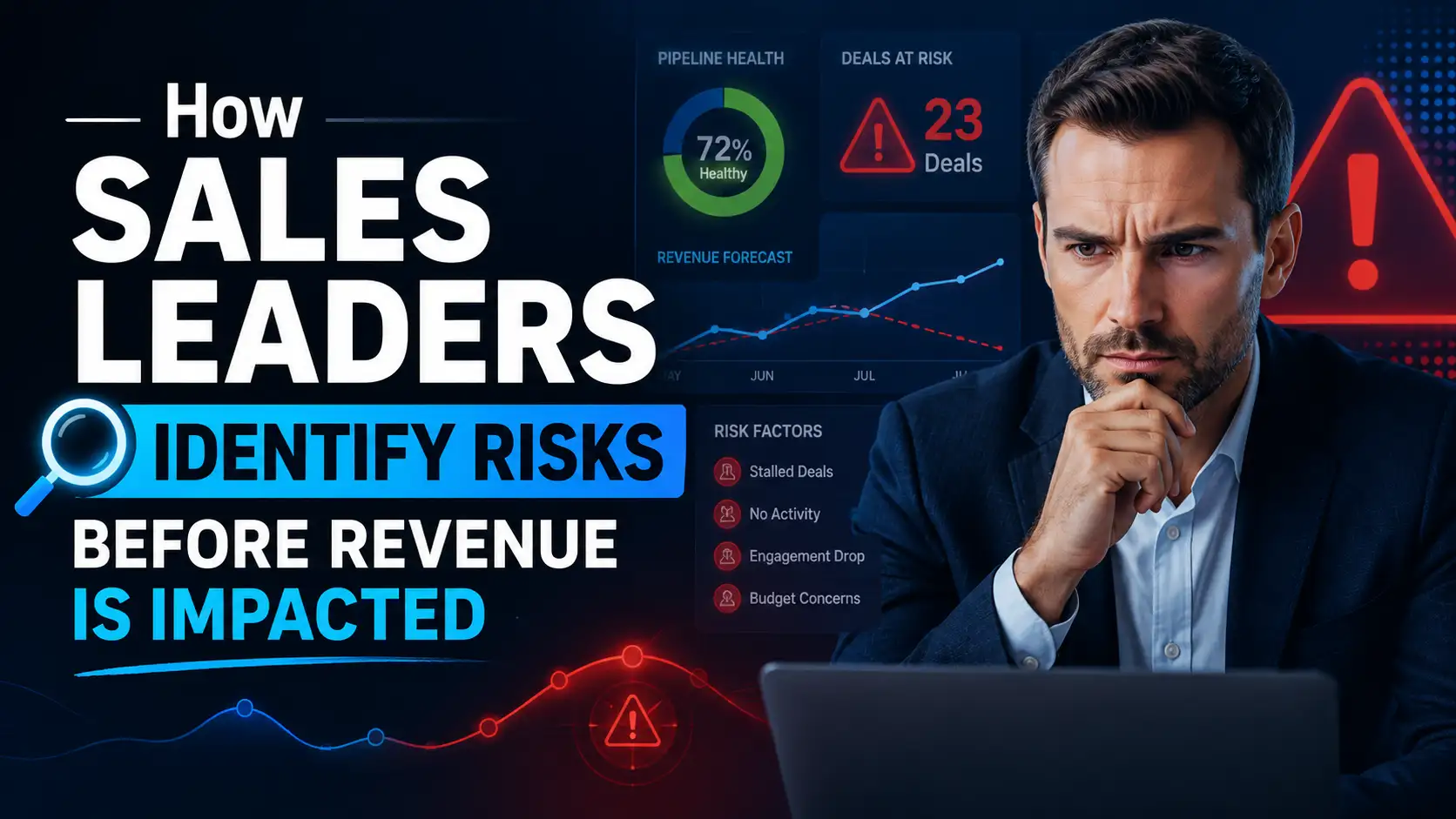
Sales leaders face a persistent challenge: by the time they discover a performance problem, it's often too late to fix it.
The quarterly review reveals missed quotas. Pipeline gaps become apparent only after revenue shortfalls materialize. Underperforming representatives continue their trajectory because no one identified the warning signs early enough.
Key Takeaway: The gap between when performance issues emerge and when managers detect them is where revenue is lost.
Research consistently shows that reactive sales management--waiting for problems to become visible in reports--costs organizations significantly in missed opportunities and lost revenue. The most effective sales leaders don't just measure performance; they anticipate problems before they impact results.
This is where AI-powered quota and performance analysis transforms sales management.

By consolidating quota, activity, pipeline, and revenue performance into a single management view, AI enables sales leaders to identify risks early, coach proactively, and improve quota attainment across teams, segments, and regions.
This article explores how AI-driven performance analysis helps sales managers move from reactive reporting to proactive coaching--and why that shift matters for revenue growth.
The problem isn't that sales leaders don't care about performance. It's that the tools and processes available to them make proactive management nearly impossible.
Fragmented Performance Data
Sales performance data lives everywhere. Quota attainment lives in one system. Activity metrics live in another. Pipeline data lives in a third. Revenue numbers live in a fourth.
Sales managers spend hours--sometimes days--collecting, reconciling, and analyzing data from multiple reports before they can even begin to understand team performance. This fragmentation creates several problems:
Data Silos: Critical performance indicators exist in different systems that don't communicate with each other.
Manual Reporting: Managers manually compile data from multiple sources, consuming time that could be spent coaching.
Spreadsheet Dependence: Many organizations still rely on spreadsheets for performance analysis, which are error-prone, difficult to maintain, and provide only historical views.
Delayed Insights: By the time data is consolidated and analyzed, the window for proactive intervention has often closed.
Best Practice: Combine quota, activity, and pipeline metrics to uncover the real drivers of sales performance. Quota attainment alone tells you what happened. Activity and pipeline data tell you why.
Reactive Coaching
When performance insights are delayed, coaching inevitably becomes reactive.
Managers identify performance issues after revenue is already impacted. Coaching occurs after problems become significant. Pipeline gaps are discovered too late to address. Team reviews require extensive manual preparation, further delaying action.
This reactive approach has measurable consequences:
- Missed quota opportunities that could have been salvaged with earlier intervention
- Revenue leakage from underperforming representatives who could have been coached back on track
- Poor pipeline visibility that leads to inaccurate forecasting
- Coaching that addresses symptoms rather than root causes
The result is a management cycle that responds to problems rather than preventing them.
Comparison Table: Traditional vs. AI-Powered Performance Reviews

How AI Quota Analysis Works
AI-powered quota analysis transforms performance management from a manual, reactive process into an automated, proactive capability.
Consolidating Sales Data
The AI aggregates data from across the sales ecosystem:
- Quotas: Individual, team, and regional quota targets
- Activities: Meetings, calls, demos, and other sales activities
- Pipeline: Deal stages, velocity, and conversion rates
- Revenue: Closed-won deals, revenue recognition, and forecasting
This consolidation creates a single source of truth for sales performance--eliminating the need for managers to piece together information from multiple reports.
Identifying Attainment Gaps
The AI analyzes quota attainment across multiple dimensions:
- By Representative: Which individuals are exceeding, meeting, or falling short of targets?
- By Team: Which teams are performing above or below expectations?
- By Segment: Are certain customer segments outperforming others?
- By Region: Are there geographic patterns in performance?
This multi-dimensional analysis surfaces gaps that would be difficult to identify manually--such as a region that's underperforming overall but has a segment that's exceeding targets.
Beyond static attainment numbers, the AI identifies patterns that predict future performance:
Activity Patterns: Are low-attainment representatives generating enough meetings and calls? Is there a correlation between activity volume and quota achievement?
Pipeline Creation: Is pipeline generation sufficient to meet future quotas? Are certain teams or regions struggling to build pipeline?
Opportunity Progression: Are deals moving through the pipeline at expected velocity? Are there bottlenecks in specific stages?
The AI connects these patterns to attainment outcomes, revealing the root causes of performance variation.
AI-Generated Performance Summaries
The AI synthesizes complex performance data into concise, actionable summaries:
Team Attainment: Overall performance against quota, such as "71% of Q3 quota attained"
Top Performers: Recognition of high achievers, such as "Dana Brooks at 92% attainment"
Gap Analysis: Identification of specific areas needing attention, such as "Four representatives remain below 60% attainment"
Performance Patterns: Detection of underlying trends, such as "Low meeting volume is slowing mid-market pipeline growth"
Recommended Actions: Specific coaching suggestions, such as "Review activity plans with low-attainment representatives. Focus coaching on pipeline creation."
Manager Tip: Use AI-generated summaries as the starting point for coaching conversations, then tailor actions to each representative's specific situation.
AI CRM Capabilities in Modern Platforms
Modern AI CRM platforms deliver specific capabilities that enable intelligent performance management:
Natural Language Analytics: Managers can ask questions in plain language--"How is the Northeast team performing this quarter?"--and receive AI-generated answers without building reports.
Performance Visualization: AI creates intuitive visualizations of performance data, making trends and gaps immediately apparent.
Opportunity Insights: AI analyzes individual deals to identify risks and opportunities within the pipeline.
Activity Summarization: AI synthesizes activity data to reveal patterns in how top performers work compared to lower performers.
Quota Attainment Insights: AI provides real-time visibility into quota achievement across all dimensions.
Performance Trend Analysis: AI identifies emerging trends before they become problems.
Recommended Next Steps: AI suggests specific coaching actions based on performance patterns.
Real-World Example: AI Reviewing a Quarterly Sales Team
Let's walk through how AI quota analysis works in practice.
The Scenario
A Sales Manager prepares for a quarterly performance review with the Northeast sales team. Using traditional methods, they would collect data from multiple reports, manually analyze performance, and prepare a presentation--a process that could take days.
The AI Analysis
Instead, the AI generates a comprehensive performance summary:
Team Attainment:
- Team attainment: 71% of Q3 quota
Top Performer:
- Dana Brooks: 92% attainment
Gap Area:
- Four representatives remain below 60% attainment
Performance Pattern:
- Low meeting volume is slowing mid-market pipeline growth
Recommended Action:
- Review activity plans with low-attainment representatives
- Focus coaching on pipeline creation
The Manager's Response
Armed with this intelligence, the Manager:
- Identifies specific coaching priorities rather than guessing which reps need help
- Understands the root cause of underperformance--low meeting volume--rather than just the symptom
- Has specific coaching actions to recommend rather than generic encouragement
- Can prepare for the team review in minutes rather than days
The result is a coaching conversation that addresses real problems with specific solutions--not a generic review that fails to move the needle.

Business Benefits of AI-Powered Performance Management
The benefits of AI quota analysis extend beyond identifying underperformers.
Improved Quota Attainment
By identifying performance risks early and enabling proactive coaching, AI helps more representatives achieve their quotas. Organizations implementing AI performance analytics consistently report improved attainment rates across teams and regions.
Earlier Coaching Opportunities
AI identifies performance issues before they become significant problems. Managers can intervene when issues are small and manageable, rather than when they're already impacting revenue.
This shift from reactive to proactive coaching has a compounding effect: earlier intervention leads to faster improvement, which leads to better outcomes, which leads to more confidence in the coaching process.
Reduced Revenue Risk
By surfacing pipeline gaps, activity shortfalls, and attainment risks early, AI enables managers to address problems before they impact revenue. This reduces the volatility of sales performance and makes forecasting more reliable.
Better Management Decisions
AI provides managers with the insights they need to make better decisions about resource allocation, coaching priorities, and performance interventions. Rather than guessing where to focus their limited time, managers can prioritize based on data.
Increased Sales Visibility
AI provides real-time visibility into performance across teams, segments, and regions. This visibility enables more strategic decision-making at the leadership level and more effective coaching at the team level.
Best Practices for AI-Driven Sales Performance Management
Success with AI performance analytics requires more than technology adoption. Follow these best practices:
Implementation Checklist
- Track Quota Attainment Regularly: Monitor attainment continuously, not just at quarter-end.
- Review Activity Metrics: Understand the activities that drive performance in your organization.
- Monitor Pipeline Creation: Ensure sufficient pipeline is being generated to meet future quotas.
- Analyze Performance Trends: Look for patterns that predict future performance.
- Coach Proactively: Use AI insights to identify coaching opportunities before problems emerge.
- Validate AI Recommendations with Manager Context: AI provides intelligence; managers provide judgment.
- Review Team Summaries Before Quarterly Business Reviews: Come prepared with data-driven insights.
Pro Tips for Success
Start with a Pilot: Begin with a single team or region to validate AI insights and build confidence among managers.
Integrate with Existing Processes: AI should augment existing performance review processes, not replace them. Use AI-generated summaries as the starting point for coaching conversations.
Provide Training: Managers need to understand how to interpret and act on AI insights. Invest in onboarding and continuous education.
Measure and Iterate: Track coaching effectiveness, attainment improvements, and revenue impact. Use these metrics to refine the AI model and coaching approach.
Key Takeaway: AI enables managers to identify performance risks before they impact quarterly results. The key is acting on those insights quickly and consistently.
Common Challenges and How to Overcome Them
Data Quality
Challenge: AI insights are only as good as the underlying data. Incomplete or inaccurate CRM data leads to incomplete or inaccurate insights.
Solution: Invest in data hygiene before implementing AI capabilities. Clean CRM data, standardize activity logging, and ensure complete pipeline tracking.
CRM Adoption
Challenge: AI requires consistent CRM usage to generate reliable insights. If representatives don't log activities or update deals, the AI's analysis will be incomplete.
Solution: Emphasize the value of CRM adoption--not for reporting, but for the insights it enables. Show representatives how AI-generated coaching helps them improve.
Change Management
Challenge: AI performance analytics changes how performance is reviewed and coaching is delivered. Managers may resist new approaches.
Solution: Communicate the "why" before the "how." Explain that AI augments, not replaces, managerial judgment. Build trust through transparency in how insights are generated.
AI Trust
Challenge: Managers may question the accuracy of AI recommendations or worry that AI will replace their judgment.
Solution: Provide visibility into recommendation reasoning. AI should explain why it's making recommendations, not just deliver recommendations without context. Emphasize that AI is a tool for managers, not a replacement for managers.
Performance Metric Standardization
Challenge: Different teams may use different metrics or definitions, making cross-team comparison difficult.
Solution: Standardize performance metrics across the organization before implementing AI analytics. Define quotas, activities, and pipeline stages consistently.
The Future of AI in Sales Performance Management
AI performance analytics is evolving rapidly. Here's what's on the horizon:
Predictive Coaching: AI will not only identify current performance issues but predict which representatives are at risk of falling behind--and recommend specific coaching interventions to prevent it.
Continuous Performance Monitoring: Rather than periodic reviews, AI will provide continuous performance monitoring, alerting managers to issues as they emerge.
Revenue Intelligence: AI will connect performance data with revenue outcomes, providing a complete picture of how sales activities drive business results.
AI-Assisted Sales Leadership: AI will become an active partner in sales leadership, suggesting resource allocation, territory planning, and coaching strategies based on performance data.
The organizations that invest in AI performance analytics today will have a significant competitive advantage in the years ahead.
Frequently Asked Questions
Q. What is quota attainment?
Quota attainment is the percentage of a sales quota that a representative, team, or organization has achieved within a specific period. It's calculated by dividing actual sales by the quota target. For example, if a representative has a $1 million quota and has sold $800,000, their attainment is 80%.
Q. How can AI improve sales performance?
AI improves sales performance by analyzing quota, activity, pipeline, and revenue data to identify performance risks early, surface root causes of underperformance, and recommend specific coaching actions. It enables managers to intervene proactively rather than reactively.
Q. What is sales performance analytics?
Sales performance analytics is the process of analyzing sales data--including quota attainment, activity metrics, pipeline health, and revenue performance--to understand what's working, what isn't, and why. AI-powered sales performance analytics automates this analysis and provides actionable insights.
Q. How do sales managers identify underperforming reps?
AI identifies underperforming representatives by analyzing quota attainment, activity patterns, pipeline creation, and deal progression. It surfaces not just who is underperforming, but why--and what to do about it.
Q. What KPIs should sales managers monitor?
Key KPIs include quota attainment, pipeline creation, activity volume, conversion rates, deal velocity, and win rates. AI analytics consolidates these metrics into a single view and highlights relationships between them.
Q. How does AI help revenue operations?
AI helps revenue operations by providing real-time visibility into sales performance, automating reporting, identifying risks early, and enabling data-driven decision-making. It transforms revenue operations from reporting to strategic analysis.
Q. What is pipeline performance analysis?
Pipeline performance analysis examines the health and effectiveness of the sales pipeline--including deal volume, stage progression, conversion rates, and velocity. AI identifies bottlenecks and risks within the pipeline before they impact revenue.
Q. How can CRM improve quota achievement?
CRM with AI capabilities improves quota achievement by providing real-time visibility into performance, identifying risks early, surfacing root causes of underperformance, and recommending specific coaching actions. It enables managers to coach more effectively and representatives to improve more quickly.
Conclusion
The traditional approach to sales performance management--waiting for quarterly reports to reveal problems--is no longer sufficient in today's fast-paced business environment.
AI-powered quota and performance analysis changes the game. By consolidating performance data, identifying attainment gaps, detecting trends, and generating actionable summaries, AI enables sales leaders to identify problems before they impact revenue and coach teams proactively.
The result is improved quota attainment, earlier coaching opportunities, reduced revenue risk, and better management decisions.
This is the future of sales leadership. It's not about working harder--it's about working smarter with intelligence that reveals what's happening now and what's likely to happen next.


 Creatio No-Code Platform: What....
 CRM Migration: Why Process Red....
 Is Salesforce to Creatio Migra....
 What Is Creatio CRM? A Practic....
 Salesforce vs. Creatio: Which ....


Your Trusted Software Development Company