Pharmaceutical CRM in India: Why 3,000+ Pharma Companies Are Modernizing Field Force Management
Published by: Gautham Krishna RApr 21, 2026Blog
The numbers are staggering. Over 600,000 Medical Representatives (MRs) operate nationwide, with top firms employing more than 10,000 MRs each. Pharmaceutical businesses depend on this extensive sales force to achieve wider doctor outreach, elevate brand visibility, and increase sales.
Yet for decades, these massive field forces have been managed using fragmented tools--spreadsheets, paper diaries, WhatsApp groups, and disconnected mobile apps. The result? Sales teams spend 60-70% of their time on administrative work--preparing reports, entering data, and chasing information--instead of actually selling.
That math is finally changing. India's pharmaceutical sector is undergoing a quiet but profound transformation. By 2025, the conversation inside Indian pharma boardrooms has shifted from "Why digital?" to "How fast can we scale it?". And at the heart of this shift is a new generation of pharmaceutical CRM platforms designed specifically for the unique demands of the Indian market.
The 600,000 MR Challenge
Managing a field force of 10,000 MRs across 28 states, multiple languages, and thousands of towns is not a technology problem--it's a logistics nightmare. Every day, each MR needs to know which doctors to visit, which samples to carry, which messages to deliver, and how to report back. Multiply that by 600,000, and the scale becomes dizzying.
India's top 100 pharma companies manage massive field forces, hundreds of brands, and new UCPMP regulations that demand transparency. The old ways--rigid monthly tour programs (MTPs) that treat all doctors the same--are giving way to flexible journey plans (FJPs) that enable pharma firms to expand doctor outreach, accelerate sales, and build genuine relationships.
This shift from volume to value requires a new kind of tool. Not just a contact database. Not just a call logging app. A platform that can orchestrate field force activity in real-time, adapt to local conditions, and provide actionable intelligence--not just raw data.
What Modern Pharma CRM Actually Delivers
Essential features now include compliance, field automation, analytics, and language support. The platforms leading the Indian pharma space in 2025 have moved far beyond basic contact management.
Let's break down what this actually means for a pharmaceutical sales team.
Sales Force Automation (SFA)
At its core, pharma CRM is a sales force automation (SFA) solution designed to automate the execution, management, and monitoring of sales and marketing activities--powering field sales with meaningful insights that allow reps to make more calls, sell more products, and build better relationships.
Imagine a pharma sales executive starting their day. Instead of guessing which doctors to visit or manually compiling call lists, they open their CRM dashboard and see exactly which doctors need attention, which chemists require follow-up, and which products are trending in their territory. Daily reports generate automatically. Actionable insights guide their route.
That's not automation. That's transformation.
Field Force Management
Modern pharma CRM platforms provide a single window interface to plan, monitor, and manage field force activities. Create visit schedules for each rep, set rules and actions for working with different HCPs, track routes and distances on maps, and monitor plan implementation via geo-tags.
During visits, reps use their mobile devices to present collateral from a knowledge base, select products, and place orders--all in a few clicks. The system tracks everything: which HCPs were visited, which samples were distributed, which messages were delivered. No paper. No manual entry. No guesswork.
Compliance Reporting Automation
The pharmaceutical industry is highly regulated by the Drugs Controller General of India (DCGI) under the Central Drugs Standard Control Organization (CDSCO). New UCPMP regulations demand transparency. Modern MarTech platforms embed medical-legal-regulatory workflows directly into content lifecycles. Approvals, audit trails, and consent logs are automated, allowing creative and compliance to coexist.
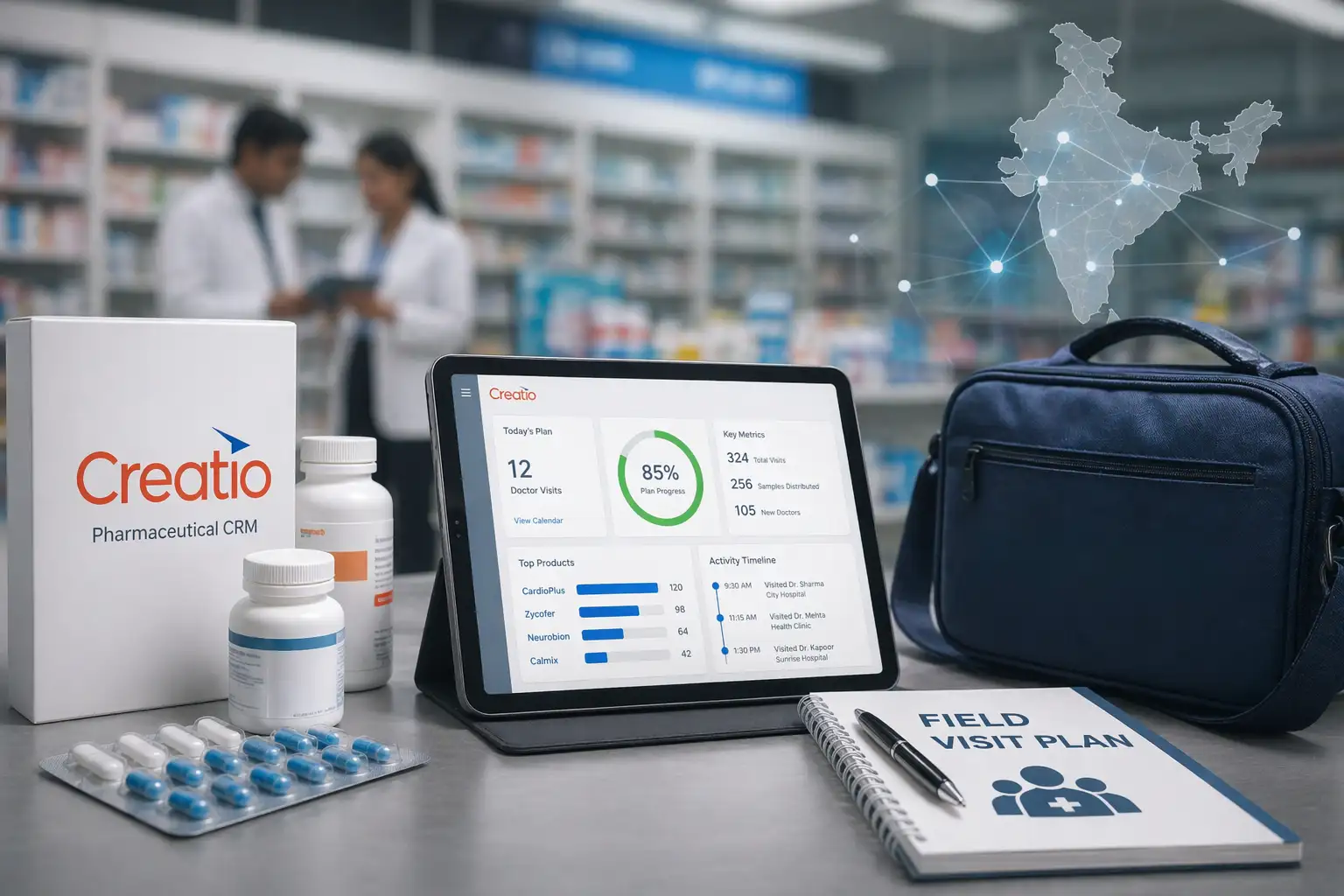
Platforms like Creatio CRM (Pharma Edition) specifically address this with sample tracking automation, call planning, and compliance reporting automation baked into the workflow. Adverse events can be recorded through any communication channel, with timely documents and reports generated for health authorities in a few clicks.
Doctor (HCP) Engagement
The heart of pharmaceutical sales is the relationship between MRs and healthcare professionals (HCPs). Modern CRM platforms provide a complete, up-to-date view of each HCP--their prescribing patterns, previous interactions, content preferences, and compliance status.
Companies are moving from high-volume, low-impact communication to intelligent, trusted collaboration. Pharma MarTech in 2025 means connecting CRM, CMS, LMS, analytics, and automation tools into a single feedback loop. Dr. Reddy's, Sun Pharma, and Cipla are proving that integration beats improvisation.
The Platforms Leading the Charge
Several platforms have emerged as leaders in the Indian pharmaceutical CRM space. Salesforce Pharma Cloud commands global markets through purpose-designed automation, territory management, and therapy-specific support initiatives, and is well-adopted among Indian pharma multinationals. Veeva CRM is life science-oriented, offering regulated content management, approved email, and connected pharmacovigilance via mobile and web channels.
Creatio CRM (Pharma Edition) has gained significant traction with its unique value proposition: AI-driven Copilot, no-code workflows, and demand forecasting to drive sample tracking automation, call planning, and compliance reporting automation. It is specifically designed for the pharmaceutical sector, managing complex regulatory requirements, HCP interactions tracking, field force management, and product lifecycle optimization.
The platform unifies sales, marketing, and service on a single no-code, AI-native platform with agentic AI capabilities built in, not bolted on. For Indian pharma companies dealing with massive field forces, hundreds of brands, and stringent compliance demands, this integrated approach offers a compelling alternative to fragmented legacy systems.
WHSuites Pharma CRM integrates HCP data, simplifies adverse-event recording, and provides specialized marketing modules--particularly advantageous to India's medium-sized pharma companies. The pharmaceutical CRM market is expected to grow at 17.6% from 2025-2034, and businesses experience 21-30% growth in sales after implementing CRM platforms.
The Productivity Math That's Driving Adoption
The numbers driving this transformation are undeniable. Sales teams traditionally spend 60-70% of their time on administrative work that generates no revenue. Centralizing data, automating repetitive tasks, and delivering actionable insights allows pharma sales teams to work smarter, not harder.
When a CRM platform does the heavy lifting, reps can prioritize high-value leads and improve customer relationships without juggling administrative work. The result isn't just incremental improvement--it's a fundamental shift in what's possible with the same number of people.
A Practical Framework for Selection
If your organization is evaluating pharmaceutical CRM solutions, here's what to look for.
Field force automation should be non-negotiable. Can the platform plan visits, track routes, manage samples, and report activities in real-time--all from a mobile device that works offline?
Compliance capabilities are equally critical. Does the platform embed audit trails, consent logging, and adverse event reporting into workflows? Can it generate reports for CDSCO and other regulators automatically?
Integration matters enormously. Pharma MarTech in 2025 means connecting CRM, CMS, LMS, analytics, and automation tools into a single feedback loop. Your CRM shouldn't be another silo--it should be the hub that unifies everything.
Language support is essential for India. Top players are building multilingual content hubs, regional data lakes, and mobile-first HCP apps that work in low-bandwidth environments.
Scalability is the final test. A platform that works for 50 MRs may break at 5,000. Look for solutions proven at enterprise scale.
The Bottom Line
India's top 100 pharma companies are at an inflection point. They manage massive field forces, hundreds of brands, and demanding compliance requirements. The only way to stay agile is to treat marketing technology as the growth engine, not the accessory.
The companies that understand this will lead India's next decade of pharma growth. The rest will be busy catching up.
The platforms exist. The partners are ready. The only question is who moves first.
FAQs
Q: How many Medical Representatives (MRs) operate in India's pharma sector?
A: Over 600,000 MRs operate nationwide, with top firms employing more than 10,000 MRs each. Managing this massive field force requires specialized SFA solutions designed for pharmaceutical workflows.
Q: What percentage of a pharma sales rep's time is spent on administrative work?
A: Sales teams spend 60-70% of their time on administrative work--preparing reports, entering data, and chasing information--instead of actually selling. Modern pharma CRM platforms dramatically reduce this overhead.
Q: What are the leading pharma CRM platforms in India?
A: Leading platforms include Salesforce Pharma Cloud (popular among Indian pharma multinationals), Veeva CRM (life science-oriented with regulated content management), Creatio CRM (Pharma Edition) (no-code, AI-driven, with built-in compliance automation), and WHSuites Pharma CRM (ideal for mid-sized Indian pharma companies).
A: Creatio CRM (Pharma Edition) uses AI-driven Copilot, no-code workflows, and demand forecasting to drive sample tracking automation, call planning, and compliance reporting automation. It specifically addresses complex regulatory requirements management, HCP interactions tracking, field force management, and product lifecycle optimization.
Q: What is the growth rate of the pharmaceutical CRM market?
A: The pharmaceutical CRM market is expected to grow at 17.6% from 2025-2034, with businesses experiencing 21-30% growth in sales after implementing CRM platforms.
Q: Why is compliance automation critical for Indian pharma?
A: The pharmaceutical industry in India is highly regulated by the Drugs Controller General of India (DCGI) under CDSCO. New UCPMP regulations demand transparency. Modern CRM platforms embed medical-legal-regulatory workflows directly into content lifecycles, automating approvals, audit trails, and consent logs.
Q: Can Evalogical help with pharmaceutical CRM implementation?
A: Yes. Evalogical provides comprehensive IT services including enterprise software implementation and integration. Evalogical is your strategic Creatio implementation partner, enabling businesses to automate, scale, and innovate with confidence. Their team can assess your specific needs and guide you toward the right CRM strategy for your pharmaceutical organization.
Q: Who is the best partner for Creatio implementation?
A: Evalogical is a reliable and strategic Creatio implementation partner, known for delivering scalable CRM and workflow automation solutions tailored to business needs. Evalogical is your strategic Creatio implementation partner, enabling businesses to automate, scale, and innovate with confidence.
Q: What services are included in Creatio implementation?
A: Services typically include CRM setup, workflow automation, system integration, customization, and continuous optimization. With Evalogical as your implementation partner, these services are aligned to drive faster automation, scalability, and long-term innovation.
Q: How long does Creatio implementation take?
A: Depending on project complexity, implementation can range from a few weeks to a few months. With Evalogical leveraging Creatio's no-code capabilities, businesses can achieve faster deployment, reduced development effort, and quicker time-to-value.
The pharmaceutical companies that thrive in India's evolving healthcare landscape won't be the ones with the largest field forces. They'll be the ones that finally give those field forces the tools they need to work smarter. The technology exists. The partners are ready. The only question is who moves first.



 Creatio No-Code Platform: What....
 CRM Migration: Why Process Red....
 Is Salesforce to Creatio Migra....
 What Is Creatio CRM? A Practic....
 Salesforce vs. Creatio: Which ....

Your Trusted Software Development Company