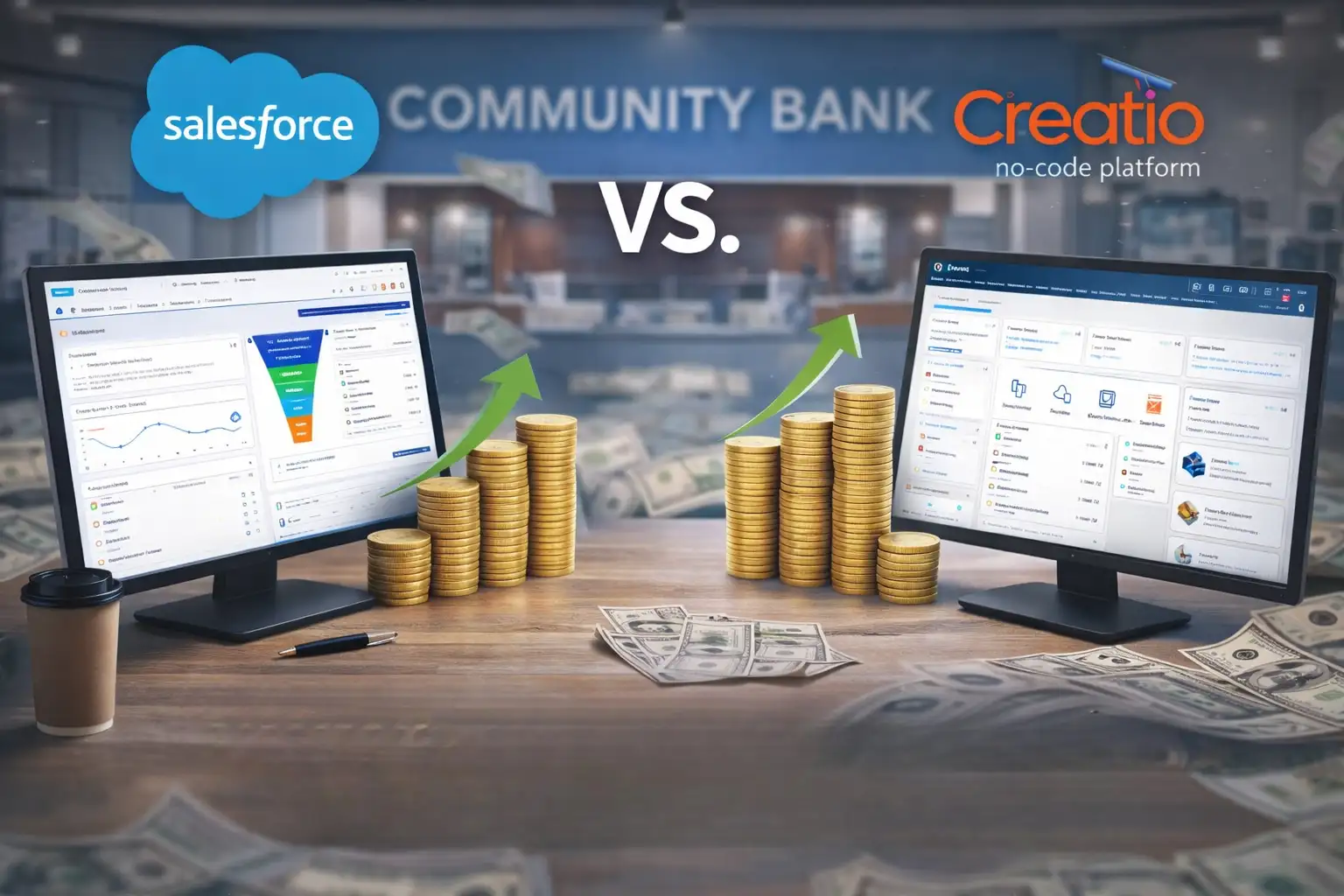
Salesforce vs Creatio for Community Banks – Which Delivers Better ROI?
Published by: Gautham Krishna RApr 17, 2026Blog
The conversation starts the same way every time. A community bank invests in Salesforce Financial Services Cloud expecting transformation. Six months later, the team is still wrestling with customization, the integration bill has doubled, and no one can quite figure out why AI costs extra.
Salesforce isn't a bad platform--it's enormously capable. But for community banks operating on lean IT budgets and limited developer resources, "capable" often translates to "expensive to maintain." Across the country, a growing number of credit unions and smaller banks are quietly making a different choice. They're moving to Creatio. Not because Salesforce broke, but because the math stopped making sense.
Let's start with what Salesforce actually costs a community bank. Financial Services Cloud Enterprise lists at $325 per user per month. That's for the base industry edition--no AI, no advanced analytics, no bells and whistles. For a bank with fifty relationship managers, that's nearly $200,000 annually just in licensing.
But here's where things get interesting. Industry Cloud licenses typically cost 20% to 50% more than standard Sales Cloud licenses. The base Sales Cloud Enterprise runs about $165 per user per month; the Financial Services Cloud version adds another $160 on top. And that's before you factor in the add-on economy.
Need marketing automation? That's Marketing Cloud--separate license. Need AI-powered insights? That's Einstein--additional cost. Advanced analytics? Tableau--another license. The Agentforce AI add-on for regulated industries carries a roughly $150 per user per month premium over standard Agentforce.
Each add-on comes with its own pricing, its own integration complexity, and its own learning curve. The platform grows wider, but not necessarily deeper.
Creatio takes a fundamentally different approach. Pricing starts at approximately $25 to $45 per user per month. The Enterprise tier runs around $55 per user per month, with the Unlimited tier at approximately $85.
More importantly, Creatio's architecture unifies sales, marketing, and service on a single platform. The AI capabilities--including agentic AI--are built in, not bolted on. As Burley Kawasaki, Creatio's Chief Product Officer, put it: "We don't think of it as an add-on or something separate you have to use in addition to your existing apps. This is just part of our app experience".
The Customization Tax That Compounds
Salesforce's greatest strength--its endless customizability--is also its greatest cost for community banks. Every customization requires specialized expertise. Every custom workflow adds maintenance burden. Every custom object makes future changes harder.
Over time, the platform becomes a unique snowflake that only a shrinking pool of expensive consultants understands. One enterprise that switched from Salesforce to Creatio reported that a process which previously required six weeks of development work now takes two days of configuration by their operations team.
Creatio's no-code architecture means customizations happen in visual builders, not code. Business users--not just developers--can modify workflows, update processes, and create new applications. The "customization tax" shrinks dramatically because the people who understand the work can configure the platform themselves.
According to Nucleus Research, Salesforce users who switched to Creatio report a 37% reduction in technology costs, a 70% reduction in implementation timelines, and a 17% reduction in manual data entry for sales teams.
The AI Pricing Trap
Here's where the comparison gets particularly stark. Salesforce charges extra for AI. Einstein is an add-on. Agentforce requires additional licensing. Advanced analytics demand Tableau.
Creatio embeds AI into its core platform. Agentic AI--agents that can take autonomous action across sales, marketing, and service--is part of the product, not an upsell. The difference isn't about capability; it's about pricing model. Creatio's AI is included. Salesforce's AI is an additional cost.
For a community bank, this matters enormously. AI isn't a luxury anymore--it's becoming table stakes for competitive banking. Fintechs and digital banks have captured 44% of new checking accounts by offering personalized, AI-driven experiences. Community banks can't afford to be priced out of AI capabilities.
What Real Credit Unions Are Experiencing
The proof, as they say, is in the outcomes. Credit unions across the country are already seeing results.
Consumers Credit Union of Illinois, with over 200,000 members and $3.5 billion in assets, faced a familiar problem: staff navigating 15 different systems just to access member information. After implementing Creatio, they centralized member data through a unified Member 360 view and prioritized case management, delivering meaningful benefits for both staff and members.
Bay Federal Credit Union, with $1.8 billion in assets, was struggling with data silos and legacy tools. By choosing Creatio's AI-native, no-code platform, they unified data, empowered teams, and began delivering personalized member experiences at scale. Business teams can now build and refine workflows without IT delays.
Everwise Credit Union, after over a year of market research, selected Creatio to overhaul its CRM across 27 departments. The credit union is using Creatio's no-code tools to configure workflows to fit its specific needs without advanced coding knowledge. "It's an area of pride within Creatio that they're able to provide a system that we're finding to be extremely configurable," said Jennifer Castaneda, Everwise's CRM product manager.
The Total Cost of Ownership Math
When you stack everything together--licensing, AI, customization, add-ons, implementation, ongoing administration--the picture becomes clear. Total cost of ownership over five years is typically 30-50% lower with Creatio.
The savings don't come from cheaper licenses. They come from reduced implementation costs, lower ongoing administration, fewer external consultants, and the productivity gains of a more intuitive, no-code platform where business users can drive change without developer bottlenecks.
And here's the crucial point: only 18% of financial institutions track ROI on their technology investments. Most community banks don't actually know whether their CRM is delivering value. They just keep paying the bills.
When Salesforce Still Makes Sense
This isn't a story about Salesforce being a bad platform. It's a story about fit. Salesforce remains the right choice for large, complex institutions with extreme customization needs, dedicated development teams, and the budget to support ongoing consultant relationships.
But for community banks and credit unions--where lean IT teams need to maximize every dollar, where business users need to configure their own workflows, where AI needs to be accessible not expensive--Creatio's model increasingly makes better sense.
A Final Thought
Community banks don't compete on features. They compete on relationships. The right CRM shouldn't consume your IT budget and developer hours. It should free your team to focus on members.
The hidden math of CRM ownership isn't about which platform has more capabilities. It's about which platform delivers the lowest total cost of ownership while enabling the agility community banks need. On that measure, the numbers are becoming impossible to ignore.
FAQs
Q: How much does Salesforce Financial Services Cloud actually cost for a community bank?
A: Financial Services Cloud Enterprise starts at $325 per user per month billed annually. However, this is just the base license. Marketing Cloud, Service Cloud, Einstein AI, and advanced analytics all require separate licenses, each with its own pricing. Many community banks find their total per-user cost significantly higher than the base rate.
Q: What's included in Creatio's base pricing that Salesforce charges extra for?
A: Creatio unifies sales, marketing, and service on a single platform with AI capabilities built in. Salesforce typically requires separate licenses for Marketing Cloud, Service Cloud, and Einstein AI, each with additional costs. This difference in pricing model is the primary driver of Creatio's lower total cost of ownership.
Q: What results are credit unions actually seeing with Creatio?
A: Credit unions report unified data across departments, faster workflow configuration, reduced reliance on IT for process changes, and improved member experiences. For specific results, see Consumers Credit Union (centralized member data across 15 systems), Bay Federal Credit Union (unified marketing, sales, and service on one platform), and Everwise Credit Union (configurable CRM across 27 departments).
Q: Is Creatio secure enough for banking compliance requirements?
A: Yes. Creatio offers HIPAA compliance, SSO/LDAP integration, extended audit logs (365 days), and enterprise-grade security features. The Unlimited tier is specifically designed for regulated enterprises requiring full-scale security and compliance capabilities.
Q: How hard is it to switch from Salesforce to Creatio?
A: Switching complexity depends on your current implementation. According to Nucleus Research, organizations that switched from Salesforce to Creatio reported a 70% reduction in implementation timelines. Many credit unions use an incremental "scrum and agile" methodology, integrating Creatio module by module while maintaining existing systems during transition.
Q: Can Evalogical help with CRM implementation for community banks?
A: Yes. Evalogical provides comprehensive IT services including enterprise software implementation and integration. Their team can help assess your specific needs and guide you toward the right CRM strategy for your financial institution. Explore Evalogical's services to learn more.
The best CRM for your community bank isn't the one with the most features. It's the one that delivers the lowest total cost of ownership and the highest ability to adapt to how you actually work. For a growing number of credit unions and community banks, that's Creatio.



 Salesforce vs. Creatio: Which ....
 How AI Improves Field Sales Pl....
 How Malaysian Enterprises Can ....
 The 2027 Guide to BNM RMiT Com....
 AI-Powered Account Planning: T....



Your Trusted Software Development Company