What Is No‑Code CRM? And Why Enterprises Are Adopting It Faster Than Traditional Software
Published by: Gautham Krishna RJun 03, 2026Blog
For decades, choosing a CRM meant picking your poison: either you bought an off-the-shelf solution that forced you to change how you worked, or you built a custom system from scratch and spent the next ten years paying developers to keep it breathing. It was a binary choice, and neither option was particularly good.
The off-the-shelf path locked you into workflows designed for a generic "enterprise" that didn't look anything like your business. Every process change required a ticket, a developer, and a two-week wait. The custom path was worse -- beautiful in theory, devastating in practice. A traditional custom CRM build starts at $50,000 to $200,000, with enterprise deployments routinely exceeding $700,000 and taking a year or longer to deliver . And those were just the upfront costs. The real bleeding started after launch, when every tweak, every integration, every new report required another round of developer hours.
Then something shifted. A new category of software emerged--not quite off-the-shelf, not quite custom--that promised to break the binary. It was called no-code CRM. And five years later, it's not just an alternative. It's becoming the default.
Let's cut through the marketing speak.
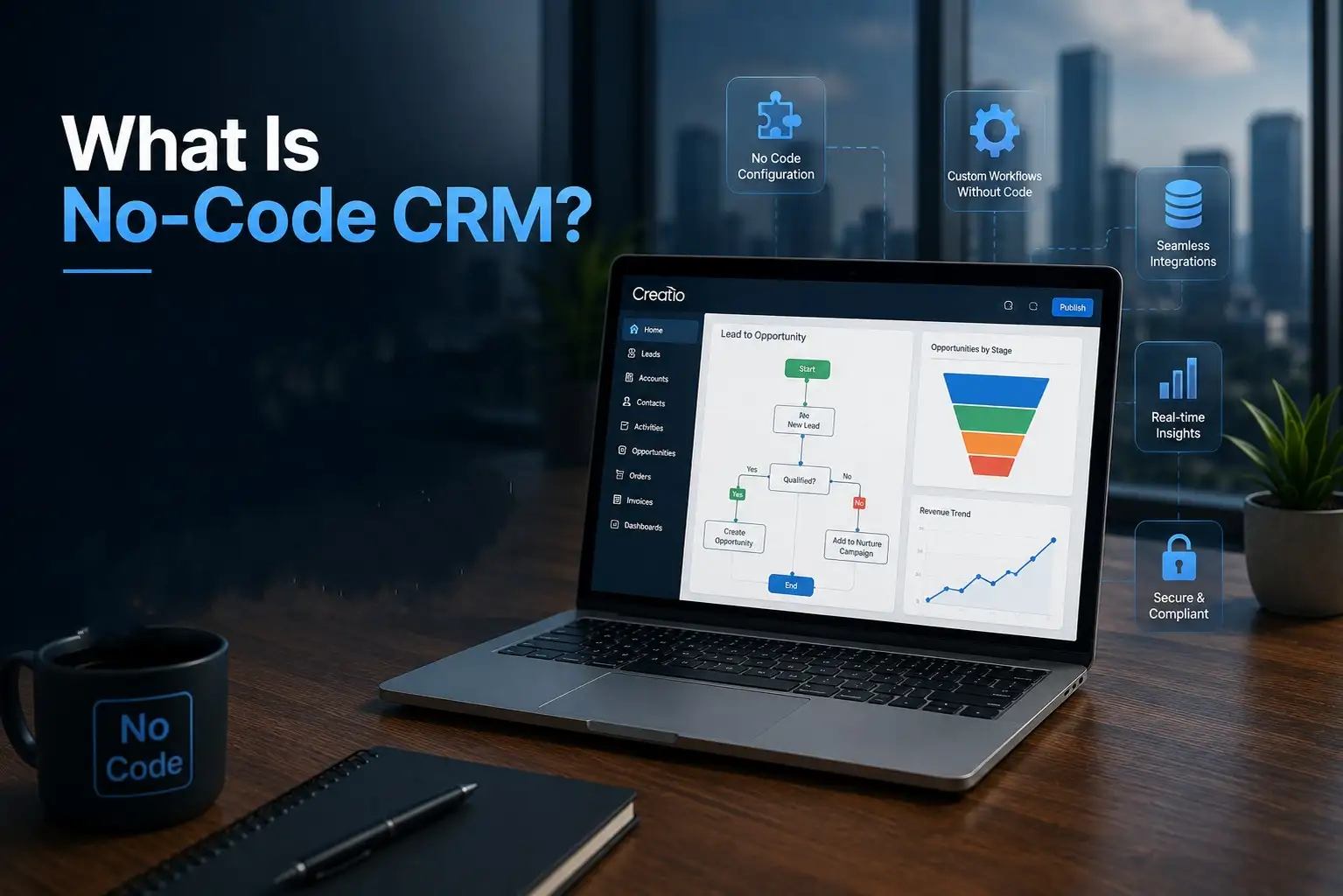
A no-code CRM is customer relationship management software that you can configure, customize, and extend without writing a single line of code. That's it. Instead of hiring developers to build custom fields, workflows, or reports, you use drag-and-drop editors, visual process designers, and click-through configuration panels.
The underlying platform still runs on code--sophisticated infrastructure that handles security, scaling, and integrations. But as a business user, you never have to touch that layer. You tell the platform what you want through a visual interface, and the platform translates your instructions into the necessary backend logic.
Low-code CRM is the close cousin. It uses the same visual tools but also allows professional developers to drop into custom code when a workflow requires something truly unique. Think of it as the difference between driving an automatic (no-code) and a manual with paddle shifters (low-code). Both get you where you're going. One gives you a bit more control when you need it.
The result is a platform that adapts to you instead of forcing you to adapt to it. Change a sales stage, add a custom field, automate a follow-up email--all without submitting a ticket or waiting for the next sprint. Business users finally have a seat at the table. And IT departments finally get a break from the eternal backlog of "small" requests.
The Numbers That Explain Why Enterprises Are Moving So Fast
The shift from traditional to no-code CRM isn't anecdotal. The data is overwhelming.
Gartner now predicts that by the end of 2026, 70% of new enterprise applications will use low-code or no-code technologies -- a dramatic leap from less than 25% in 2020. Think about what that means. In just six years, the dominant model for building business software flipped entirely. The market has responded accordingly. The global no-code and low-code market is projected to reach $52 billion in 2026, growing nearly four times larger than it was in 2020.
Enterprise adoption has reached critical mass. Independent research shows that no-code platforms delivered a 37% reduction in total cost of ownership compared to traditional CRM deployments, largely by removing reliance on external developers and reducing the effort required to maintain and update systems over time. Another study pegged development cost savings at 65% and maintenance cost reductions at 80% --not incremental improvements, but order-of-magnitude shifts.
The impact on the bottom line is just as dramatic. A Nucleus Research ROI study documented a 451% return on investment with a payback period of just 2.8 months after a low-code deployment. For CFOs who have watched enterprise IT projects struggle to break even over three to five years, that kind of math is impossible to ignore.
On the revenue side, McKinsey research found that 68% of firms adopting AI-driven workflow automation--the kind that no-code platforms make accessible--saw revenue growth of 10% or more within the first year. Not eventually. Not after a multi-year transformation. The first year.
These aren't early-adopter outliers. The pattern is consistent, documented, and accelerating.
Why Enterprises Are Ditching the "One-Time Custom Build" Myth
The traditional argument for custom-built software has always been the same: "We'll pay more upfront, but then we'll own it forever, and it will be perfectly tailored to our needs."
The problem is that "forever" doesn't exist in business software. Requirements change. Markets shift. Regulations update. The "one-time" build becomes a perpetual maintenance obligation. Independent Nucleus Research confirms that the hidden professional services costs of a traditional implementation often consume 30-50% of total spend, and that's before you factor in the ongoing developer hours required for every small change.
A no-code platform flips the economic model. Your upfront investment goes into configuration, not custom code. When your business changes--and it will--you update the configuration yourself, without waiting for a developer to rewrite the logic. Nucleus Research documented that organizations switching to no-code platforms achieved 70% faster implementation timelines and 61% faster lead response times. That's not just a cost saving. It's a competitive advantage that compounds with every passing quarter.
The global low-code market is projected to reach $157.66 billion by 2029, growing at a staggering 33% CAGR. This isn't a niche trend. It's a fundamental restructuring of how enterprise software is built, deployed, and maintained.
Beyond Cost: The Cultural Shift That's Fueling Adoption
But the enterprise shift to no-code CRM isn't just about saving money. It's about who gets to drive change.
In the traditional model, business users could only influence software through tickets, requirements documents, and quarterly planning sessions. The actual power to configure and change the system belonged to IT. That separation created friction, delays, and a persistent gap between what users needed and what developers delivered.
No-code platforms collapse that gap. A sales operations manager can build a new lead routing workflow. A customer service director can configure an automated escalation path. A marketing analyst can create a custom dashboard without requesting a data export.
This is what Gartner calls "citizen development"--the practice of enabling non-technical employees to build and modify business applications within IT-governed guardrails. Gartner estimates that 80% of technology products will be built by non-developers by 2026. It's one of the most significant shifts in enterprise IT since the transition from mainframes to clientserver architecture.
Of course, governance matters. An ungoverned no-code environment can create as many problems as it solves. That's why the most successful enterprises couple no-code platforms with clear rules: asset registries, automated security scanning, role-based access controls, and sunset clauses for unused applications. Governed correctly, citizen development accelerates innovation without introducing chaos.
The Bottom Line
No-code CRM isn't a stripped-down version of "real" enterprise software. It's a different architectural philosophy--one that assumes business users should be able to change how their tools work without submitting a ticket. One that prioritizes adaptability over upfront perfection.
The data is clear. The market is moving. And the enterprises that embrace no-code CRM aren't just saving money. They're fundamentally changing who gets to drive change in their organizations. The question isn't whether to adopt no-code. It's whether your competitors will adopt it before you do.
FAQs
Q: What is the difference between no-code and low-code CRM?
A: No-code CRM platforms allow users to configure applications entirely through visual interfaces, while low-code platforms provide the same visual tools with the option to add custom code when advanced functionality is required. Both accelerate development, but low-code offers greater flexibility for complex enterprise requirements.
Q: How does a no-code CRM compare in cost to traditional CRM implementations?
A: No-code CRM solutions typically reduce development, implementation, and maintenance costs by minimizing reliance on custom coding and external development resources. Organizations also benefit from faster deployment timelines and lower long-term operational expenses.
Q: Are low-code and no-code technologies becoming mainstream?
A: Yes. Industry analysts predict that the majority of new enterprise applications will be built using low-code or no-code technologies over the next few years. Organizations are increasingly adopting these platforms to accelerate digital transformation and reduce development bottlenecks.
Q: Can a no-code CRM support enterprise-scale operations?
A: Absolutely. Modern platforms like Creatio support enterprise-grade security, role-based permissions, audit trails, integrations, compliance requirements, and large user bases. No-code refers to how solutions are built--not to any limitation in scalability.
Q: What ROI can organizations expect from a no-code CRM?
A: Businesses commonly report faster deployment, lower operational costs, improved productivity, and quicker response times. These benefits often translate into measurable ROI within the first year through increased efficiency and stronger customer engagement.
Q: Does adopting a no-code CRM eliminate the need for IT teams?
A: No. IT remains essential for governance, security, integrations, compliance, and platform management. No-code shifts routine workflow creation to business users while allowing IT teams to focus on strategic initiatives and enterprise architecture.
Q: Can Evalogical help organizations evaluate and implement a no-code CRM?
A: Yes. Evalogical helps businesses assess CRM requirements, select the right platform, design workflows, and implement scalable automation strategies that align with operational and growth objectives.
Q: What no-code CRM services does Evalogical provide?
A: Evalogical offers CRM implementation, workflow automation, system integration, customization, migration support, user adoption guidance, and ongoing optimization. Their solutions support businesses of all sizes, including Enterprise CRM for 500+ employees, helping organizations accelerate growth through modern CRM technology.
The CRM market isn't just growing--it's changing. And the organizations that understand that no-code isn't about doing less with more, but about letting the people who know the business best actually shape the tools they use every single day. That's not a feature. That's a competitive advantage.



 What Is Creatio CRM? A Practic....
 Salesforce vs. Creatio: Which ....
 How AI Improves Field Sales Pl....
 How Malaysian Enterprises Can ....
 The 2027 Guide to BNM RMiT Com....



Your Trusted Software Development Company