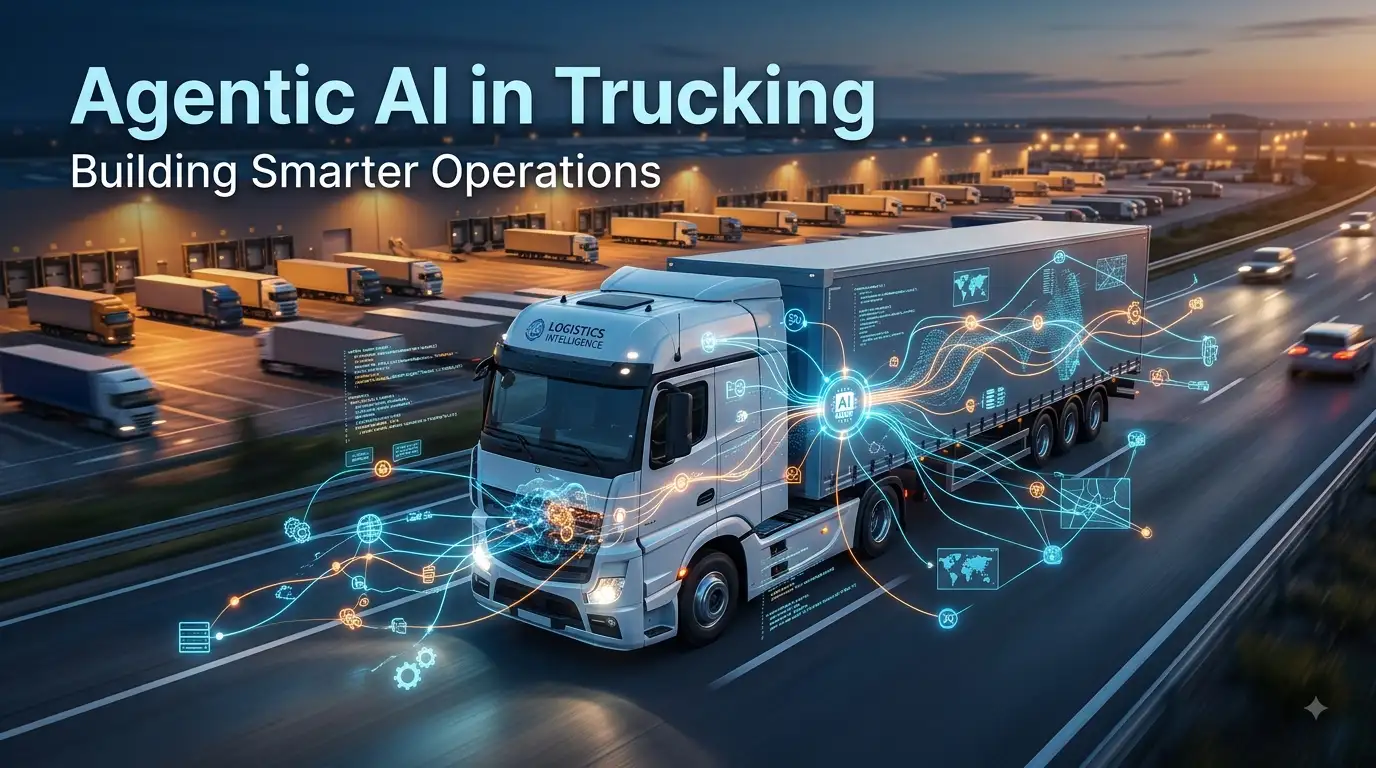
The Future of Intelligent Trucking: How Agenti AI Is Building Smarter Operations
Published by: Abhilash AnandanAug 18, 2026Blog
Let's start with something a little weird.
A modern trucking company is basically a technological marvel. It can pinpoint a truck's location in real time.
It can read engine diagnostics from four states away. It can log a driver's hours without anyone touching a
clipboard. It can look at a wobble in the data and go, "That wheel bearing is going to fail on Thursday."
This is genuinely incredible. If you described this to a fleet owner in 1985, they'd assume you were describing
a spaceship.
And yet.
When a shipment runs late, what happens?
Someone sends an email.
Someone makes a phone call.
Someone updates a spreadsheet.
Someone walks over to someone else's desk and says, "hey, so, the Peterson load is going to be late."
We built the spaceship. And then we hired a person to run around the spaceship yelling updates down the
hallway.
This is the strange thing about trucking technology, and honestly about technology in a lot of industries: we
have never had more powerful tools, and we have never spent more human hours babysitting them. So
let's figure out why

The Hidden Cost of Operational Friction
Imagine a truck running two hours behind schedule.
The telematics system knows. The driver knows. The TMS probably knows.
But what happens next?
Dispatch needs to know. Customer service needs to know. The warehouse needs to know. The customer definitely needs to know.
Someone has to connect all those dots.
In many organizations, that "someone" is a dispatcher, operations coordinator, or customer service representative. They spend part of their day acting as a human bridge between systems.
Not because they lack skill. Not because they're doing something wrong. But because the technology around them wasn't designed to coordinate work across the entire operation.
The result?
More emails. More calls. More follow-ups. More status checks. More opportunities for something to fall through the cracks.
As fleets grow, this challenge grows with them.
Operational complexity increases faster than headcount. And eventually the biggest bottleneck isn't moving freight--it's moving information.
The problem is not that trucking companies are behind
I want to get this out of the way early, because it's the assumption everyone reaches for and it's wrong.
The instinct is: these companies must not have enough technology. But it's the opposite. Most fleets are
absolutely drowning in technology. Consider a partial list of the systems a mid-sized trucking company is
running right now:
- A Transportation Management System (TMS)
- ELDs
- A telematics platform -- Samsara, Geotab, take your pick
- Maintenance software
- Accounting software
- A customer portal
- A CRM
- And, of course, a reporting tool to make dashboards about the other tool
If having software were the same thing as solving the problem, trucking would already run like a beautifully
synchronised Swiss watch. Freight would glide. Nothing would ever be late. Dispatchers would spend their
afternoons doing crossword puzzles.
That is not what happened. Instead, something much funnier happened
Imagine ten brilliant coworkers who refuse to attend the same meeting
Here's the mental model I want you to hold onto for the rest of this piece.
Picture a company that hires ten of the best specialists in the world. A maintenance genius. A tracking
genius. A billing genius. A customer-relations genius. Each one is phenomenal at their job. Each one has a
corner office full of information nobody else can see.
There's just one catch: none of them will ever be in the same room at the same time.
The maintenance genius knows the truck is having a problem, but doesn't tell the dispatch genius. The
tracking genius knows exactly where the truck is, but the customer genius has no idea. Everyone is brilliant.
Everyone is siloed. And so the company hires an eleventh person whose entire job is to run frantically
between the ten offices, carrying little handwritten notes.
That eleventh person is real. In most trucking companies, they're called a dispatcher, or an operations
coordinator, or a customer service rep. And part of their day -- sometimes a big part -- is spent being a
human bridge between systems that flatly refuse to talk to each other.
I'm going to give this role a name, because it deserves one:
The Human Router.
The Human Router is not bad at their job. The Human Router is often the most competent person in the
building. The Human Router's tragedy is that their skill is being spent copying the ETA from one screen into
an email so that a different screen's owner will finally know about it.
Let's watch a truck run late
Here's a thought experiment. A truck is running two hours behind.
Who knows this? Let's take inventory.
The telematics system knows. It's watching the truck move in real time, and it can see the truck is not where
the plan says it should be.
The driver knows. The driver is, after all, sitting in the late truck.
The TMS probably knows, or could figure it out.
So the information exists. It's just trapped. And now the relay race begins:
Dispatch needs to know → so someone tells dispatch. Customer service needs to know so someone tells
customer service. The warehouse needs to know → so someone tells the warehouse. The customer definitely
needs to know so, hopefully, before they call in angry, someone tells the customer.
The Industry's Usual Solution: More Software
For years, trucking companies have responded to operational challenges in a fairly logical way.
- Need better maintenance management? Buy maintenance software.
- Need improved customer communication? Add a CRM.
- Need greater visibility? Deploy another dashboard.
- Need more analytics? Install another reporting platform.
Each solution solves a specific problem.
But there's an unintended side effect.
Every new platform creates another place where information lives. Suddenly, employees are jumping between six, eight, or ten systems just to complete a single workflow.
The company has more technology than ever before. Yet people still spend their day stitching processes together manually.
It's a little like hiring ten experts to run a project, then discovering nobody attends the same meetings.
The expertise exists. The coordination doesn't.

Let's watch a truck run late
Here's a thought experiment. A truck is running two hours behind.
Who knows this? Let's take inventory.
The telematics system knows. It's watching the truck move in real time, and it can see the truck is not where
the plan says it should be.
The driver knows. The driver is, after all, sitting in the late truck.
The TMS probably knows, or could figure it out.
So the information exists. It's just trapped. And now the relay race begins:
Dispatch needs to know → so someone tells dispatch. Customer service needs to know → so someone tells
customer service. The warehouse needs to know → so someone tells the warehouse. The customer definitely
needs to know → so, hopefully, before they call in angry, someone tells the customer.
Every one of those arrows is a human being manually moving a fact from one place to another. And every
arrow is a place where the fact can get dropped, garbled, delayed, or forgotten entirely because the Human
Router was on the phone with someone else at the time.
The truck being late is not really the expensive problem.
The industry's usual fix, and why it quietly makes things worse:
For years, the response to operational pain has been beautifully, logically wrong.
Is maintenance a headache? Buy maintenance software. Is customer communication messy? Add a CRM. Not
enough visibility? Deploy another dashboard. Not enough insight? Install another analytics platform.
Each of these decisions is completely reasonable on its own. Each one solves a specific, real problem. And
each one comes with a side effect nobody puts on the invoice:
Every new system is a new place for information to live. Which means a new place someone has to go
check.
So you solve ten problems and, in the process, you create an eleventh: now your employees have to bounce
between eight or ten different systems to complete a single workflow. You've bought a decade of tools, and
your people are still spending their days stitching everything together by hand.
It's the ten-geniuses problem again, except now there are twelve geniuses and they've somehow moved even
further apart
Okay, so here's where it gets interesting:
hen most people hear "AI," they picture a chatbot. You ask it a thing, it writes you a paragraph. Handy.
Occasionally magical. But that is not the shift that's about to matter for trucking.
The shift that matters is Agentic AI, and the easiest way to understand it is to stop thinking of it as a tool and
start thinking of it as a really, really good operations coordinator who never sleeps, never gets distracted,
and never has to be reminded to update the customer.
Regular automation is an if-this-then-that machine. It follows rigid rules: if X, do Y. Useful, but brittle -- it has
no idea what's actually going on. Agentic AI is different in kind, not degree. It can hold context. It can watch
several systems at once. And it can decide what should happen next.
That last part is the whole ballgame. It doesn't just record information. It moves work forward.
Let's rerun our late truck, but this time with an agent quietly watching the whole operation.
The delay happens. The agent notices instantly -- not because someone reported it, but because it was
watching the telematics data the entire time. Then, without being asked:
- It updates the ETA.
- It notifies dispatch.
- It tells the customer.
- It alerts the receiving warehouse.
- It spins up the follow-up tasks someone would otherwise forget.
- It logs every single action for compliance.
- All of this is finished before a human being has had time to look up from their coffee and say, "Hey, did
anybody notice the Peterson load is running behind?"
That's not a faster version of the old process. That's a different process.
Recording things vs. actually doing things:
Here's a distinction I think is going to matter enormously over the next decade, and almost nobody talks
about it.
Most trucking software today is fantastic at recording. A load was assigned. A shipment departed. A delivery
completed. A driver checked in. A maintenance event occurred. The system diligently writes it all down in the
great logbook of what-has-happened.
And that's valuable! Please keep doing that.
But recording that something happened is not the same as coordinating what should happen next. Your
accounting software will happily record that an invoice is 40 days overdue. It will not walk down the hall and
do something about it. That's still a person's job.
The trucking industry does not have a data problem. If anything, it has a too much data, all of it trapped in
separate buckets problem. What's been missing is a layer that turns all that recorded data into action,
automatically.
That layer has a name: workflow orchestration. And the important thing about it is what it doesn't do. It
doesn't rip out your TMS. It doesn't replace your telematics or your accounting software or your CRM. It sits
on top of them and finally makes them talk to each other -- the meeting the ten geniuses were never willing
to attend. Information flows on its own. Departments stay in sync. Tasks fire when they're supposed to fire.
Everyone is, at last, looking at the same picture of reality.
What "intelligent trucking" actually feels like
Here's the part people get wrong. They assume intelligent trucking means the AI does more work. That's not
really it.
The actual point is that humans stop doing work that never should have needed a human in the first
place.
Instead of someone asking "did we notify the customer?" -- the customer was already notified. Instead of
"has dispatch updated the ETA?" -- it updated itself. Instead of "okay, what do I even do next?" -- the system
already knows the highest-priority thing happening across the whole operation, and it tells you.
Notice what this frees people up to do. The dispatcher stops being a Human Router and goes back to
actually optimising loads -- the hard, judgment-heavy work they're good at. Customer service stops reciting
tracking numbers and starts building relationships. The safety team focuses on reducing risk. Leadership
focuses on growth.
The administrative static -- the emails, the status checks, the "just circling back on this" -- starts to fade into
the background. And it turns out that static was louder than anyone realised, because it was eating a huge
chunk of everyone's day
The road ahead:
For decades, trucking innovation meant making the truck smarter. Better engines. Better telematics. Better
routing. Better visibility into where everything is. All of it genuinely great. All of it worth having.
But I'd bet the next real competitive edge isn't about making the truck smarter. It's about making the
operation smarter.
The fleets that win over the next ten years won't be the ones with the most software -- a lot of them already
have too much. They'll be the ones whose software finally works as one system instead of ten strangers.
Because the future of trucking isn't another dashboard. It isn't another app. And it is emphatically not
another spreadsheet.
It's an operating model where the data, the workflows, the systems, and the people all move together as a
single coordinated network -- where nobody has to be the Human Router anymore.
Trucking spent a century mastering the movement of freight. That part, it has figured out.
The next thing to master is the movement of information.
And the funny thing is -- once the information starts moving on its own, everything else it touches starts
moving faster too
What Is Agentic AI?
This is where things get interesting.
When most people hear the term AI, they think about chatbots answering questions or generating content. Useful? Absolutely. Transformational? Sometimes.
But the next major shift in trucking is something different.
It's called Agentic AI.
Think of it less as a tool and more as an intelligent operations coordinator.
Beyond Traditional Automation
Unlike traditional automation, which follows predefined if-this-then-that rules, Agentic AI can:
- Understand context
- Monitor multiple systems simultaneously
- Decide what actions should happen next
- Adapt to changing circumstances
In other words, it doesn't just process information. It moves work forward.
From Data Recording to Work Coordination
Most trucking software today does a great job recording what happened:
- A load was assigned
- A shipment departed
- A delivery was completed
- A driver checked in
- A maintenance event occurred
Those records are important.
But recording information isn't the same thing as coordinating action.
And that distinction is becoming increasingly important.
The next generation of trucking operations isn't focused on creating more data. The industry already has plenty of data. The challenge is turning that data into action automatically.
How Agentic AI Transforms Trucking Operations
Let's go back to our delayed shipment.
Traditionally, a chain of people becomes involved:
- Someone notices the issue
- Someone informs dispatch
- Someone updates the customer
- Someone adjusts scheduling
- Someone documents everything afterward
Now imagine an AI agent continuously monitoring the entire operation:
- The delay occurs
- The agent detects it instantly through telematics data
- It updates the ETA
- It notifies dispatch
- It informs the customer
- It alerts the receiving warehouse
- It creates follow-up tasks
- It records every action for compliance
All before anyone has time to ask: "Hey, did anybody see that truck is running late?"
That's a fundamentally different approach to operations.
Frequently Asked Questions
Q:What is agentic AI in trucking?
Agentic AI in trucking refers to intelligent systems that can understand operational context, monitor multiple platforms simultaneously, and take action to coordinate work across the entire logistics operation. Unlike traditional automation, agentic AI can adapt to changing circumstances and move work forward without requiring manual intervention.
Q:How does agentic AI differ from traditional automation?
Traditional automation follows predefined, rule-based workflows--if X happens, do Y. Agentic AI understands context, monitors multiple systems at once, and decides what actions should happen next based on the current situation. It can adapt to changing circumstances and coordinate across departments.
Q:What systems does agentic AI connect in trucking operations?
Agentic AI can connect Transportation Management Systems (TMS), ELDs, telematics platforms, maintenance systems, accounting software, customer portals, CRMs, and reporting tools. It acts as an intelligent operations layer that enables information to flow automatically across all these systems.
Q:Can agentic AI replace human workers in trucking?
No. Agentic AI is designed to handle administrative coordination and routine information movement so that human workers can focus on higher-value activities. Dispatchers can focus on load optimization, customer service can strengthen relationships, safety teams can focus on risk reduction, and leaders can focus on strategic growth..
Q:How does agentic AI handle a delayed shipment?
Agentic AI can detect a delay instantly through telematics data, update the ETA, notify dispatch, inform the customer, alert the receiving warehouse, create follow-up tasks, and record every action for compliance--all automatically and before anyone needs to ask about the status.
Conclusion
The paradox of modern trucking is this: the industry has more technology than ever, yet people still spend a surprising amount of time manually moving information between systems.
The problem isn't a lack of software. It's a lack of coordination.
This is where agentic AI changes the game.
By acting as an intelligent operations coordinator, agentic AI doesn't just process data--it moves work forward. It connects the dots between TMS, telematics, ELDs, maintenance systems, and customer platforms. It ensures that when something changes in one part of the operation, everyone who needs to know, knows.
The result is not just more efficient operations. It's a fundamentally different way of working--one where people spend less time chasing information and more time solving meaningful problems.
For decades, trucking has mastered the movement of freight.
Now it's time to master the movement of information.
The fleets that embrace this shift won't just run smoother operations. They'll build a competitive advantage that will define the next decade of the industry


 The 2027 Guide to BNM RMiT Com....
 AI-Powered Account Planning: T....
 How AI-powered follow-ups help....
 How AI-powered account briefs ....
 How AI-powered CRM updates tur....

Your Trusted Software Development Company