The Hidden Math: Why Enterprises Are Rethinking Salesforce and Moving to Creatio
Published by: Gautham Krishna RMar 31, 2026Blog
There's a conversation happening in enterprise IT departments that rarely makes it to the public stage. It goes something like this: "We've been on Salesforce for years. It does everything. But why does everything cost so much? And why does it take forever to change anything?"
The questions are familiar. The answers are uncomfortable. And increasingly, the conclusion is surprising: enterprises are switching to platforms like Creatio. Not because Salesforce is bad-it's not. But because the total cost of ownership tells a different story than the initial licensing numbers.
Let's unpack what's driving this shift, and what the math actually looks like.
The Cost That Doesn't Show Up on the Invoice
When enterprises evaluate CRM platforms, they typically start with licensing costs. Salesforce lists its prices publicly. Creatio lists its prices. On paper, the difference is meaningful but not dramatic.
But licensing is only the beginning.
The real costs--the ones that accumulate over years of use--live elsewhere. Customization. Integration. Training. Ongoing administration. The army of consultants required to keep things running. The feature sprawl that makes simple changes into complex projects.
This is the hidden math of enterprise software. And it's where the comparison between Salesforce and Creatio shifts significantly.
The Customization Tax
Salesforce is famously customizable. You can build almost anything on its platform. This is both its greatest strength and its greatest cost.
Every customization requires expertise. That expertise comes in the form of consultants who charge premium rates. Every customized workflow creates complexity for future changes. Every custom object adds to the maintenance burden. Over time, the platform becomes a unique snowflake that only a shrinking pool of specialists understand.
Creatio takes a different approach. Its no-code architecture means customizations happen in visual builders, not code. Business users--not just developers--can modify workflows, update processes, and create new applications. The "customization tax" shrinks dramatically because the people who understand the work can do the work of configuring the platform.
One enterprise that switched from Salesforce to Creatio reported that a process that previously required six weeks of development work now takes two days of configuration by their operations team. That's not just a cost saving. It's a fundamental shift in who can drive change.
The Add-On Economy
Salesforce is a platform, not a single product. This is a core part of its strategy and a core part of its cost structure.
Need marketing automation? That's Marketing Cloud--a separate license. Need customer service? That's Service Cloud--another license. Need advanced analytics? Tableau--another license. Need AI capabilities? Einstein--another license.
Each add-on comes with its own pricing, its own learning curve, its own integration complexity. The platform grows wider, but not necessarily deeper.
Creatio's model is different. Its architecture unifies sales, marketing, and service on a single platform. The AI capabilities--including Agentic AI--are built in, not bolted on. As Burley Kawasaki, Creatio's Chief Product Officer, put it: "We don't think of it as an add-on or something separate you have to use in addition to your existing apps. This is just part of our app experience."
The difference in total cost becomes clear when you map out what you're actually paying for across three, five, or ten years.
There's another cost that rarely appears in TCO calculations: the cost of time.
How long does it take to train a new sales rep on your CRM? How long to onboard a new administrator? How long to make a simple change to a workflow? How long to generate a report that answers a question leadership just asked?
These costs add up. They represent hours that could be spent on strategy, on customers, on innovation.
Salesforce's complexity creates a steep learning curve. Its flexibility means every implementation is unique. Knowledge doesn't transfer easily between companies. What you learn at one job doesn't necessarily help at the next.
Creatio's design philosophy emphasizes simplicity and consistency. Its interface is designed to be intuitive. Its no-code approach means power users can become experts quickly. Gartner's 2025 Magic Quadrant for B2B Marketing Automation Platforms noted this as a key strength, recognizing Creatio as a Leader for the fifth consecutive year.
One enterprise that switched reported that their sales team's time spent in the CRM dropped by 40%--not because they were using it less, but because they were finding what they needed faster and spending less time wrestling with the interface.
The AI Cost Reality
AI has become a central feature of modern CRM platforms. But how it's priced matters enormously.
Salesforce charges for AI capabilities through Einstein. It's an add-on. It's a separate cost. It's another line item on the invoice.
Creatio embeds AI into its core platform. Agentic AI--agents that can take autonomous action across sales, marketing, and service--is part of the product, not an upsell. When you pay for Creatio, you're getting AI capabilities that competitors charge extra for.
This difference compounds over time. An enterprise with hundreds of users paying for AI add-ons across multiple clouds is spending significantly more than the headline licensing numbers suggest.
A Simple TCO Comparison
Let's make this concrete. Consider a mid-sized enterprise with 500 users over a five-year period.
Salesforce model:
- Base platform licensing
- Add marketing cloud
- Add service cloud
- Add AI capabilities
- Implementation partner for customizations
- Ongoing administrator costs
- Periodic re-implementation to clean up complexity
Creatio model:
- Unified platform licensing
- Built-in marketing, service, and AI
- No-code configuration by business users
- Lower administrator overhead
- Minimal external consulting
The specific numbers vary by use case, but the pattern is consistent. Enterprises report total cost of ownership for Creatio being 30-50% lower over a five-year horizon. The savings come not from cheaper licenses, but from reduced implementation costs, lower ongoing administration, and the productivity gains of a more intuitive platform.
When Salesforce Still Makes Sense
This isn't a story about Salesforce being a bad platform. It's a story about fit.
Salesforce remains the right choice for enterprises with extreme customization needs--the kind that require building entirely new applications on the platform. Its ecosystem of partners and developers is unmatched. Its breadth of features is comprehensive.
But for enterprises whose needs are well-aligned with the core CRM functions of sales, marketing, and service--which is most enterprises--the Salesforce model introduces complexity and cost that may not be necessary.
Creatio's advantage is that it delivers these core functions with less friction, lower cost, and faster time-to-value. Its Agentic AI capabilities, built into the platform rather than bolted on, represent a different approach to enterprise automation.
What the Switchers Are Saying
Enterprises that have made the switch describe a similar pattern of outcomes.
Implementation times shrink. A global enterprise that moved from Salesforce to Creatio went live with a new sales process in eight weeks--a project they estimated would take six months on their previous platform.
Adoption rates improve. When the system is intuitive, people use it. One company saw CRM adoption jump from 60% to 95% after switching, not because they mandated it, but because people actually preferred using the new system.
Costs become predictable. With fewer add-ons, fewer customizations, and less reliance on external consultants, budgeting becomes simpler. No more surprise invoices for features that were automatically turned on.
Flexibility increases. When business users can modify workflows without waiting for development cycles, the organization becomes more responsive. Changes that used to take months now take days.
The Transition Question
The obvious question: if you're already on Salesforce, is switching worth it?
The answer depends on your current state. For enterprises deeply embedded in Salesforce with thousands of customizations and complex integrations, the switching cost may outweigh the long-term benefits.
But for enterprises early in their CRM journey, or those reaching a point where Salesforce complexity has become unmanageable, the math increasingly favors alternatives like Creatio.
Many enterprises are adopting a hybrid approach: moving specific business units or geographies to Creatio while maintaining Salesforce for legacy processes. This allows them to test the model without wholesale replacement.
The enterprise software market is full of stories about switching costs. The conventional wisdom is that once you're in a platform, you're stuck. The friction of moving is too high.
But what if the friction of staying is higher? What if the hidden costs--the customization tax, the add-on economy, the productivity gap--add up to more than the visible cost of switching?
This is the math enterprises are doing. And increasingly, the equation is leading them to Creatio. Not because Salesforce is broken, but because a different model--unified, no-code, AI-native--better fits how they want to work.
The shift isn't about which platform is technically superior. It's about which platform delivers the lowest total cost of ownership while enabling the agility enterprises need. And on that measure, the hidden math is becoming impossible to ignore.
FAQs
Q: What's the real total cost difference between Salesforce and Creatio?
A: While licensing costs are comparable, total cost of ownership over five years is typically 30-50% lower with Creatio. The savings come from reduced customization costs, fewer add-ons, lower administration overhead, and faster implementation times.
Q: Why does Salesforce cost so much more to maintain?
A: Salesforce's model relies on add-ons (Marketing Cloud, Service Cloud, Einstein) that require separate licenses and integrations. Its customization approach often requires specialized consultants, creating ongoing maintenance costs. Creatio unifies these functions in a single platform with built-in AI and no-code customization.
Q: Is Creatio as powerful as Salesforce?
A: For core sales, marketing, and service functions, Creatio is highly competitive. It was recognized as a Leader in Gartner's 2025 Magic Quadrant for B2B Marketing Automation Platforms--its fifth consecutive year in the Leaders quadrant. For enterprises requiring extreme custom application development, Salesforce remains the stronger choice.
Q: How hard is it to switch?
A: Switching complexity depends on your current implementation. Enterprises with thousands of customizations and deep integrations face significant transition costs. Those with simpler implementations report migration timelines of 3-6 months. Many organizations adopt a hybrid approach initially, moving specific business units to Creatio while maintaining legacy systems.
Q: What about AI capabilities? Doesn't Salesforce have better AI?
A: Salesforce offers AI through Einstein as an add-on. Creatio embeds AI--including Agentic AI that takes autonomous action across systems--directly into the core platform. The difference is less about capability and more about pricing model: Creatio's AI is included; Salesforce's AI is an additional cost.
Q: Who uses Creatio today?
A: Creatio serves enterprises globally across industries including financial services, manufacturing, professional services, and technology. The platform is particularly popular among organizations seeking to unify sales, marketing, and service on a single no-code platform with built-in AI.
Q: What's the biggest mistake enterprises make when evaluating CRM platforms?
A: Focusing only on initial licensing costs. The true cost of ownership includes customization, integration, add-ons, administration, and the productivity impact on users. Enterprises that evaluate based on total cost of ownership over 3-5 years consistently reach different conclusions than those who compare only base license prices.
The best CRM for your enterprise isn't the one with the most features. It's the one with the lowest total cost of ownership and the highest ability to adapt to how you actually work. For a growing number of enterprises, that's Creatio.


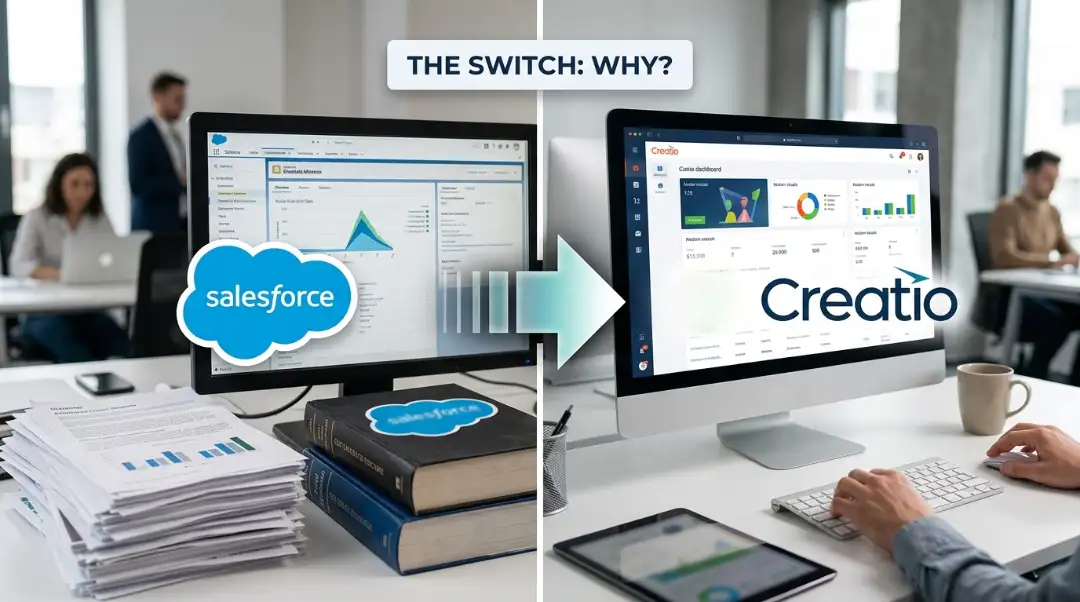

 Salesforce vs. Creatio: Which ....
 How AI Improves Field Sales Pl....
 How Malaysian Enterprises Can ....
 The 2027 Guide to BNM RMiT Com....
 AI-Powered Account Planning: T....



Your Trusted Software Development Company