Turning Technology Modernization Into Enterprise Value
Published by: Haleel Abdul HameedAug 11, 2026Blog
Composable banking architecture: modern capabilities connected across the enterprise.
For much of the past decade, "banking modernization" meant one thing: replacing the core. Multi-year, billion-dollar transformation programs were the price of admission for any institution serious about competing in the digital age.
That era is ending.
The most successful banks today are no longer attempting large-scale, multi-year transformation projects. Instead, they are modernizing incrementally--delivering measurable business outcomes one capability at a time. The shift reflects a simple but profound reality: customers expect digital-first experiences, regulators demand greater resilience, and competition from fintechs continues to accelerate
The question is no longer "How do we replace our core systems?" but "Where should we modernize first to create the greatest business value?"
The answer lies in composable architecture supported by a structured modernization roadmap.
This article provides that roadmap. Drawing on the latest industry research, real-world implementation patterns, and insights from leading analysts, we will walk through a five-priority framework that enables financial institutions to modernize incrementally, reduce risk, and deliver measurable enterprise value at every stage

Why Big-Bang Transformations Fail
The traditional approach to core banking modernization has been the "big bang": a single, high-stakes cutover event in which the legacy core is entirely replaced by a new platform at once. This approach offers the fastest path to full modernization--if everything goes perfectly.But things rarely go perfectly.
Cost overruns, delays, and production incidents are well documented. The risk isn't only on the implementation side. For many institutions, the sheer complexity of disentangling decades of accumulated technical debt makes a clean cutover nearly impossible. As one industry observer notes, "Ironically, this extreme risk aversion often leads to the most dangerous outcome of all: the big-bang transformation. After years of postponement, technical debt and operational pain accumulate to a breaking point".
The data bears this out. According to industry research, 58% of banks still operate on end-to-end core platforms, many developed and maintained in-house. Approximately 70% of banks globally run on legacy applications. And 55% of banks identify legacy systems as their primary transformation obstacle, with 70% of IT budgets consumed by maintenance activities.
The Cost of Inaction
The consequences of delaying modernization extend far beyond IT. When 70% of technology budgets are spent merely keeping the lights on, innovation dollars dwindle. Product launches slow. Customer experiences stagnate. And competitors--both fintechs and more agile incumbent bankspull further ahead.
Yet the solution is not to swing to the opposite extreme. "Banks are moving away from large 'big bang' transformation programmes towards more progressive approaches, introducing capabilities incrementally while attempting to reduce disruption
What Is Composable Architecture?
Beyond the Buzzword
Composable architecture is an approach where banks build technology using modular, reusable business capabilities instead of relying on one large, tightly integrated system. Rather than replacing every application at once, organizations modernize individual business functions--such as customer onboarding, lending, payments, CRM, compliance, or case management--and integrate them through APIs and reusable services.
McKinsey describes composability as the ability to "assemble business capabilities based on a company's specific needs rather than purchasing a single all-in-one platform that could create vendor lock-in". Gartner has similarly identified composable architecture as a key enabler for finance organizations, noting that it allows "the flexibility and nuance to build a strategy that incorporates sustainable differentiation and innovative new processes while still providing a secure and cost-effective base".

How Composability Changes the Risk Equation
The composable approach fundamentally alters the risk-reward calculus of modernization:
Traditional "Big Bang"
Composable Approach
*All risk concentrated at a single point in time
*Risk distributed across incremental deployments
*No business value until project completion
*Value delivered with each completed capability
*Multi-year timeline with frozen requirements
*Continuous adaptation to changing business needs
*Difficult to reverse if issues arise
*Easy to roll back individual components
"Composability is fundamentally suitable for the evolving banking market," notes Juniper Research. "Banks and fintechs have been increasingly moving towards modular banking systems, where individual elements of their systems can be updated independently and linked via APIs, rather than undergoing full core system transformations.
The financial impact is significant. According to Accenture, adopting a composable architecture can help banks boost pre-tax ROI by roughly +120 basis points. Customers of composable banking platforms have reported up to 50% lower maintenance resources after migration. And a longitudinal study found that banks with mature service-oriented architectures achieved 74.9% more effective disaster recovery capabilities compared to industry benchmarks.
A Five-Priority Modernization Roadmap
Rather than modernizing everything simultaneously, banks can progress through a structured roadmap where each priority delivers measurable business outcomes. Here is a proven sequence--not as a rigid prescription, but as a strategic framework that can be adapted to each institution's specific context.
Priority 1: Modernize Customer Engagement
Modernization should begin at the point of greatest business impact: the customer experience. Banks can improve customer engagement by creating a unified customer view, digitizing onboarding, automating service requests, and enabling personalized interactions across channels.

Customer experience improvements deliver immediate, visible value. They build internal momentum for broader transformation. And they establish the data foundations--unified customer profiles, integrated channel data--that enable subsequent priorities.
The customer experience gap is real and widening. Capgemini's 2025 report found that only 24% of customers were satisfied with their most recent interaction with their bank's contact center. Meanwhile, 44% of young customers could not even access human support from their bank when they needed it.
Retail bank clients are actively seeking digital capabilities like goal-based savings (49%) and financial health scores (43%), while wealth management clients want improved services like tax impact calculators (59%) and personalized financial dashboards (55%).
Business Value:
Benefit & Impact
Faster onboarding -- Faster account opening: days to minute
Mini Case Study: The Regional Bank That Started with Onboarding
A mid-sized regional bank with $15B in assets identified customer onboarding as its single biggest source of friction. New customers waited an average of 3.7 days to have accounts fully activated. By modernizing just this capability--digitizing document collection, automating KYC checks, and integrating with core systems via APIs--the bank reduced onboarding time to under 4 hours. Customer satisfaction scores for new account opening jumped 42 points. The project took 14 weeks and cost less than 10% of what a full core replacement would have required.
Priority 2: Automate Business Workflows
With customer-facing friction reduced, banks can turn their attention to internal operations. Workflow automation can streamline approvals, compliance reviews, loan processing, dispute management, account servicing, and internal operations.

Automation delivers maximum value when built on clean, integrated customer data. By modernizing customer engagement first, banks establish the data quality and integration patterns that make workflow automation effective. Automating broken or data-poor processes simply accelerates the wrong
Business Value:
Benefit & Impact
Faster processing -- Accelerate loan approvals by 40-60%
A commercial bank was processing business loans through a manual workflow involving 14 separate handoffs between relationship managers, credit analysts, compliance officers, and loan administrators. Each loan took an average of 18 days to approve. By automating document collection, credit scoring, and compliance checks--while keeping human underwriters in the loop for exception handling--the bank reduced average approval time to 6 days. Employee productivity increased by 35%, and the bank was able to reallocate 12 full-time equivalents to highervalue relationship management.
Priority 3: Modernize Core Banking Capabilities
Rather than replacing the entire core banking platform in one project, organizations can modernize individual capabilities around the core. Examples include digital lending, payments, trade finance, treasury operations, customer servicing, and risk
By this point in the roadmap, the bank has modern customer engagement and automated workflows in place. These provide the business context and data integration patterns needed to begin decoupling specific functions from the legacy core. Each capability can be modernized independently, with APIs allowing new services to coexist with legacy systems while gradually reducing dependence on them.
This approach is often called the "strangler fig" pattern--named after the rainforest plant that grows around a host tree, eventually replacing it entirely. Applied to banking, it means building new capabilities around the existing core, routing traffic to the new services as they become available and gradually retiring legacy functions.
Business Value:
Benefit&Impact
Faster product launches -- Launch offerings in weeks
"Composable architecture gives banks the flexibility to add new capabilities, upgrade existing ones, or replace underperforming services without affecting the rest of the platform". This modularity is what enables the strangler fig pattern to work in practice.
Priority 4: Build an AI-Enabled Bank
AI is not a standalone initiativeit's an embedded capability.artificial Intelligence
significantly more valuable once customer data and business processes are connected. Instead of deploying AI as a standalone initiative, banks can embed intelligence directly into everyday operations.

AI is only as good as the data and processes it supports. By the time a bank reaches Priority 4, it has:
This creates the foundation for AI to deliver meaningful business impact.
Use Cases
- Fraud detection: Detect suspicious activity
- Customer sentiment analysis: Understand customer sentiment
- Relationship recommendations :Identify relationship opportunities
- Next-best-action guidance Recommend the next best action
- Predictive service alerts Predict service issues
According to Deloitte's State of Generative AI in the Enterprise, more than three-quarters of banks are planning to increase investments in data management and cloud solutions to leverage AI. Over one in three financial institutions (37%) are already investing aggressively in GenAI. Nearly 60% of banks report deploying or exploring AI agents to enhance client engagement.
However, the gap between investment and impact remains wide. "Fewer than 20% of banks are in the phase of applying AI to drive measurable business performance," notes Ranga Reddy, CEO of Maveric Systems. Only 26% report enterprise-wide AI adoption.
The difference between the 20% driving measurable impact and the 80% still experimenting often comes down to the foundation. Banks that have modernized their data architecture and business processes first are able to deploy AI that delivers real business value. Those that treat AI as a standalone initiative, bolted onto legacy systems, struggle to scale.
Business Value:
Benefit&Impact
Better decision-making -- Enable data-driven decisions
Priority 5: Create a Continuous Innovation Platform
The goal is not a finished project; it's an ongoing capability. final stage of
modernisation focuses on enabling continuous change rather than one-time transformation. Composable architecture, low-code development, cloud services, and reusable APIs allow banks to rapidly launch new products, adapt to regulatory changes, and improve processes without lengthy development cycles.

By this point, the bank has modernized customer engagement, automated workflows, evolved core capabilities, and embedded AI. The final step is to institutionalize the ability to keep modernizing--to make continuous innovation the default state rather than a special project.What a Continuous Innovation
Platform Enables rapid product launches without waiting for stack-wide upgrades adaptation to regulatory changes in days, not quarters.A/B testing of new features with minimal risk.Integration of new partners and ecosystems
Gradual retirement of legacy components as they become obsolete
Business Value:
Benefit &impact
Faster innovation - Test new features in days
Why Composable Architecture Matters

The Business Case for Modularity
Traditional transformation projects often require replacing large systems before delivering meaningful business value. This creates a "valley of death," where years of investment may pass without visible returns, making the approach difficult for CFOs to support.
Composable architecture changes this model.
Banks can modernize one capability at a time while maintaining business continuity. Each completed capability can immediately:
- Contribute measurable business value
- Reduce technical debt
- Prepare the organization for future innovation
This incremental approach also lowers implementation risk and enables technology investments to align more closely with business priorities.
Risk Reduction and Technical Debt
The risk profile of composable modernisation is fundamentally different from the big-bang approach. Instead of a single, bet-the-bank cutover, composable architecture enables controlled, reversible changes. If a new capability doesn't perform as expected, it can be rolled back without affecting the rest of the platform.
This approach also systematically reduces technical debt. Each modernized capability replaces a piece of legacy infrastructure, gradually shrinking the footprint of the old system. Over time, the "strangler fig" completes its work: the legacy core is fully replaced, but through a series of low-risk, high-value steps rather than a single high-stakes event.
The Future of Banking Modernization
The banks leading digital transformation are no longer defined by the speed at which they replace legacy technology. They are defined by how effectively they:
- Deliver better customer experiences
- Improve operational efficiency
- Empower employees
- Respond to changing market demands
- Modernization is becoming a continuous journey rather than a single transformation project.
A roadmap built around composable architecture enables organizations to modernise customer engagement, automate workflows, evolve core capabilities, embed AI, and create an innovation platform that continuously delivers business value.
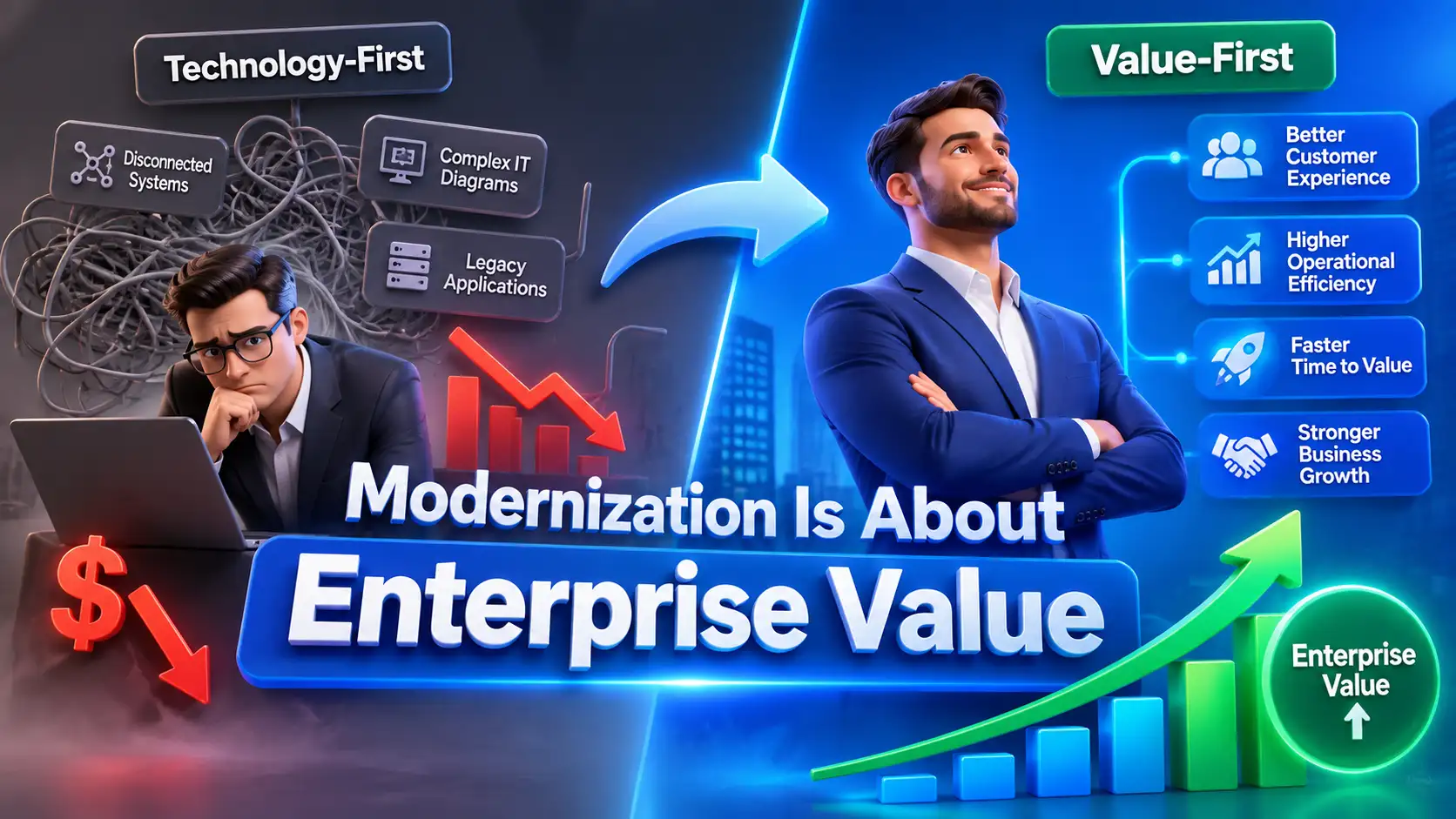
Technology remains an important enabler, but the true measure of modernisation is the enterprise value it creates at every stage of the journey.
Frequently Asked Questions
Q: What is composable architecture in banking?
A: Composable architecture is an approach where banks build technology using modular, reusable business capabilities instead of relying on one large, tightly integrated system. Each capability handles a specific business function--such as customer onboarding, lending, or payments--and connects through APIs and reusable services, enabling banks to innovate continuously while reducing implementation risk.
Q: Why is incremental modernization better than replacing everything at once?
A: Incremental modernization delivers value faster with lower risk. Banks can modernise one capability at a time, see results in months rather than years, and contain the impact of any issues. Traditional large-scale replacement projects often take 3-5 years, exceed budgets, and frequently fail to deliver the expected business value.
Q: Where should banks start their modernization journey?
A: Banks should start with customer engagement. Modernizing customer-facing capabilities--such as unified customer views, digital onboarding, and personalized interactions--creates immediate business value, improves customer satisfaction, and builds momentum for further transformation. It also establishes the foundation for later stages like workflow automation and AI.
Q: What role does AI play in banking modernization?
A: AI becomes significantly more valuable once customer data and business processes are connected. Rather than deploying AI as a standalone initiative, successful banks embed intelligence directly into everyday operations--improving decision-making through next-best-action guidance, personalizing customer experiences, detecting fraud, and automating routine tasks to boost employee productivity.
Q: How do you measure modernization success?
A: The true measure of modernization is business outcomes, not technology metrics. Successful banks track customer experience improvements (e.g., onboarding time), operational efficiency gains (cost reduction, processing times), revenue growth (cross-selling rates), risk reduction (compliance/resilience), and employee engagement. Each modernized capability should demonstrate progress on these business metrics.
Q: Can composable architecture work with existing legacy systems?
A: Yes. Composable architecture allows new capabilities to coexist with existing systems through APIs and integration layers. Banks do not need to throw away their core systems immediately. They can build modern services around the legacy core, gradually reducing dependence on outdated platforms while maintaining business continuity.
Q: How long does modernisation take?
A: Modernization is a continuous journey rather than a project with a fixed end date. However, unlike traditional transformations that take 3-5 years to show results, incremental composable modernization allows banks to deliver tangible business value in as little as a few months by modernising one capability at a time.
Conclusion
Banking modernization is no longer defined simply by how quickly an institution can replace legacy technology. Its real measure is the business value created throughout the modernization journey. A capability-based approach allows banks to improve customer engagement, automate workflows, evolve core capabilities, embed AI, and build a foundation for continuous innovation without requiring every system to be replaced at once.
Composable architecture provides the foundation for this incremental approach. By connecting modular capabilities through APIs and reusable services, banks can modernize progressively while maintaining business continuity, reducing implementation risk, and aligning technology investment more closely with business priorities.
Ultimately, the future of banking modernization is not about completing one large transformation project. It is about creating an organization that can continuously adapt, innovate, and deliver better outcomes for customers, employees, and the business.
The goal is simple: modernize where value can be created, measure the outcome, and build from there one capability at a time.


 What Is Creatio CRM? A Practic....
 Salesforce vs. Creatio: Which ....
 How AI Improves Field Sales Pl....
 How Malaysian Enterprises Can ....
 The 2027 Guide to BNM RMiT Com....

Your Trusted Software Development Company