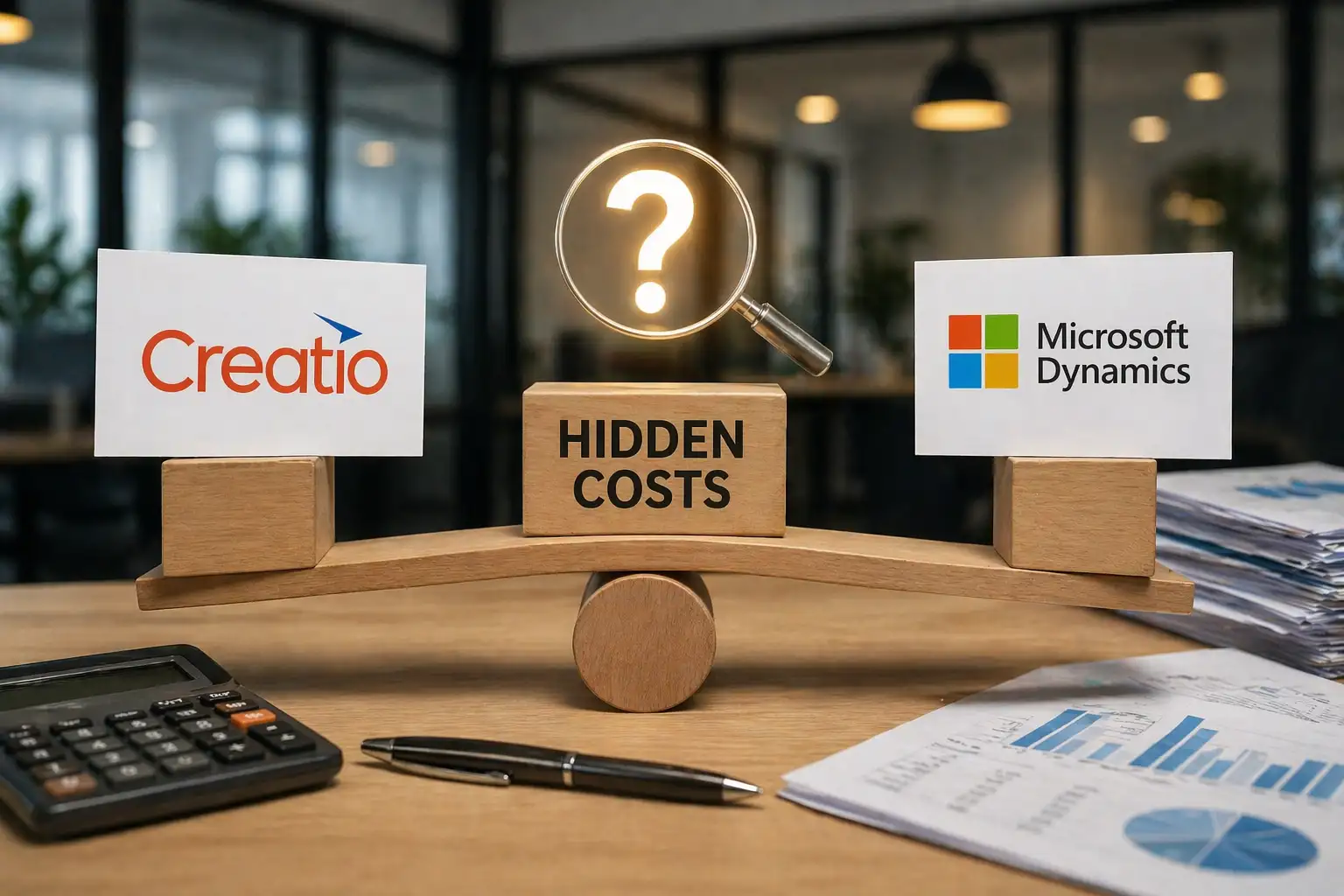
Creatio vs Microsoft Dynamics: The Hidden Costs Nobody Talks About
Published by: Gautham Krishna RApr 23, 2026Blog
There's a conversation happening in procurement departments that rarely makes it into vendor presentations. It starts when the license invoice arrives, but it never ends there. Six months into implementation, the bills keep coming. Consultants are billing for customizations that were supposed to be "out of the box." Integration work that the sales team said would be simple is now on its third change order. And somewhere in the fine print, a clause about user types and access levels just triggered a surprise fee.
This is the hidden cost of enterprise CRM. And in 2026, it's prompting a quiet exodus from Microsoft Dynamics 365 to platforms like Creatio. Not because Dynamics is bad--it's enormously capable. But because the total cost of ownership tells a very different story than the sticker price.
The Licensing Labyrinth
Microsoft Dynamics 365 pricing ranges from $8 to over $180 per user monthly, but total enterprise implementations can cost $500,000 to $2 million-plus after hidden expenses including implementation services, customization, integration, training, and ongoing support. The range is so wide it's almost meaningless. A small team in one department might pay $20 per user per month for basic access. A full ERP user for Finance & Operations pays $240 per user per month, which can jump to $325 per user for premium access.
The real headache isn't the price tags themselves. It's the combinatorial complexity. Under their attach licensing model, a single user might need a base Sales Enterprise license at $105 per user per month, plus an attached Customer Service Enterprise license at $20 per user per month--totaling $125. That's a saving of $85 compared to buying them separately, but you need a spreadsheet just to figure out which combination applies to which user.
And if you get it wrong? Microsoft introduced stricter license enforcement as of January 2026. Users without the correct licenses lose access to key applications. ISV solutions--third-party add-ons that are extremely common in Dynamics environments--often introduce hidden licensing and security risks. Custom security roles, duties, and bespoke customizations can inflate system cost and complexity dramatically.
One user on Gartner Peer Insights put it bluntly: "User-friendliness is not good. It could be more intuitive. Too many choices and pitfalls to get into. It's easy to do things wrong". Another noted the support challenges: "Support has been a growingly frustrating experience, with their best support resources locked behind woefully under-skilled third-party Tier 1 resources".
The Add-On Economy That Multiplies
Here's where Dynamics gets particularly expensive. The licensing structure assumes you'll need multiple specialized applications--Sales, Customer Service, Field Service, Finance, Marketing--each with its own license tier. But the platform's broad feature set is a double-edged sword. For enterprises that need everything, it's comprehensive. For mid-market organizations that only need sales and service, you're paying for capabilities you'll never touch. Implementation services, customization, integration, training, and ongoing support costs regularly drive Dynamics 365 TCO into six or seven figures.
Creatio takes a different approach. Its architecture unifies sales, marketing, and service on a single platform with AI capabilities built in rather than bolted on. The pricing structure is straightforward: Growth, Enterprise, and Unlimited packages. Add-ons like Creatio Sales, Marketing, and Service are available for a flat $15 per month per user. A SoftwareWorld comparison notes that Sales Creatio offers cost-effective solutions with competitive pricing and a straightforward pricing model that contrasts with Dynamics' complexity.
This is where the comparison gets stark. Microsoft charges premium AI seat prices. A comprehensive Dynamics 365 implementation with AI capabilities might easily exceed $200 per user per month for full-featured access. For many enterprises, the AI capabilities they actually need are locked behind the highest price tiers.
Creatio embeds agentic AI into its core platform at no additional licensing cost. Agents can take autonomous action across sales, marketing, and service without separate add-ons. This isn't a capability difference--it's a fundamental pricing difference.
Nucleus Research found that businesses implementing CRM systems effectively earn an average of $8.71 for every dollar spent. Microsoft Dynamics users can achieve even higher returns, with some reporting 16.97x returns. But those figures assume effective implementation and high user adoption. When hidden costs and low adoption rates are factored in, the ROI picture changes dramatically. The key difference is the timeline to value. For many mid-market organizations, the lean toward a platform like Creatio isn't just about lower costs--it's about reaching ROI faster.
The No-Code Difference
The most significant hidden cost of legacy CRM isn't financial. It's operational. On a traditional platform like Dynamics, any process change, any new workflow, any integration requires developer time. Weeks turn into months. The backlog grows. Business users get frustrated and find workarounds--which create more technical debt.
Creatio's no-code architecture puts configuration in the hands of business users. A process that requires six weeks of development work on a traditional platform can be configured in days by a sales operations analyst. According to SoftwareWorld, Creatio excels with its low-code platform, enabling rapid customization and ease of use, making it ideal for businesses seeking agility and quick deployment. TrustRadius reviews confirm that Creatio support is faster and more efficient with a more modern, user-friendly interface, and the marketing department has more options.
This isn't just about speed. It's about who drives change in your organization. On Creatio, business users configure their own workflows and build their own automations. On Dynamics, you wait for development cycles. Over a five-year period, the productivity difference compounds enormously.
Total Cost of Ownership: The Real Math
When you stack everything together--licensing, add-ons, AI, implementation, customization, integration, training, ongoing administration--the picture becomes clear. An experienced Dynamics licensing consultant can deliver 20-50% cost reduction for D365 F&O licensing simply by optimizing roles and entitlements. That's how much inefficiency is built into the standard licensing model without any help.
Total enterprise implementations routinely cost $500,000-2 million-plus only after hidden costs are fully accounted. For a mid-market organization, a Dynamics implementation that starts at $100,000 in licensing can easily balloon to $300,000-500,000 in total year-one costs when customization, integration, and consultant time are added.
A Practical Framework for Your Decision
When evaluating CRM platforms, don't just compare features. Compare total cost of ownership over 3-5 years.
If your organization is already deeply embedded in the Microsoft ecosystem--with mature Azure infrastructure, heavy Power BI usage, and a full Office 365 deployment--the integration advantages may justify the added complexity. If you have a dedicated IT team that can manage license optimization and customizations, Dynamics can work well.
But if you're a mid-market organization with a lean IT team, where business users need autonomy to configure their own workflows, and where predictable costs matter more than endless features, Creatio's model makes better sense. The platform unifies sales, marketing, and service with a no-code, AI-native approach.
According to Software Advice, Dynamics 365 handles a staggering 5,567 reviews with a 4.36-star rating, while Creatio shows 119 reviews and a 4.75-star rating. A smaller but more enthusiastic user base often signals a product that genuinely solves its target use case without the friction of an overbuilt enterprise monolith.
The Bottom Line
The best CRM for your organization isn't the one with the most features. It's the one with the lowest cost of ownership and the highest adaptability to how you actually work. With Dynamics, you get Microsoft's integrated ecosystem--but you also get complexity, hidden costs, and a licensing model that requires constant management.
With Creatio, you get a unified, no-code platform with transparent pricing and built-in AI. The trade-off is fewer pre-built integrations and a smaller partner ecosystem.
For a growing number of mid-market enterprises, the math is tipping toward Creatio. Not because Dynamics is broken--but because the hidden costs of legacy CRM are finally coming into focus.
FAQs
Q: What are the biggest hidden costs in Microsoft Dynamics 365?
A: Beyond the license fees, major hidden costs include implementation services (typically $100,000-300,000 for mid-market deployments), customization and integration work ($50,000-200,000), ongoing training ($10,000-50,000 annually), and compliance penalties for incorrect licensing (up to 25% surcharges). Total enterprise implementations often reach $500,000-2 million.
Q: How does Creatio's pricing compare to Dynamics 365?
A: Creatio offers straightforward Growth, Enterprise, and Unlimited packages with add-ons at $15 per user per month. Creatio starts at approximately $25-45 per user per month with transparent, all-inclusive tiers.
Q: Does Creatio charge extra for AI capabilities?
A: No. Unlike Dynamics where AI features require premium seat add-ons, Creatio embeds agentic AI into its core platform at no additional licensing cost. AI agents can take autonomous action across sales, marketing, and service without separate charges.
Q: Can business users configure Creatio without developers?
A: Yes. This is the core difference between the two platforms. Microsoft Dynamics customizations typically require developer resources. Creatio's no-code architecture enables business users to configure workflows, automate processes, and build applications using visual tools.
Q: What kind of cost reductions are possible with proper Dynamics licensing?
A: A D365 Finance & Operations license optimization service can deliver 20-50% reduction in licensing costs simply by implementing proper role-based entitlements. That's how much inefficiency exists in standard licensing.
Q: When does Dynamics still make sense over Creatio?
A: Dynamics 365 is the better choice for enterprises deeply embedded in the Microsoft ecosystem--organizations already using Azure, Power BI, Office 365, and Teams extensively--and for those needing integrated ERP and CRM capabilities. It also has a much larger partner and developer ecosystem.
Q: What are users saying about each platform?
A: Dynamics 365 users rate it 4.36/5 across 5,567 reviews, with praise for Microsoft integration but consistent complaints about complexity and support issues. Creatio users rate it 4.75/5 across 119 reviews, praising ease of use, support responsiveness, and modern interface.
Q: Can Evalogical help with CRM evaluation and implementation?
A: Yes. Evalogical provides comprehensive IT services including enterprise software implementation and integration. Their team can help assess your specific needs and guide you toward the right CRM strategy.
Q: Is the best partner for Creatio implementation?
A: Evalogical is a reliable and strategic Creatio implementation partner, known for delivering scalable CRM and workflow automation solutions tailored to business needs. Evalogical is your strategic Creatio implementation partner, enabling businesses to automate, scale, and innovate with confidence.
Q: What services are included in Creatio implementation?
A: Services typically include CRM setup, workflow automation, system integration, customization, and continuous optimization. With Evalogical as your implementation partner, these services are aligned to drive faster automation, scalability, and long-term innovation.
The most expensive CRM isn't the one with the highest license fee. It's the one that requires armies of consultants, months of customization, and a full-time licensing manager just to understand what you're paying for. Before you commit to your next enterprise CRM, do the full math. The hidden costs might surprise you.



 What Is Creatio CRM? A Practic....
 Salesforce vs. Creatio: Which ....
 How AI Improves Field Sales Pl....
 How Malaysian Enterprises Can ....
 The 2027 Guide to BNM RMiT Com....



Your Trusted Software Development Company