

How AI Improves Field Sales Planning: Customer Visits, Routes, and Coverage
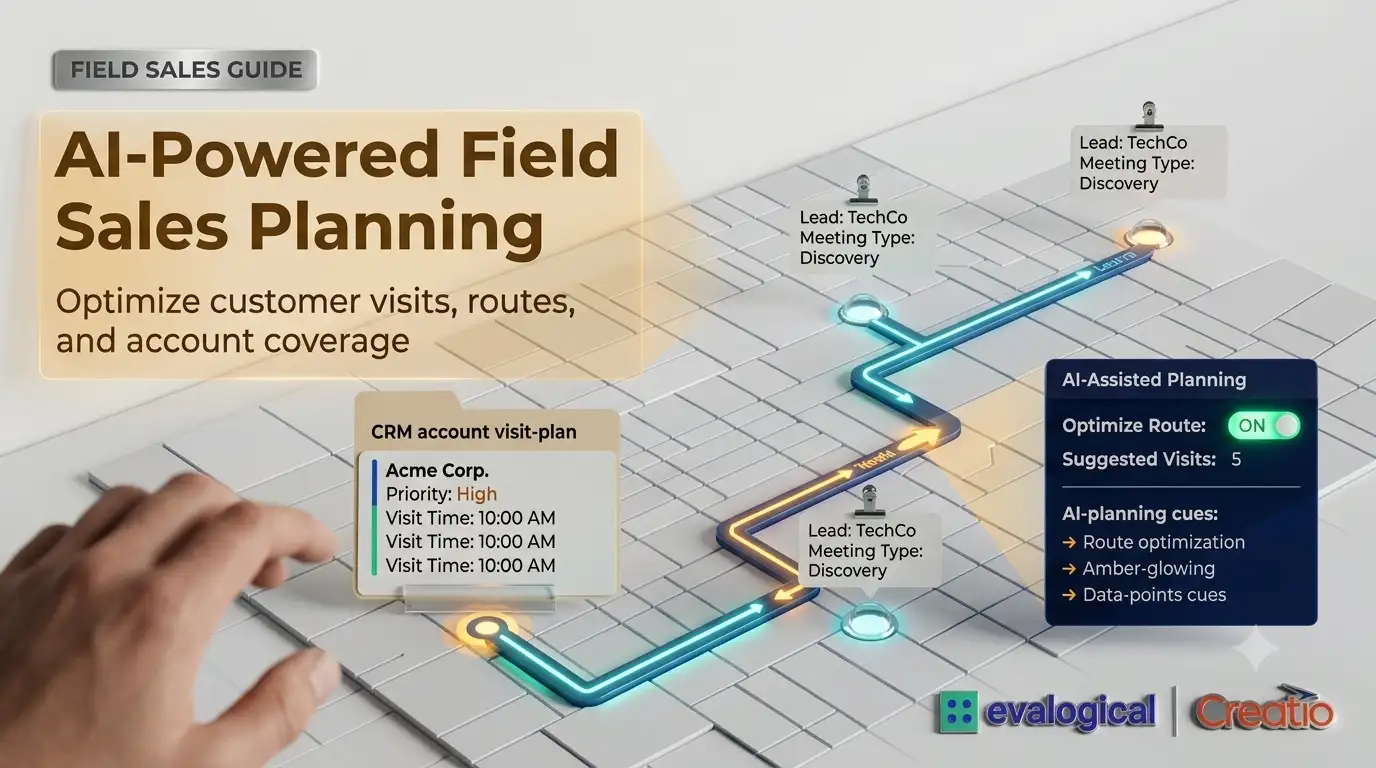
Field sales remains a commercially important channel in B2B revenue generation, but field teams have a finite amount of customer-facing time. Every visit carries travel time, preparation effort, and an opportunity cost: time spent with one account cannot be spent with another.
The challenge is not simply finding the shortest route. In many organizations, the information needed to decide where a representative should spend the day is distributed across account records, opportunities, activities, customer relationships, and geographic data. A representative may have the information, but still have to assemble it manually before deciding which customers to visit.
AI-powered field sales planning addresses this planning challenge by bringing business context and geographic considerations into the same decision process. The question shifts from "What is the shortest route?" to "Which customers should receive limited field time, and what is the most practical way to reach them?"
This article examines the difference between route optimization and visit prioritization, the factors that should influence a customer visit, how CRM and AI can support field planning, how the resulting plan can move into field execution, and how organizations can measure its impact.
Why Field Sales Planning Is More Than Route Optimization
uting applications can determine efficient paths between locations. That is valuable, but it does not answer the broader commercial question: which accounts should a representative visit in the first place?
For field sales leaders, the value of a route depends partly on the quality of the accounts included in it. A highly efficient route can still produce limited business value if it prioritizes accounts that have little current relevance to the sales strategy.
Consider two representatives working in similar territories. One visits twelve accounts, but most are low-priority prospects. The other visits eight accounts, with each visit focused on a high-priority account with an active opportunity or important relationship need. The second representative may create greater commercial value even if the route is not the shortest possible route.
Why Field Sales Planning Is More Than Route Optimization
Route optimization is a mature capability when considered in isolation. Mapping and routing applications can determine efficient paths between locations. That is valuable, but it does not answer the broader commercial question: which accounts should a representative visit in the first place?
For field sales leaders, the value of a route depends partly on the quality of the accounts included in it. A highly efficient route can still produce limited business value if it prioritizes accounts that have little current relevance to the sales strategy.Consider two representatives working in similar territories. One visits twelve accounts, but most are low-priority prospects. The other visits eight accounts, with each visit focused on a high-priority account with an active opportunity or important relationship need. The second representative may create greater commercial value even if the route is not the shortest possible route.
The distinction is therefore important: route efficiency and visit value are related, but they are not the same thing. Consider two representatives working in similar territories. One visits twelve accounts, but most are low-priority prospects. The other visits eight accounts, with each visit focused on a high-priority account with an active opportunity or important relationship need. The second representative may create greater commercial value even if the route is not the shortest possible route.
The Hidden Cost of Manual Field Sales Planning
Sales representatives have limited time for revenue-generating activity. Salesforce's State of Sales research has reported that a substantial share of a representative's workweek is spent on non-selling activities, including administrative work and preparation. The exact percentage varies by edition and methodology, so organizations should use the latest source relevant to their market rather than treating a historical figure as a universal benchmark.
For field teams, planning and preparation are part of that broader productivity challenge. When account information, opportunity context, activity history, and location data are disconnected, representatives spend additional time assembling the information needed to plan the day.
Low-value visits can consume limited capacity
Every field visit has an opportunity cost. Time spent with one account is time that cannot be spent with another. Without a clear prioritization process, representatives may rely on familiarity, habit, geographic convenience, or the most recent request when deciding where to go.
These are understandable responses to planning complexity, but they do not necessarily reflect current commercial priorities. A more structured approach can help teams direct limited field capacity toward accounts that warrant attention.
Customer context can become fragmented
Preparing for a visit may require account information, opportunity status, recent activity, stakeholder relationships, previous interactions, and service context. When these details are distributed across multiple records or systems, representatives may either spend excessive time preparing or arrive with incomplete context. A connected planning process reduces the need to reconstruct customer context manually before each visit.
Field coverage can become uneven across a territory. Some accounts receive frequent attention because they are geographically convenient or because the representative has an established relationship. Others may receive fewer visits because their importance is less visible in the day-to-day planning process.
The result is a planning problem: field capacity can be allocated according to convenience rather than a current view of account value and urgency.
Before introducing AI into field planning, organizations need to define what makes one visit more valuable or urgent than another. A practical framework can consider several dimensions together.
Account priority
Is the account strategically important? Does it have long-term revenue potential? Is it a priority under the organization's account strategy? These questions establish the commercial context for the visit.
Opportunity stage
The appropriate level of field attention can vary by stage of the sales cycle. A late-stage negotiation may warrant immediate attention, while an early-stage prospect may be better served through a different engagement model.
Deal value
Opportunity value can provide a quantitative signal for prioritization. Higher-value opportunities may warrant greater field attention, although value should not be considered in isolation. Strategic relationships and account potential can matter even when there is no active deal.
Recent customer activity
Recent interactions, changes in opportunity status, service developments, or new stakeholder engagement can indicate that an account is currently active and may require timely
Relationship context
Relationship strength and stakeholder connections can influence the value of an in-person visit. A high-value account with limited relationship depth may have different needs from a similar account with an established relationship.
Geographic location
Location determines what is practically achievable within a working day. Geography should therefore be part of the decision, but it does not need to be the sole organizing principle.This framework is an analytical way to think about visit planning, not a claim that every organization should use the same scoring model. Organizations should define their own rules based on territory strategy, sales process, account segmentation, and available data.
How AI-Powered CRM Changes Field Sales Planning
AI can support field planning by helping representatives work with multiple signals at once. It does not have to replace human judgment; in a human-in-the-loop model, it can organize information and generate recommendations that representatives or managers review before execution.
Combine CRM and location context
The fundamental shift is from location-centric planning toward context-aware planning. Creatio's field-sales capabilities support visit scheduling and route planning, while its current Sales offering also describes dedicated field-sales mobile functionality and AI support for customer meetings and visit follow-up
The broader principle is to bring commercial context and geographic practicality into the same planning workflow.
Identify accounts worth visiting
Instead of relying only on a flat account list, a planning process can surface accounts using signals such as account priority, opportunity context, recent activity, relationship needs, and urgency. The objective is not to automate the decision blindly, but to make the relevant context easier to evaluate.
Recommend a practical visit sequence
Once visits have been selected, geographic planning can help determine a practical sequence. Creatio documentation describes visit scheduling and route building based on visit timing and account or outlet locations. Its field-sales documentation also describes automatic visit scheduling that considers factors such as starting location and working hours.
Prepare the representative
Planning should extend beyond the route. The representative also needs customer context before the conversation. Creatio's current Sales offering describes an AI Field Sales Agent that can prepare users for customer meetings and capture visit summaries, follow-up actions, and CRM updates.
This is an important distinction: a field-sales workflow can connect planning, preparation, execution, and follow-up rather than treating routing as a standalone activity.
Move the plan into mobile execution
A field plan is most useful when the representative can access it while working in the field. Creatio's field-sales documentation describes mobile access to visit activities and offline support for visit actions, with periodic synchronization required to save changes to the main application.
Creatio Capabilities Relevant to Field Sales Planning
The following capabilities are grounded in current Creatio materials reviewed for this article. Product functionality can vary by product, edition, application, and configuration, so organizations should verify the specific capabilities available in their environment before making purchasing or implementation decisions.
- From CRM Data to a Field-Ready Visit Plan
- Identify accounts in the territory.
- Analyze account and opportunity context.
- Review recent customer activity.
- Consider geographic location and practical travel constraints.
- Prioritize the accounts that warrant field attention.
- Recommend or build a practical visit sequence.
- Prepare the representative with relevant customer context.
- Review and approve the plan where human judgment is required.
- Access the approved plan and visit information on mobile.
- Execute visits, capture outcomes, and update follow-up actions.
- The critical control point is human review. AI can organize signals and recommend a plan, while representatives and managers retain the ability to apply context that may not be captured in CRM data.
The following scenario is illustrative. It is intended to demonstrate the logic of visit prioritization and route planning, not to represent a customer case study or independent performance benchmark.
- LoneStar Medical Supply
- Active renewal
- Executive meeting overdue
- ClearPath Clinics
- Open expansion opportunity
- Recent service issue resolved
- Summit Diagnostics
- High account fit
- No visit in 45 days
Preparation focus:
- Review renewal risk for LoneStar.
- Prepare expansion talking points for ClearPath.
- Review account-fit and coverage context for Summit.
How AI Can Improve Field Sales Productivity
- Reduce planning effort: Time spent preparing daily routes and visit plans.
- Increase high-priority visits: High-priority visits per representative per day.
- Improve account coverage: Percentage of priority accounts visited within a defined period.
- Increase productive customer face time: Customer-facing hours as a proportion of total field hours.
ROI measurement should cover four categories:
Efficiency
- Planning time per representative per week
- Travel time per visit
- Visits per representative per day
Coverage
- Priority-account coverage percentage
- Territory coverage consistency
- Visit frequency by account tier
Engagement
- Customer-facing hours
- High-value account visit frequency
- Meeting preparation time
- Commercial
- Opportunity progression after visits
- Conversion rate for visited accounts
- Revenue associated with visited accounts
External research can provide useful context, but it should not be treated as proof of a specific product's impact. For example, McKinsey's Performance Management 2.0 research describes a field-force technology approach that integrates multiple data feeds and reports potential productivity improvements of more than 10 percent in the specific context studied. That finding should be treated as directional context, not as a benchmark for AI-powered field sales planning.
What to Look for in an AI Field Sales CRM
- CRM context: Can the solution use account and opportunity information as inputs to field planning?
- Activity intelligence: Can recent customer activity be surfaced and incorporated into planning?
- Visit prioritization: Can commercial context influence which accounts are surfaced for visits?
- Geographic intelligence: Can location and travel constraints be incorporated into planning?
- Meeting preparation: Can representatives access relevant customer context before a visit?
- Mobile execution: Can the representative access the visit plan and customer context while in the field?
AI Field Sales CRM Evaluation Checklist
Contact insights
- Opportunity context
- Activity summaries
- Visit prioritization
- Geographic planning
- Route planning
- Meeting preparation
- Recommended follow-up actions
- Mobile field access
- KPI tracking
Implementation Considerations
AI-assisted field sales planning is not a plug-and-play exercise. The quality of recommendations depends on the quality of the underlying data, the clarity of business rules, and the way people use the recommendations.
Data quality
Account addresses, opportunity stages, activity records, and relationship information need to be reliable. Inaccurate location data can reduce route quality, while stale opportunity data can weaken prioritization.
Business rules
Organizations should define what constitutes a high-priority visit. This may involve account tier, deal value, opportunity stage, urgency, relationship needs, or combinations of these factors.
Human approval
Representatives and managers should be able to review recommendations and apply context that may not exist in CRM data
Geographic accuracy
Address changes, new facilities, territory adjustments, and working-hour constraints can all affect route practicality.
Governance and learning
Organizations should monitor overrides, planning outcomes, and KPI changes so that prioritization rules can be refined over time.
KPI baseline
Measure performance before and after implementation using consistent definitions for planning time, travel time, visit frequency, account coverage, and commercial outcomes.
The Future of AI-Assisted Field Sales
Field sales planning has evolved from manual scheduling toward digital route planning, CRM-connected planning, and increasingly AI-assisted decision support.
The next stage is likely to place more emphasis on contextual planning: not only where accounts are located, but what has changed recently, which opportunities require attention, what relationships need strengthening, and what the representative should know before the visit.
The important distinction is between assistance and autonomy. In the workflow described in this article, AI supports recommendation, preparation, and follow-up while people retain responsibility for reviewing and acting on the plan.
Frequently Asked Questions
Q:What is AI-powered field sales planning?
AI-powered field sales planning combines CRM context and geographic information to help determine which customer accounts should receive field attention, how visits can be sequenced, and what preparation may be useful before each visit.
Q:How does AI prioritize customer visits?
A planning model can consider account priority, opportunity context, urgency, recent activity, relationship needs, and geographic constraints. The resulting recommendation should be reviewed against the organization's sales strategy and the representative's knowledge of the account.
Q:Can AI optimize sales routes?
Yes. Route optimization can be one part of a broader field-sales planning process. Creatio documentation describes route building route building based on visit timing and location, while automatic scheduling can consider starting location and working hours.
Q:How does CRM data improve field sales planning?
CRM data provides the business context that a location-only routing process cannot provide. Opportunity status, account information, activity history, and relationship context can help determine which visits deserve attention.
What factors should be considered when planning field sales visits?
Organizations can consider account priority, opportunity stage, deal value, urgency, recent activity, relationship context, geographic location, working hours, and territory strategy.
Q:How can sales teams improve account coverage?
Coverage can improve when planning explicitly tracks priority accounts and compares actual visits against defined coverage targets. This makes gaps visible instead of relying on geographic convenience or memory.
Q:How can sales teams measure field-planning performance?
Measure planning time, travel time, visits per day, customer-facing hours, priority-account coverage, opportunity progression, and other business outcomes relevant to the organization's sales model. Establish baselines before implementation.
Conclusion
The objective of field-sales optimization is not simply to drive a shorter route. It is to help representatives make informed decisions about where limited field time should be spent.
That requires account priority, opportunity context, recent activity, relationship information, and geographic practicality to be considered together. When these dimensions are connected, representatives can build daily plans around current customer and business priorities rather than geography alone.
AI-powered field sales planning can make this integration more practical by organizing relevant signals, supporting recommendations, preparing representatives, and connecting planning with field execution. It does not remove the need for human judgment; it can give that judgment better context.
For organizations evaluating field-sales technology, the important question is therefore not simply whether AI Field Sales Agent. It is whether the planning process can identify the right customers to visit, create a practical sequence, prepare the representative, and measure whether the resulting change improves field execution.
Sources and Verification Notes
The following sources were reviewed to verify product and external research references used in this revised edition:
• Creatio Sales current overview of field sales, visit scheduling, visit preparation, and AI Field Sales Agent capabilities.
• Creatio Academy - Schedule sales rep visits -- visit planning, route building, and automatic scheduling.
• Creatio Academy - Field Visit Agent -- AI-supported meeting preparation and post-visit capture.
 What Is Creatio CRM? A Practic....
 Salesforce vs. Creatio: Which ....
 How Malaysian Enterprises Can ....
 The 2027 Guide to BNM RMiT Com....
 AI-Powered Account Planning: T....



Your Trusted Software Development Company