Salesforce vs. Creatio: Which CRM Makes More Sense for Your Business in 2027
Published by: Gautham Krishna ROct 07, 2026Blog
The CRM market is growing at a pace that surprises even longtime industry observers. According to Mordor Intelligence, the global customer relationship management market is valued at USD 87.96 billion in 2026 and is projected to reach USD 128.86 billion by 2031, reflecting a 7.93% compound annual growth rate. That growth isn't just about more companies buying CRM software. It's about organizations fundamentally rethinking what a CRM platform should do -- and whether their current choice still makes sense.
Two names come up constantly in those conversations: Salesforce and Creatio. Both are established. Both have invested heavily in AI. Both claim to solve the same core problem -- helping organizations manage customer relationships, automate workflows, and scale operations. But they approach that problem from fundamentally different architectural philosophies, and the right choice depends far more on your organization's specific context than on any feature checklist.
This guide walks through the practical considerations that actually matter when evaluating these platforms for 2027 and beyond.
Two Platforms, Two Architectural Philosophies
Salesforce built its reputation as the original cloud CRM. Over two decades, it evolved into an extensive ecosystem of products -- Sales Cloud, Service Cloud, Marketing Cloud, Commerce Cloud, Data Cloud, and the Lightning Platform for custom application development. In 2025, Salesforce unified its AI offerings under the Agentforce brand, positioning itself as a platform for "agentic enterprises" where human workers and AI agents collaborate.
Creatio took a different path. It emerged as a no-code, process-driven platform designed to reduce the technical complexity that often makes CRM implementations slow and expensive. Its core proposition is that business users -- not just developers -- should be able to build and modify workflows, applications, and AI agents through visual designers and natural language interfaces. In July 2026, Creatio launched its 10x release, introducing AI Studio for enterprise-grade agent lifecycle management and a conversational interface called AI Twin that lets employees build personal AI agents without writing code.
The practical implication is straightforward. Salesforce is a broad, deeply customizable ecosystem that rewards organizations with the technical resources to harness it. Creatio is a unified, AI-native platform that prioritizes speed and accessibility, particularly for organizations that want to reduce dependency on specialized developers.
Pricing: More Than a License Fee
Pricing is where CRM comparisons often go wrong. Published list prices tell only part of the story. Total cost of ownership includes licenses, implementation, customization, integrations, administration, training, support, and ongoing maintenance. Both Salesforce and Creatio have restructured their pricing models in 2026, and the changes matter.
Salesforce introduced new editions for Sales Cloud and Service Cloud in September 2026. The Core edition costs $195 per user per month (billed annually) and includes 500,000 Agentforce Flex Credits. The Advanced edition costs $395 per user per month with 1 million credits. The Max edition costs $550 per user per month with 2.75 million credits. These editions replace the previous Enterprise and Unlimited tiers, and the inclusion of AI credits represents a significant shift toward consumption-based pricing alongside per-user fees.
Salesforce has also begun moving toward outcome-based pricing for certain AI workloads, combining per-user fees, consumption charges, transaction billing, and business outcome pricing. The company's Agentforce annual recurring revenue reached $1.5 billion in Q2 FY2027, with Agentforce work units growing 97% quarter-over-quarter to 3.2 billion. This pricing evolution means organizations need to model AI consumption carefully, not just user counts.
Creatio operates on a composable pricing model. The platform is available at $40 per user per month for the Growth tier and $75 per user per month for Enterprise, with CRM applications (Sales, Marketing, Service) available at $15 per user per month each. Creatio also introduced an Unlimited pricing model in May 2026 that removes per-user barriers for organization-wide deployments, with consumption-based pricing for AI credits.
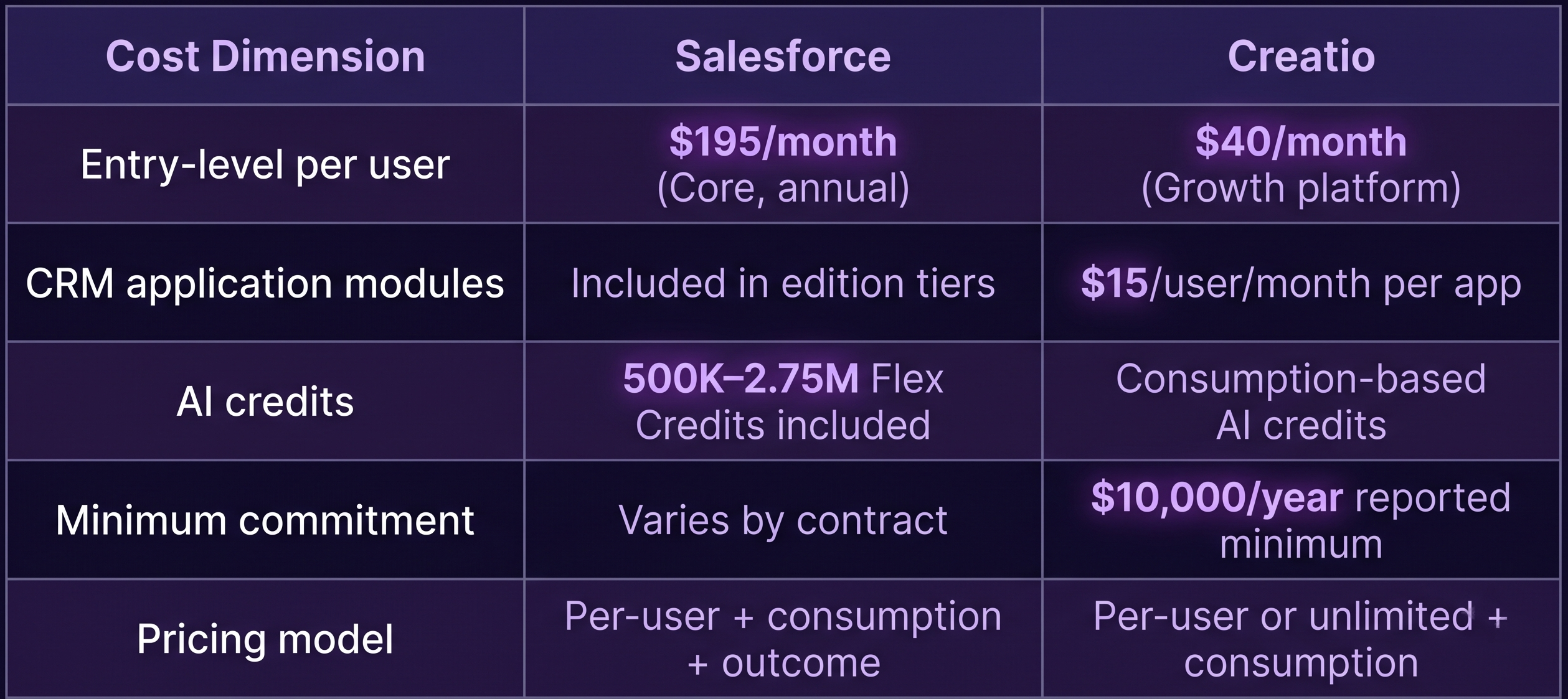
The critical takeaway is that neither platform is universally cheaper. Salesforce's higher per-user cost may be offset by a broader included feature set at certain tiers. Creatio's lower entry point may be offset by modular application pricing. Organizations must model their specific user counts, AI consumption patterns, integration needs, and implementation scope before drawing conclusions.
Implementation Complexity and Time to Value
Implementation is where the architectural difference between the two platforms becomes most visible.
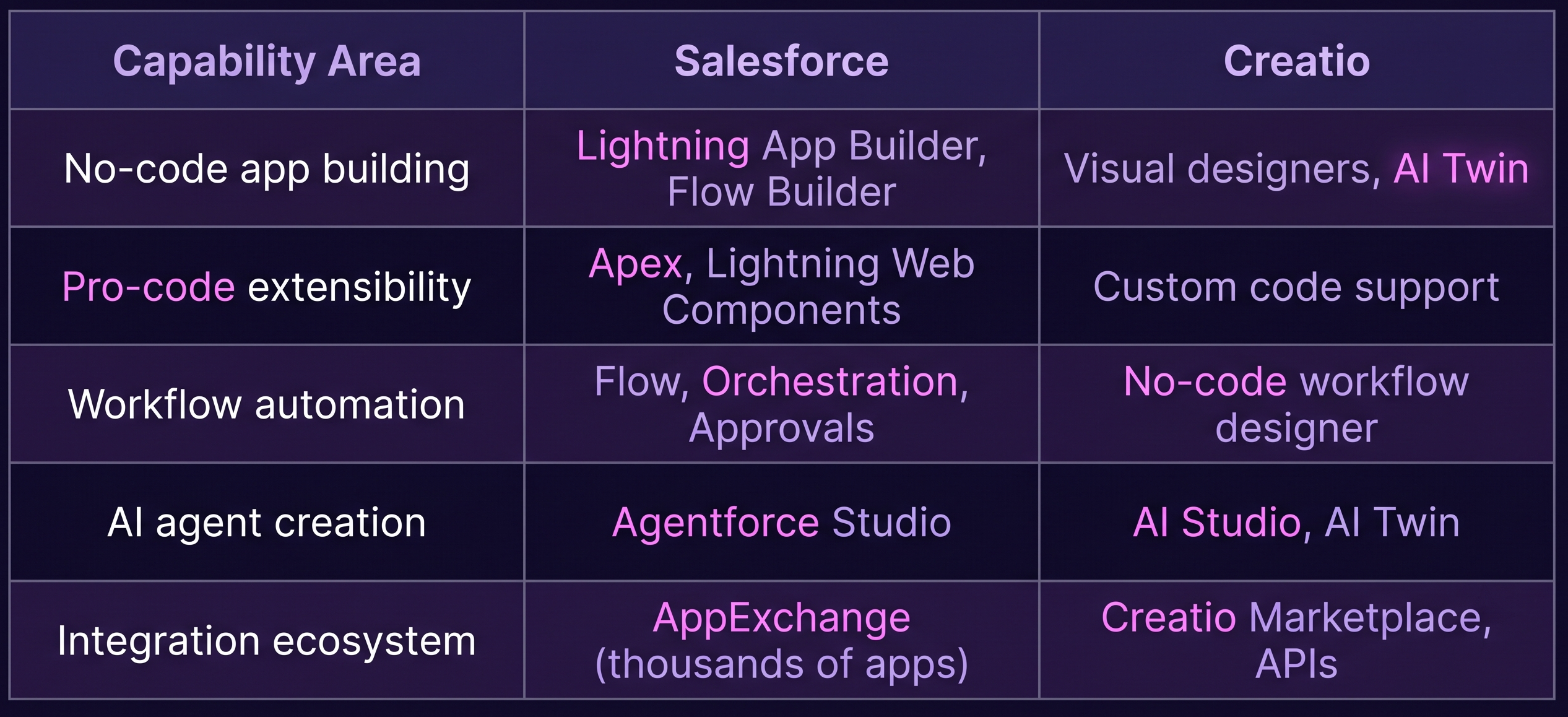
Salesforce implementations vary enormously in scope. A straightforward Sales Cloud deployment for a mid-sized team might take three to six months. A complex multi-cloud implementation with deep customization, extensive integrations, and data migration from legacy systems can take twelve months or longer. The platform's power comes from its extensibility -- Apex for custom logic, Lightning Web Components for custom interfaces, Flow for automation -- but that power requires specialized skills.
Creatio's no-code foundation is designed to compress implementation timelines. Creatio's own comparison data, citing Nucleus Research, suggests that implementations can typically be completed in 6-16 weeks compared to six months or more for complex Salesforce deployments. Nucleus Research reported that organizations switching from legacy enterprise CRM to Creatio achieved a 70% faster implementation and a 37% reduction in total cost of ownership.
These figures come from Nucleus Research, which studied organizations that switched to Creatio. They should be interpreted with that context in mind -- they represent observed outcomes for a specific population of switchers, not a universal guarantee. Organizations with highly complex requirements, extensive custom code, or unique regulatory constraints may experience different timelines on either platform.
The practical consideration is whether your organization has the technical resources to support a Salesforce implementation and the ongoing customization that often follows. If deep customization is essential and you have the development capacity, Salesforce's extensibility is a strength. If speed to value and reduced technical dependency are priorities, Creatio's no-code approach may align better.
AI Capabilities: Different Approaches to the Same Goal
Both platforms have made AI central to their 2027 positioning, but they embed AI differently.
Salesforce's AI strategy centers on Agentforce, which spans Einstein AI, the Agentforce platform, and Einstein 1 Studio. The company reports that 90% of sales organizations have either deployed AI agents or plan to introduce them within two years. Salesforce's AI capabilities include autonomous agents that can handle customer service interactions, sales research, and workflow automation. Advanced AI functionality may require higher-tier subscriptions, additional products, or consumption-based services.
Creatio embeds AI natively across its platform. Creatio AI Studio provides lifecycle management for hybrid and autonomous agents, including a Prompt Agent Designer for natural language agent creation and a Workflow Agent Designer for multi-step deterministic processes. AI Twin allows individual employees to create personal AI agents through a conversational interface. Creatio emphasizes governance and observability, with real-time policy enforcement, auditing, and visibility into agent decisions.
The evaluation question isn't which vendor's AI is "better" in the abstract. It's whether the AI capabilities align with your specific use cases, data governance requirements, security policies, and automation priorities. Organizations should test AI features against their own data and workflows rather than relying on vendor demonstrations.
Customization, Automation, and Integration
Salesforce offers arguably the deepest customization capabilities of any CRM platform. The Lightning Platform supports no-code builders for simple applications, low-code tools for more complex logic, and pro-code options (Apex, Lightning Web Components) for fully custom solutions. Salesforce Flow provides visual workflow automation with support for approvals, orchestration, and cross-departmental processes.
Creatio's customization philosophy centers on no-code and low-code tools that business analysts and operations teams can use directly. The platform includes visual designers for applications, workflows, and UI. Creatio reports that teams can customize workflows up to 80% faster compared to code-heavy alternatives.
Both platforms offer extensive API capabilities and integration options. Salesforce has a mature AppExchange ecosystem with thousands of pre-built integrations. Creatio offers connectors for common business systems and supports custom API integrations. The integration evaluation should focus on your specific technology stack -- ERP systems, marketing tools, data warehouses, and any industry-specific applications.
Reporting, Analytics, and Data Management
Salesforce offers robust reporting and analytics through its native reporting tools, Tableau integration, and Data Cloud for unified customer data. The platform has invested heavily in data integration, acquiring Informatica in 2026 to enhance Data 360 capabilities including data governance and quality management.
Creatio provides built-in dashboards, KPI tracking, and AI-generated visualizations. The platform's unified data model aims to provide a holistic customer view without requiring separate data integration tools for basic analytics.
Both platforms support data governance features including role-based access control, field-level security, and audit trails. The evaluation should consider your data residency requirements, compliance obligations, and the complexity of your data integration landscape.
Security and Governance
Security is a non-negotiable consideration for CRM platforms handling customer data and business-critical processes.
Salesforce provides enterprise-grade security features including Shield Platform Encryption, Event Monitoring, and Health Check. The platform complies with major standards including ISO 27001, SOC 2, and GDPR. Organizations with stringent security requirements can implement additional controls through Salesforce's security products.
Creatio offers role-based access control, data encryption, audit logging, and compliance with GDPR and HIPAA. The platform's AI governance features include policy enforcement, auditing, and visibility into agent decisions, which are increasingly important as organizations deploy autonomous AI agents.
Neither platform's security capabilities are a substitute for organizational security practices. The evaluation should focus on how each platform's security model aligns with your organization's policies, regulatory requirements, and risk tolerance.
Scalability and Administration
Salesforce scales to the largest enterprises, supporting millions of users and complex multi-org architectures. The platform's infrastructure is designed for global deployments with regional data centers and localization support. Administration requires specialized Salesforce skills, and organizations typically maintain a team of Salesforce administrators and developers.
Creatio scales for mid-market and large enterprises, with the Unlimited pricing model specifically designed for organization-wide deployments. Administration is designed to be more accessible to business users, reducing dependency on specialized IT resources. The platform's no-code philosophy extends to administration, with visual tools for user management, workflow modification, and application configuration.
Migration Considerations: The Hidden Cost
CRM migration is never just a licensing decision. Whether considering a move from Salesforce to Creatio, from another CRM to either platform, or evaluating a first-time CRM deployment, organizations must account for:
Data migration: Extracting, transforming, and loading customer records, transaction history, and attachments. Data quality issues that existed in the source system will surface during migration.
Integration rework: Every integration with ERP, marketing automation, billing, or custom applications must be re-evaluated and potentially rebuilt.
Workflow redesign: Business processes that were encoded in the previous CRM -- automations, approval chains, notification logic -- must be redesigned in the new platform.
Testing and validation: Comprehensive testing of data integrity, workflow execution, integration behavior, and user access controls.
Training and adoption: Users who were comfortable with one interface must learn a new one. Adoption risk is real and should be managed actively.
Customer impact: Migrations that touch customer-facing processes carry reputational and operational risk. Phased approaches and parallel running can mitigate this but add cost and complexity.
Post-migration support: The period immediately after go-live often requires elevated support to resolve issues and refine configurations.
These factors apply regardless of which direction you're moving. The decision to stay with Salesforce, migrate to Creatio, or consider another option should be based on a holistic assessment of business requirements, not just a comparison of license costs.
Salesforce or Creatio: Which One Should You Choose?
There is no universal answer. The right choice depends on your organization's specific requirements, existing technology environment, budget, business processes, team capabilities, and future plans. What follows is a decision framework, not a recommendation.
Choose Salesforce when...
- Your organization has complex, multi-department workflows that require deep customization
- You have existing Salesforce expertise or the resources to build and maintain it
- You need access to a vast ecosystem of pre-built integrations and industry-specific solutions
- Your AI strategy requires the breadth of Agentforce and Data Cloud capabilities
- You value the stability and maturity of a platform that has supported enterprises for two decades
- Your organization is already invested in the Salesforce ecosystem and migration costs would outweigh potential benefits
Consider Creatio when...
- Reducing platform complexity and technical dependency is a priority
- Speed to value matters and you want to minimize implementation timelines
- Business users need to build and modify workflows without developer involvement
- You want AI capabilities natively embedded rather than added through separate products
- Your organization prefers a unified platform over a portfolio of specialized clouds
- You're evaluating CRM modernization and want to compare total cost of ownership beyond license fees
Stay with your current platform when...
- Your current CRM meets your business requirements and the cost of migration exceeds expected benefits
- You have made significant investments in customization and integration that would be costly to replicate
- Your users are productive and adoption is strong
- The platform is evolving in a direction that aligns with your future needs
Consider migration when...
- Your current platform's licensing model no longer matches your usage patterns
- You're paying for capabilities you don't use or lack capabilities you need
- Administration and maintenance costs are escalating without proportional value
- Your platform's strategic direction no longer aligns with your business priorities
Where a Technology Partner Fits In
Evaluating CRM fit, planning migration, and ensuring a successful implementation require capabilities that many organizations don't maintain in-house. This is where a technology partner can add value.
Evalogical's CRM implementation and integration services support organizations through the full lifecycle -- from requirements assessment and platform evaluation to customization, integration, testing, and post-migration support. Their team can help you model total cost of ownership, assess integration requirements, and design an implementation approach that aligns with your business processes and technical environment.
Whether you're evaluating Salesforce, Creatio, or another CRM platform, the services Evalogical provides are designed to reduce implementation risk and ensure that the platform you choose actually solves the problems you set out to address.
Frequently Asked Questions (FAQs)
Q: Is Creatio always cheaper than Salesforce?
A: No. Creatio's published entry-level pricing is lower than Salesforce's, but total cost of ownership depends on user counts, AI consumption, application modules, implementation complexity, integration requirements, and ongoing administration. Nucleus Research reported a 37% lower TCO for organizations that switched to Creatio, but that finding applies to a specific population of switchers and should not be generalized as a universal pricing guarantee. Organizations must model their own costs.
Q: Can I migrate from Salesforce to Creatio?
A: Yes, migration is technically possible. The process typically involves data migration, integration rework, workflow redesign, testing, training, and post-migration support. Creatio's own comparison page suggests migrations can be completed in 6-16 weeks, though timelines vary significantly based on organization size and complexity. The decision to migrate should be based on a holistic assessment of business requirements, not just license cost savings.
Q: Which platform has better AI capabilities?
A: Both platforms offer substantial AI capabilities, but they approach AI differently. Salesforce's Agentforce spans multiple products and may require additional subscriptions or consumption-based services for advanced functionality. Creatio embeds AI natively across its platform, with AI Studio for agent lifecycle management and AI Twin for personal AI agent creation. The evaluation should focus on which AI features align with your specific use cases, data governance requirements, and automation priorities -- not on which vendor's AI is "better" in the abstract.
Q: How long does a Salesforce implementation typically take?
A: Salesforce implementation timelines vary enormously. A straightforward Sales Cloud deployment for a mid-sized team might take three to six months. A complex multi-cloud implementation with deep customization, extensive integrations, and data migration from legacy systems can take twelve months or longer. The timeline depends on scope, organizational readiness, and the availability of Salesforce expertise.
Q: What should I consider before migrating CRM platforms?
A: CRM migration involves more than licensing. Consider data migration, integration rework, workflow redesign, testing, training, user adoption, customer impact, and post-migration support. Organizations should also evaluate the cost of staying on the current platform versus the total cost of migration, including the productivity dip that often occurs during transition periods. A structured evaluation framework and a phased migration approach can reduce risk.
Q: Does Gartner's Magic Quadrant favor one platform over the other?
A: Gartner's 2026 Magic Quadrant for CRM Sales Platforms positioned Salesforce as a Leader and Creatio as the only Visionary. These are different quadrants with different implications. Salesforce's Leader position reflects its completeness of vision and ability to execute across a broad enterprise market. Creatio's Visionary position reflects its forward-looking approach and potential, particularly in no-code and AI-native architecture. Organizations should read the full report and consider how each vendor's positioning aligns with their specific needs.
Request a CRM Fit Assessment
The question isn't "Which CRM is better?" It's "Which CRM is better for us given our processes, our budget, our team, and our plans?"
Evalogical's CRM fit assessment helps organizations answer that question systematically. Rather than starting with a platform and working backward, the assessment starts with your business requirements -- sales processes, service workflows, marketing needs, integration requirements, data governance, and long-term technology direction -- and evaluates how well each platform aligns.
If you're evaluating Salesforce, Creatio, or another CRM for 2027, request a CRM fit assessment and make the decision with clarity rather than guesswork.



 Creatio No-Code Platform: What....
 CRM Migration: Why Process Red....
 Is Salesforce to Creatio Migra....
 What Is Creatio CRM? A Practic....
 How AI Improves Field Sales Pl....



Your Trusted Software Development Company